On this page
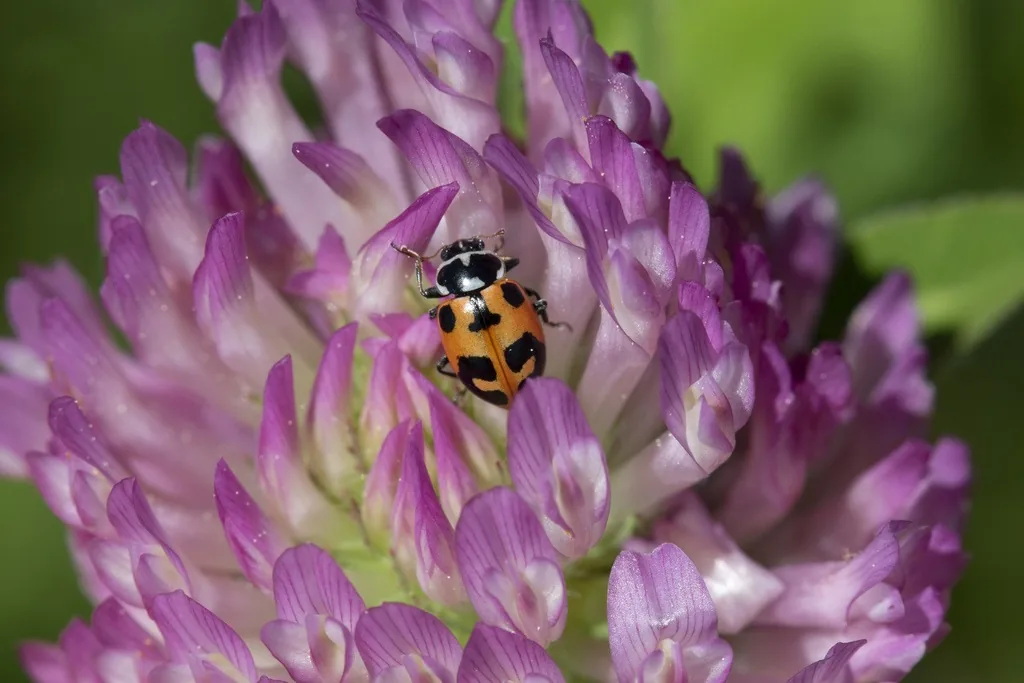
How to identify it
Look-alikes
| Look-alike | How to tell them apart |
|---|---|
| Convergent lady beetle (Hippodamia convergens) | A relative in the same genus, easily recognized by the two white dashes that converge on its pronotum. The parenthesis lady beetle is identified by the parenthesis-shaped marks on its wing covers.[1] |
Where it lives
It is a native North American lady beetle. The studies cited here found it in Nebraska grasslands and alfalfa, in Iowa soybean fields, and in populations collected between 40 and 44 degrees north latitude.[1][2][3][4]
Biology and life cycle
It is often found in prairie settings and overgrown areas. Of the 229 Nebraska specimens in one college collection, many came from grassland habitats, about 27 percent were associated with alfalfa, and relatively few were recorded from sunflowers.[1][2]
In Iowa soybean fields, native species including the parenthesis lady beetle, Coleomegilla maculata and the soft-winged flower beetle Collops nigriceps dominated the predator community, while in Michigan soybean fields the introduced seven-spotted and multicolored Asian lady beetles were the most abundant predators.[3]
Adults pass the winter in a reproductive diapause set off by short days. In laboratory rearing at 22 degrees C, short days of 12 or 10 hours of light sent all females into diapause, while under 16-hour days only 15 to 19 percent entered it.[4]
In Nebraska it is not as common as most of the other lady beetles in the University of Nebraska guide.[1]
Health risk
It is a small predatory beetle, and none of these sources describes any risk to people.[1][3]
Control
Prevention
Leave it alone. It is a native predator, and University of Nebraska Extension advises letting lady beetles arrive on their own and avoiding practices such as spraying broad-spectrum insecticides, which hinder their success.[1][3]
Biological control
Buying lady beetles to release is not recommended, because released beetles usually fly away within a few days.[1]
Common questions
- How do I recognize a parenthesis lady beetle?
- Look for a small, elongated lady beetle, 4 to 5 mm long, with a parenthesis-shaped mark on each wing cover. It runs quickly or drops to the ground when disturbed.[1]
- Where do parenthesis lady beetles live?
- They are often found in prairies, grasslands and overgrown areas, and in crop fields such as alfalfa in Nebraska and soybeans in Iowa.[1][2][3]
- Is the parenthesis lady beetle common?
- In Nebraska it is less common than most of the other lady beetles in the University of Nebraska guide, though one college collection holds 229 Nebraska specimens from many locations.[1][2]
Sources
- University of Nebraska-Lincoln Extension, “Lady Beetles of Nebraska, EC1780 (A. P. Cunningham, J. R. Brandle, S. D. Danielson and T. E. Hunt, 2007).” extensionpubs.unl.edu/publication/ec1780/2007/pdf/view/ec1780-2007.pdf (accessed 2026-11-09)
- Insects (MDPI), full text in PubMed Central (PMC13705464), “Brust, Hesler et al. Large Coccinellidae Collected in the Nebraska Panhandle Reveal High Diversity, Rare Species, and Undocumented Plant Associations. Insects 17: 1018 (2026), doi:10.3390/insects17101018.” doi.org/10.3390/insects17101018 (accessed 2026-11-09)
- PLoS ONE (Public Library of Science), full text in PubMed Central (PMC3172212), “Gardiner, O'Neal and Landis. Intraguild Predation and Native Lady Beetle Decline. PLoS ONE 6: e23576 (2011), doi:10.1371/journal.pone.0023576.” doi.org/10.1371/journal.pone.0023576 (accessed 2026-11-09)
- Environmental Entomology (Entomological Society of America), indexed in PubMed (PMID 32860040), “Obrycki. Comparative Studies of Reproductive Diapause in North American Populations of Three Hippodamia Species (Coleoptera: Coccinellidae). Environmental Entomology 49: 1164-1170 (2020), doi:10.1093/ee/nvaa100 (abstract).” doi.org/10.1093/ee/nvaa100 (accessed 2026-11-09)
- iNaturalist, “Hippodamia parenthesis taxon page (order and family).” www.inaturalist.org/taxa/133141 (accessed 2026-11-09)