On this page
How to identify it
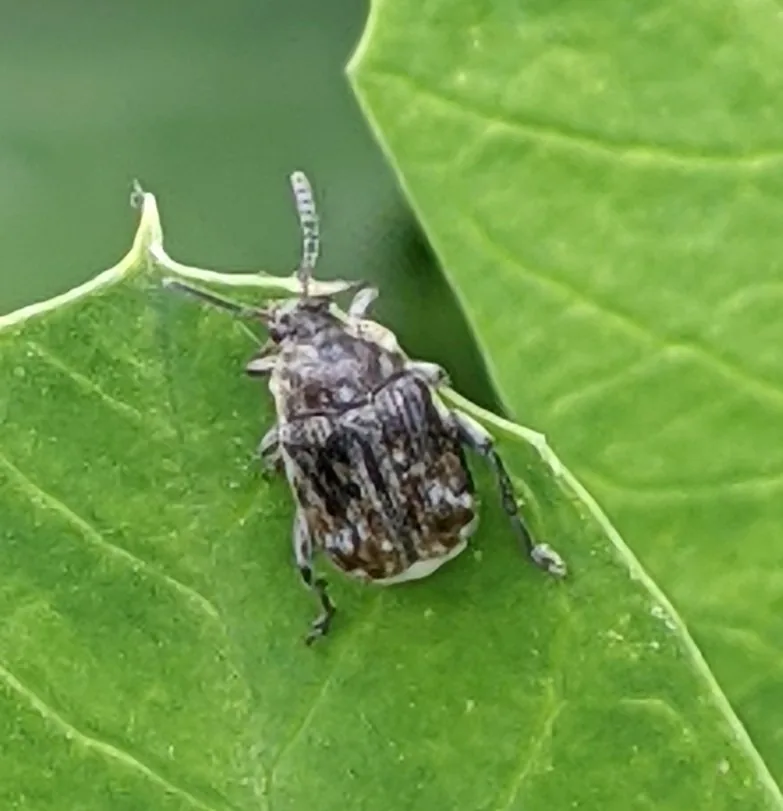
- A chunky beetle about 0.19 to 0.2 inch (5 mm) long with a short, broad snout, brown flecked with white, black and gray patches. The top of the abdomen is exposed behind the wing covers and is white-tipped.[1][2][3]
- The larva is C-shaped, legless, cream colored with a brown head, up to 0.25 inch, and lives one to a pea inside the seed. Infested dry peas carry a circular exit hole.[1][2]
- The elongated yellow eggs are laid on the outside of the pod, singly or in pairs, though a pod may carry up to a dozen.[1]
Look-alikes
| Look-alike | How to tell them apart |
|---|---|
| Pea leaf weevil (Sitona lineatus) | The more common pea pest and a true weevil; Montana State says not to confuse the two, since the pea weevil's damage is inside the seed.[2] |
Where it lives
Montana State calls it one of the most problematic insect pests of field peas, particularly in the western United States, and the PNW Handbook covers it in Pacific Northwest green and dry pea. In Montana it was first reported from the Hi-Line area in 2014; surveys of 33 fields, five elevators and 16 farm bins in 2016 and 2017 found none, but infested seed with live weevils turned up from the Chester area in December 2017.[2][1]
Biology and life cycle
Adults overwinter with the peas, mainly in storage but also in the field, and emerge about the time peas bloom to feed on pollen, petals, leaves and pods, gathering on the flowers at early bloom and mating after a pollen meal. Eggs hatch in one to three weeks, and the larva burrows through the pod into a pea, where it matures in five to six weeks; infested peas 'heat', which speeds its development. Pupation takes about two weeks in late summer, and the new adult may leave the pea at once or stay inside it all winter. There is one generation a year, and beetles are more common near field borders.[1][3][2]
Because the larvae are still inside the seed at harvest, they finish developing in the grain bin, emerging from threshed seed as much as a month later. Montana State's sheet notes this makes it strictly a field pest rather than a stored-grain breeder, even though most of its damage is done in the bin.[3][2]
Damage and signs
- Each larva hollows out the center of a pea and leaves a round exit hole. Infested seed loses weight and viability, draws dockage at sale and is unfit for human consumption. Where the pest is well established, untreated crops run 30 to 70 percent infestation, nearly every pea can be hit at high populations, and continued feeding in storage can take up to 70 percent of grain weight.[2][1][3]
- One weevil per 25 sweeps of an insect net may mean 10 percent infested peas at harvest.[1][3]
Health risk
Not a biter or stinger, but handling infested peas has caused occupational allergy: Spanish farmers and agronomists working with Bruchus pisorum-infested dried peas developed airborne contact urticaria, asthma and anaphylaxis, with tests positive to the beetle's own extract and not to pea proteins. The allergen appears to enter by inhalation or by puncture from setae the beetle sheds.[4]
Control
Prevention
Do not plant infested seed unless it has been fumigated, plant and harvest early, and harvest carefully to prevent shattering, which scatters weevils through the field. Resistance exists in pea germplasm, but the High Plains guide notes no resistant varieties are available in the United States.[1][3]
Sanitation
Destroying crop residues is very important, and volunteer peas must be destroyed too. Montana State notes sheep can graze out residues, eating the larvae in shattered pods or exposing them to direct sunlight.[1][3][2]
Biological control
Montana State has said that if damage there becomes significant it would seek a USDA-APHIS permit to introduce the egg parasitoid Uscana senex, reported to parasitize up to 82 percent of eggs.[2]
Pesticides
Sprays target the adults before they lay eggs: apply soon after the first blooms appear and before pods form, with more applications if weevils keep migrating in; once eggs are on the pods it is too late. Sample along field margins and fence rows as well as in the field. Thresholds are two adults per 25 sweeps in the High Plains guide and Montana sheet (one per 25 for white peas), and the PNW Handbook calls spraying at bloom before any adults are found the most conservative approach. Home-use actives in the handbook are acetamiprid (not on green peas), bifenthrin, carbaryl, esfenvalerate, pyrethrins and zeta-cypermethrin; commercial lists add beta-cyfluthrin, cyfluthrin, malathion and phosmet, the last highly hazardous to bees for up to four days.[1][3][2]
Common questions
- My stored peas have little round holes. Will the beetles spread through the bin?
- The pea weevil lays eggs only on pods in the field; the larvae finish developing in stored seed and leave through those exit holes. Montana State's sheet says it is strictly not a stored grain pest, though adults can overwinter in the stored peas.[2][1]
- Can I spray once I see eggs on the pods?
- It is too late by then. Treat adults soon after first bloom and before pods form.[1]
- Is it the same as the pea leaf weevil notching my pea leaves?
- No. Montana State stresses the two are different insects; the pea weevil's larvae are inside the seeds.[2]
Sources
- Pacific Northwest Pest Management Handbooks (Oregon State, Washington State and University of Idaho Extension), “Pea, green and dry: Pea weevil, Pacific Northwest Insect Management Handbook.” pnwhandbooks.org/insect/vegetable/vegetable-pests/hosts-pests/pea-green-dry-pea-weevil (accessed 2026-11-10)
- Montana State University Western Triangle Agricultural Research Center, “Reoccurrence of new pest: pea weevil in Montana (Reddy and Gadi, January 15, 2018; with the MSU 2015 pea weevil sheet).” agresearch.montana.edu/wtarc/fielddays-pdf/2018MTAGAlert1.pdf (accessed 2026-11-10)
- High Plains IPM Guide (PDF hosted by Montana State University), “Dry Peas: Pea weevil, High Plains IPM Guide (Blodgett; University of Wyoming, University of Nebraska, Colorado State University and Montana State University, April 29, 2006).” agresearch.montana.edu/wtarc/producerinfo/entomology-insect-ecology/PeaWeevil/HighPlainsIPM.pdf (accessed 2026-11-10)
- Contact Dermatitis (Wiley), “Armentia, Alvarez, Moreno-Gonzalez, Martin, Fernandez, Martin, Moro, Vega, Barrios, Castillo and Pineda. Occupational airborne contact urticaria, anaphylaxis and asthma in farmers and agronomists due to Bruchus pisorum. Contact Dermatitis 83: 466-474 (2020), PMID 32592184.” pubmed.ncbi.nlm.nih.gov/32592184/ (accessed 2026-11-10)
- iNaturalist, “Bruchus pisorum taxon page (order and family).” www.inaturalist.org/taxa/215465 (accessed 2026-11-10)