On this page
How to identify it
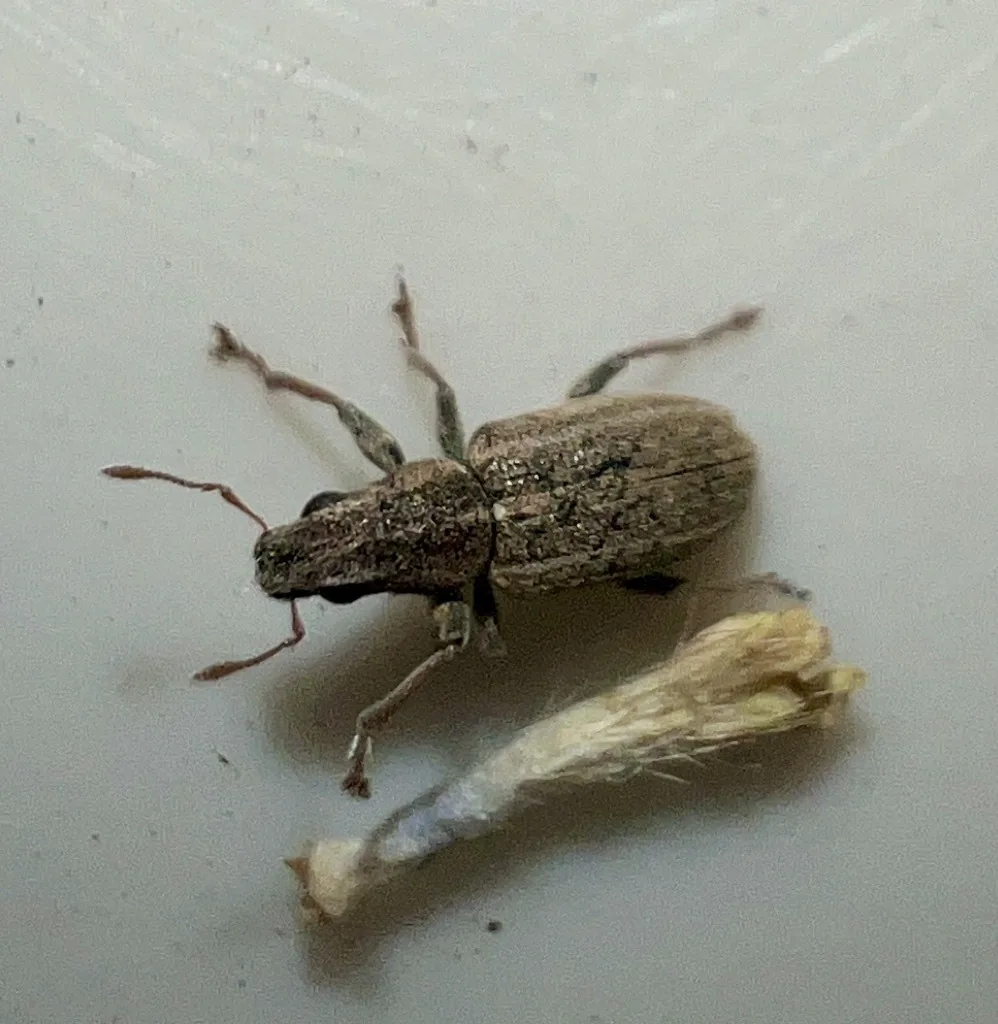
- The adult is a slender, grayish-brown snout beetle about 4 to 5 mm long (roughly 1/6 inch), with a short snout.[1][2][3]
- Three faint, light-colored stripes run lengthwise along its body. The Pacific Northwest handbook places them on the thorax.[1][3]
- The grubs live inside the root nodules. They are legless, C-shaped, soft and milky white with a dark brown head, and 3 to 6 mm long.[1]
- The eggs are small, smooth and oval, white when laid on the soil and darkening to almost black before they hatch.[1]
Look-alikes
| Look-alike | How to tell them apart |
|---|---|
| Sweet clover weevil | Pea leaf weevil can be confused with the sweet clover weevil, but only the pea leaf weevil has three light-colored stripes running lengthwise.[1] |
Where it lives
Alberta Agriculture describes it as an introduced pest that has spread from British Columbia and the northwestern United States into the southern prairies of Alberta and Saskatchewan, where it was first recorded in 2000. The Pacific Northwest handbooks cover it as a pest of dry and seed peas and of alfalfa.[1][2][3]
Biology and life cycle
Adults spend the winter in shelterbelts, ditches and perennial legume stands. They come out in late April and early May and feed on any legume they find, then gather in pea and faba bean fields to breed.[1]
They fly when it is warmer than about 17 degrees C (63 degrees F) and can cover a few kilometers, so they usually arrive from outside a field and the first damage shows along the borders. They also migrate in large numbers when other crops they have been feeding in are harvested.[1][3]
Each female lays 1,000 to 1,500 eggs in the soil near seedlings. Adults live a long time and keep laying for about three months, so eggs, larvae and adults can all be found at once even though there is only one generation a year.[1]
The grubs feed on the Rhizobium root nodules for about six weeks, going through five larval stages, then pupate in the soil. Development from egg to adult takes roughly 10 weeks.[1]
New adults emerge from late July through August, peaking in mid-August, and feed on pulse crops before going into winter shelter. Adults are numerous in spring and sometimes again in late summer.[1][2][3]
Besides pea and faba bean, adults feed on the leaves of alfalfa, dry beans, clover, lentils, lupins and vetch, but they do not reproduce in these crops and generally cause little loss.[1]
Damage and signs
- Adults chew the leaf margins and growing points of emerging pea seedlings in May and June, leaving a scalloped or notched edge. Plants usually compensate, and the Pacific Northwest handbook says this leaf notching has not been found to reduce stand or yield appreciably.[1][2]
- The grubs cause the serious damage. By eating the nitrogen-fixing nodules they partly or completely shut down the plant's nitrogen fixation, which leads to poor growth, low seed yields and greater drought stress.[1]
- Warm spells above about 20 degrees C (68 degrees F) in late April or early May bring the weevils into fields early and raise the risk of yield loss; in cool springs they arrive later and the effect is smaller, especially once the crop is past the sixth node.[1]
- In alfalfa, adult feeding occasionally causes substantial defoliation, which matters most on seedling stands; serious damage to seedling alfalfa has been reported several times.[3][1]
Health risk
It is a crop pest of peas, beans and other legumes, and none of these sources describes any risk to people.[1][2][3]
Control
Prevention
Seed early to maximize yields, inoculate pea seed, and rotate with a crop that is not a host. Fields under no-till suffer less damage than conventionally tilled fields.[1]
Traps and physical control
Start scouting when peas emerge and continue to the sixth-node stage. Adults drop to the ground when approached and are hard to see, so check plants for fresh notches on the clam leaf (the newest, still-folded leaf pair) at several spots along the margin and farther into the field.[1]
A trap crop of winter peas planted on the field border in fall, or a spring variety planted earlier along the edge, draws the weevils in. Watch it closely and control the weevils there before they move into the main crop.[1]
Biological control
Preliminary observations show that native ground beetles eat pea leaf weevil eggs, though more research is needed on biological control.[1]
Pesticides
Where weevil numbers were high in the area the year before, a registered insecticide seed treatment gives the most consistent control; the Pacific Northwest handbook lists thiamethoxam as a seed treatment for peas.[1][2]
Alberta recommends foliar sprays at the 2- to 3-node stage when 3 of 10 seedlings in 5 to 10 spots show notches on the clam leaf. If feeding is only on lower leaves, the weevils have probably already laid their eggs and spraying is no use, and after the sixth node control is not likely to be needed. Plot studies have found no yield difference between sprayed and unsprayed plots, even above that threshold.[1]
The Pacific Northwest handbook lists alpha-cypermethrin, carbaryl, cyfluthrin and phosmet for peas. Because weevils in alfalfa are usually spotty, treatments aimed at the field margins can be very effective there, and the listed alfalfa insecticides are hazardous to bees and should not be used while bees are foraging.[2][3]
Common questions
- What is making scalloped notches on my pea seedlings?
- Even, scalloped or notched leaf edges on pea seedlings in May and June are the typical sign of adult pea leaf weevils, which feed on the leaf margins and growing points.[1]
- Is the leaf damage what hurts yield?
- Mostly not. Plants usually make up for the lost leaf area; the larvae feeding on the root nodules underground cause the serious losses.[1][2]
- When is spraying worth it?
- Alberta's guidance is to spray at the 2- to 3-node stage when about 3 in 10 seedlings show fresh notches on the clam leaf. Once the crop is past the sixth node, or if feeding is only on the lower leaves, spraying is unlikely to help.[1]
Sources
- Alberta Agriculture and Rural Development (PDF hosted by Montana State University, Western Triangle Agricultural Research Center), “Pea Leaf Weevil, Agdex 622-30 (January 2014).” agresearch.montana.edu/wtarc/producerinfo/entomology-insect-ecology/PeaLeafWeevil/AlbertaFactSheet.pdf (accessed 2026-11-09)
- Pacific Northwest Pest Management Handbooks (Oregon State University, Washington State University and University of Idaho Extension), “Dry edible and seed pea-Pea leaf weevil (Pacific Northwest Insect Management Handbook).” pnwhandbooks.org/insect/legume-grass-field-seed/pea/dry-edible-seed-pea-pea-leaf-weevil (accessed 2026-11-09)
- Pacific Northwest Pest Management Handbooks (Oregon State University, Washington State University and University of Idaho Extension), “Alfalfa hay-Pea leaf weevil (Pacific Northwest Insect Management Handbook).” pnwhandbooks.org/insect/hay-pasture/alfalfa/alfalfa-hay-pea-leaf-weevil (accessed 2026-11-09)
- iNaturalist, “Sitona lineatus taxon page (order and family).” www.inaturalist.org/taxa/231082 (accessed 2026-11-09)