On this page
How to identify it
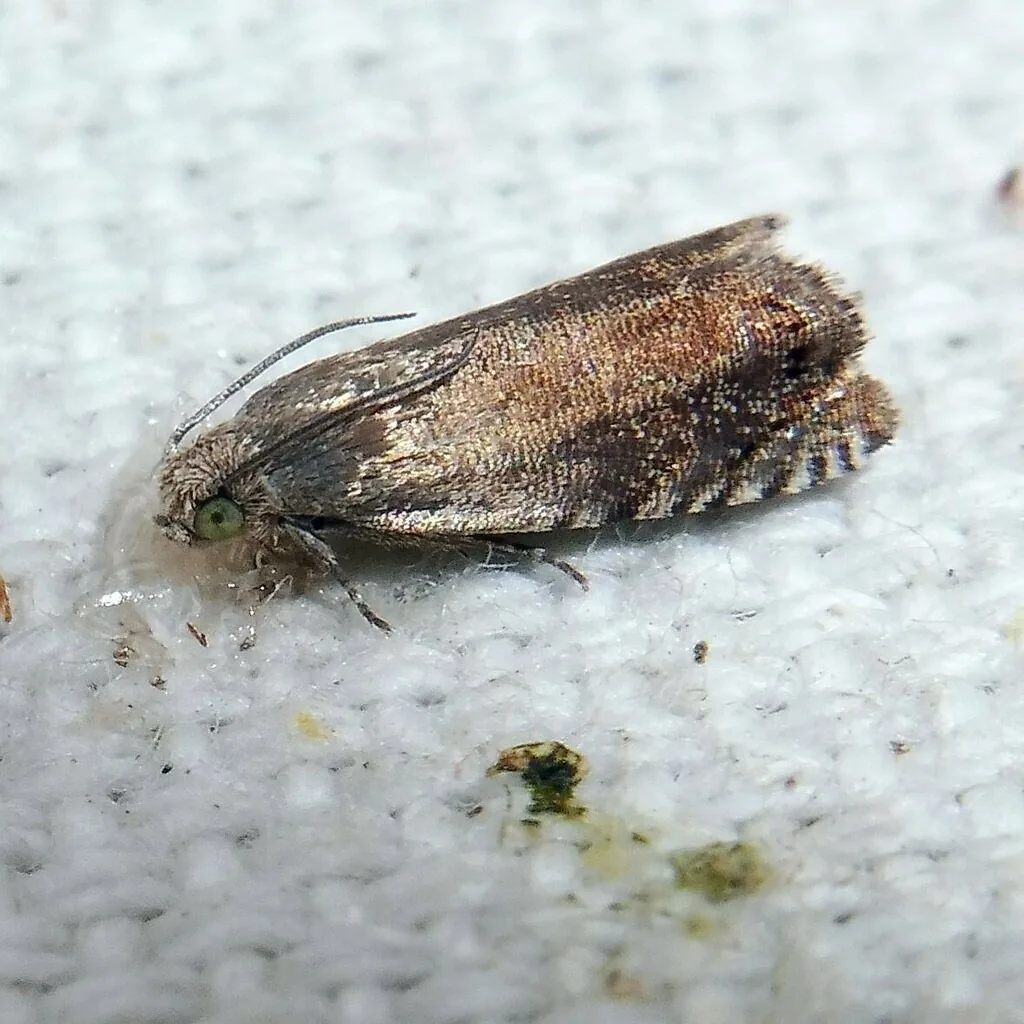
- The adult is a small moth with a wingspan of about half an inch and long antennae. Its brownish gray forewings carry white and yellow spots in a herringbone pattern.[1]
- The caterpillar is yellowish white with a light brown head and a few short hairs, and it grows to about half an inch long. It is found inside the pod, feeding on the peas.[1][2]
- The pupa is dark brown, about a third of an inch long, with rows of spines.[1]
- Infested pods may turn yellow or ripen early. When opened they show a hole in the side of the pod, a lot of droppings (frass), and peas with irregular cavities eaten into them.[2]
Where it lives
Washington State University Extension describes it as an occasional pest of home-grown peas, and the Pacific Northwest insect management handbook lists it among the pests of green and dry peas. It is also a pest of peas in Europe, where studies of it have been carried out in Germany, Norway and the United Kingdom.[2][1][3][4][5]
Biology and life cycle
It feeds on peas, sweet peas, vetch, clover and lentil.[2][1]
The caterpillars spend the winter in a silken cocoon in the soil just below the surface, and pupate in late spring; the Pacific Northwest handbook puts the start of pupation in May.[2][1]
Adults fly toward pea crops from the end of May, when peas begin flowering, until the end of July. The timing of emergence follows the build-up of heat units; a German study found that it tracks air and soil temperature and day length, with long days of about 14 hours triggering the moths' sensitivity to temperature.[1][2][3]
Females look for sheltered spots in dense vegetation and lay eggs over 5 to 11 days, one to three at a time on the stipules or leaflets; Washington State University also lists blossoms, stems and pods as egg sites. Female moths are drawn to scents given off by pea flowers.[1][2][4]
Eggs hatch in one to three weeks depending on temperature. The young caterpillar wanders for about a day, then bores into a young pod through a tiny hole. It feeds for roughly 18 to 30 days, leaves the pod, drops to the soil and spins a cocoon mixed with soil particles to spend the winter.[1][2]
There is usually one generation a year.[1]
Damage and signs
- The caterpillars tunnel into pods and eat the seeds. Up to six peas in a pod are often damaged, though usually only one or two badly.[1]
- For commercial growers, holes in the peas, caterpillars and stains can cause processors and packers to reject whole loads. Researchers describe it as a cause of major crop losses in pea production.[1][4]
Health risk
These sources treat the pea moth only as a crop pest and do not describe any harm to people.[1][2]
Control
Prevention
Plant as early as possible and don't delay harvest; earlier crops may escape serious attack.[2][1]
If pea moth has been a problem before, rotate out of peas and other host plants for a year or two to suppress it for the next pea crop.[2]
Sanitation
Destroy wild vetches and other weeds near the pea planting.[1]
Traps and physical control
Tillage can destroy caterpillars overwintering in the soil; disking twice is often recommended.[1]
Pesticides
Because the caterpillars feed inside the pods, Washington State University Extension does not recommend insecticides for home gardeners. The Pacific Northwest handbook does list home-garden options, including Bacillus thuringiensis var. kurstaki (Btk), spinosad, azadirachtin (neem oil), pyrethrins and several pyrethroids; read and follow the label for peas.[2][1]
Monitoring with pheromone traps
In the United Kingdom, traps baited with sex attractants are used to monitor pea moth, with one system for dry-harvested peas and another for peas grown for freezing or canning.[5][1]
The Pacific Northwest handbook notes that where traps are used, growers wait 10 to 15 days from the start of steady moth catches before spraying, to let eggs be laid and hatch.[1]
Common questions
- Why are there little caterpillars inside my peas?
- They are most likely pea moth caterpillars. The moth lays eggs on the plants, and the young caterpillars bore into the pods through a hole so small it is easy to miss, then feed on the peas until they leave for the soil.[2][1]
- Will spraying my pea plants stop pea moth?
- Washington State University Extension does not recommend insecticides for home gardeners, because the caterpillars are protected inside the pods. Planting early, harvesting on time and rotating peas to a new spot for a year or two are its suggested steps.[2]
Sources
- Pacific Northwest Pest Management Handbooks (Oregon State, Washington State and University of Idaho Extension), “Pea, green and dry-Pea moth (Pacific Northwest Insect Management Handbook).” pnwhandbooks.org/insect/vegetable/vegetable-pests/hosts-pests/pea-green-dry-pea-moth (accessed 2026-11-09)
- Washington State University Extension, “Pea: Pea Moth (HortSense fact sheet; A. L. Antonelli; last reviewed December 2022).” hortsense.cahnrs.wsu.edu/fact-sheet/pea-pea-moth (accessed 2026-11-09)
- Bulletin of Entomological Research (via NCBI PubMed), “Key factors affecting the spring emergence of pea moth (Cydia nigricana) (G. Thoming and H. Saucke; Bulletin of Entomological Research 101(2): 127-133, 2011; abstract).” pubmed.ncbi.nlm.nih.gov/20158929/ (accessed 2026-11-09)
- Phytochemistry (via NCBI PubMed), “Attraction of pea moth Cydia nigricana to pea flower volatiles (G. Thoming and G. K. Knudsen; Phytochemistry 100: 66-75, 2014; abstract).” pubmed.ncbi.nlm.nih.gov/24508043/ (accessed 2026-11-09)
- Journal of Chemical Ecology (via NCBI PubMed), “Application of sex attractants for monitoring the pea moth, Cydia nigricana (C. Wall; Journal of Chemical Ecology 14(10): 1857-1866, 1988; abstract).” pubmed.ncbi.nlm.nih.gov/24277099/ (accessed 2026-11-09)
- iNaturalist, “Cydia nigricana taxon page (order and family).” www.inaturalist.org/taxa/217987 (accessed 2026-11-09)