On this page
How to identify it
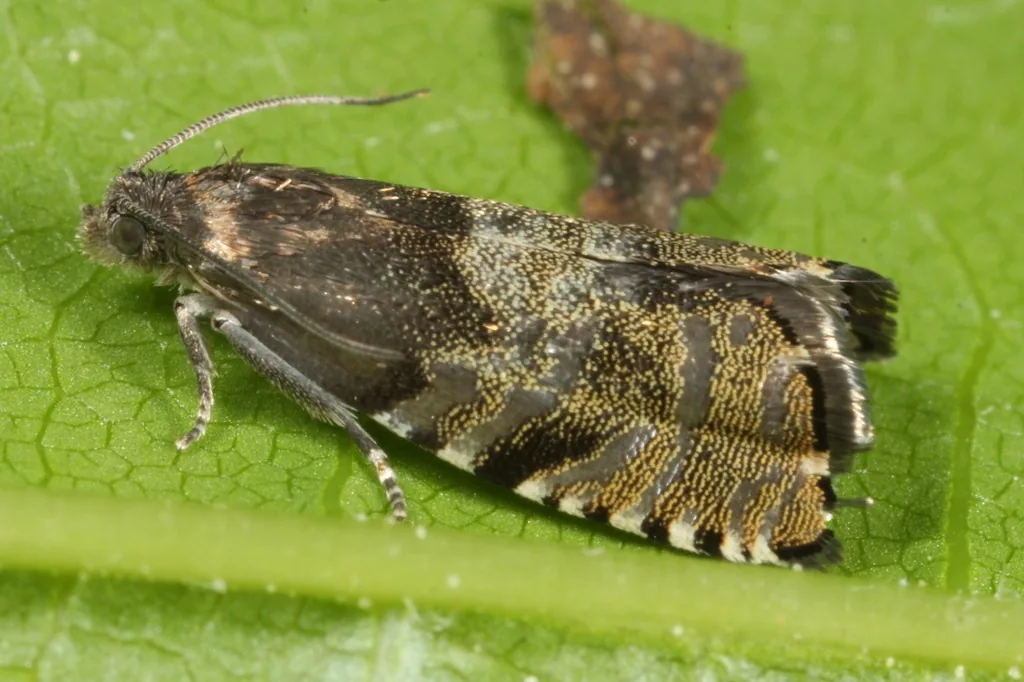
- The moth is small, with forewings about 4.5 to 7 millimeters (under 1/3 inch) long. It is dark brown with lighter, metallic bands across the forewings, and its hindwings are brown.[1]
- The larva is pale yellow to white with a light or dark brown head and a light brown shield behind the head. It is found inside spruce cones, not out on the foliage.[1][2]
- Inside an infested cone the larvae leave a double, branching tunnel, and one cone can hold several larvae.[1][2]
- Several related pine-feeding Cydia moths look very similar, so an expert may need to dissect a specimen to confirm the species.[1]
Look-alikes
| Look-alike | How to tell them apart |
|---|---|
| Other Cydia moths | Related Eurasian Cydia moths that feed on pines look much the same; a specialist confirms the species by dissecting the genitalia.[1] |
Where it lives
It occurs from Europe east to China and Japan, and in North America in the northern United States and Canada. Larvae are also intercepted in North America on spruce cones imported from Europe.[1]
Biology and life cycle
Spruces are the main hosts. White spruce is the main host listed by Natural Resources Canada, and the USDA list also includes black, red, Engelmann, blue, Sitka and Norway spruce, along with a few firs and pines.[1][2]
Females lay eggs under the scales of young cones. Young larvae feed on the scales, then move to the seeds, and older larvae tunnel through the cone. They pupate inside the cone.[1]
It has one or two generations a year. In North America two are common, with moths flying in April and May and again in August and September; in Europe a single generation is most common. The moths are active in the afternoon.[1]
Swedish researchers identified the female sex pheromone, a two-part blend, and used it to trap the moths in the field.[3]
Damage and signs
Health risk
The sources describe it only as a seed and cone feeder on spruce; they mention no harm to people.[1][2]
Control
Biological control
Two Swedish seed-orchard studies found that sprays of the biological insecticide Bacillus thuringiensis cut damage from other cone-feeding caterpillars but did not reduce spruce seed moth infestation.[5][6]
When to call a professional
In seed orchards, pheromone mating disruption cut catches of male moths in traps by 94 to 100 percent, but it reduced larvae in cones only with wax-droplet dispensers at high density and the highest dose, and only in half the trials. Researchers say the method has potential but needs refining.[4]
Common questions
- Does the spruce seed moth hurt spruce trees in a yard?
- The sources describe it as a feeder on spruce cones and seeds, not on needles or wood, and they mention damage to seed crops rather than to the trees themselves.[1][2][4]
- Does Bt spray work on spruce seed moth?
- Not in Swedish seed-orchard trials, where Bacillus thuringiensis sprays did not reduce spruce seed moth infestation even though they helped against other cone-feeding caterpillars.[5][6]
Sources
- USDA APHIS Identification Technology Program, “Cydia strobilella fact sheet, Tortricids of Agricultural Importance (T. M. Gilligan and M. E. Epstein).” idtools.org/id/leps/tortai/Cydia_strobilella.htm (accessed 2026-11-09)
- Natural Resources Canada, Canadian Forest Service, “Spruce seed moth, Trees, insects and diseases of Canada's forests.” tidcf.nrcan.gc.ca/en/insects/factsheet/10971 (accessed 2026-11-09)
- Journal of Chemical Ecology (via NCBI PubMed), “Identification of the sex pheromone of the spruce seed moth, Cydia strobilella L. (H.-L. Wang et al.; Journal of Chemical Ecology 36(3): 305-313, 2010; abstract).” pubmed.ncbi.nlm.nih.gov/20186469/ (accessed 2026-11-09)
- Journal of Pest Science (via NCBI PubMed), “Challenges of pheromone-based mating disruption of Cydia strobilella and Dioryctria abietella in spruce seed orchards (G. P. Svensson et al.; Journal of Pest Science 91(2): 639-650, 2018; abstract).” pubmed.ncbi.nlm.nih.gov/29568249/ (accessed 2026-11-09)
- Journal of Economic Entomology (via NCBI PubMed), “Assessment of cone-damaging insects in a Swedish spruce seed orchard and the efficacy of large-scale application of Bacillus thuringiensis (O. Rosenberg and J. Weslien; Journal of Economic Entomology 98(2): 402-408, 2005; abstract).” pubmed.ncbi.nlm.nih.gov/15889731/ (accessed 2026-11-09)
- Journal of Economic Entomology (via NCBI PubMed), “Bacillus thuringiensis variety kurstaki x aizawai applied to spruce flowers reduced Dioryctria abietella infestation without affecting seed quality (C. Glynn and J. Weslien; Journal of Economic Entomology 97(6): 1836-1841, 2004; abstract).” pubmed.ncbi.nlm.nih.gov/15666734/ (accessed 2026-11-09)
- iNaturalist, “Cydia strobilella taxon page (order and family).” www.inaturalist.org/taxa/217990 (accessed 2026-11-09)