On this page
How to identify it
- Infested cones show holes and frass held together by webbing. On the shoots, reddened needles and frass mixed with webbing near the buds are the other signs.[1]
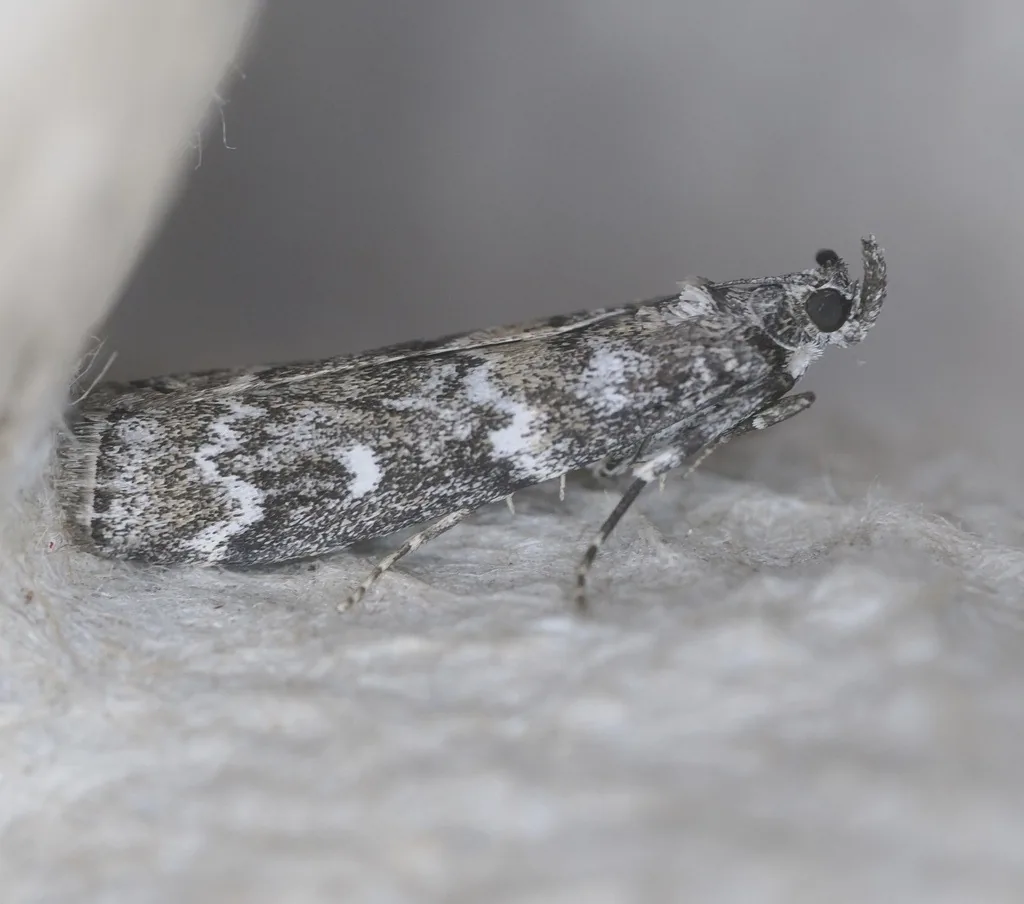
- The moth is usually silvery gray, 22 to 26 mm across, with zigzag white lines and a white spot in the middle of each forewing.[2]
- The full-grown caterpillar is about 18 mm long, reddish or amber brown, with hairy warts on each body segment.[2]
Look-alikes
| Look-alike | How to tell them apart |
|---|---|
| Fir coneworm | The fir coneworm (Dioryctria abietivorella) is a similar cone-feeding Dioryctria; Natural Resources Canada says the two are alike in many respects, and it attacks pine cones as well as fir and spruce.[1] |
| Spruce budworm | Spruce budworm (Choristoneura fumiferana) caterpillars feed on the foliage of the same trees, and Natural Resources Canada says the coneworm is often associated with it. The coneworm's main feeding is inside cones, and it may even eat budworm larvae when the two compete for food.[1] |
Where it lives
It occurs throughout most or all of the forested regions of Canada and west to the Lake States in the northeastern United States, and in the West it is recorded in British Columbia and Idaho.[2][3][1]
Biology and life cycle
White spruce and balsam fir are the preferred hosts. Black and red spruce are also main hosts in Canada, and Sitka, Engelmann, Norway and Colorado blue spruces, Douglas-fir, larch, lodgepole pine and jack pine are attacked too.[1][2][3]
There is one generation a year. In Canada the moths emerge from late June to early August and lay eggs singly or in small groups about the crown, in bark cracks, lichens, shoot axils or between cone scales. The eggs hatch in about 10 days.[1][2][3]
Larvae that hatch late spin a silk shelter and overwinter without feeding; others bore into a cone, develop part way, and pass the winter there in diapause.[1][2]
In spring the overwintered caterpillar mines one or two old needles and then moves into a bud, a pollen cone or a developing seed cone. It feeds mainly in cones but turns to the foliage when cones are scarce, occasionally eats pollen from the male flowers of white spruce, and may feed on leaf-eating caterpillars such as the spruce budworm when they compete for food.[1][2][3]
The spruce coneworm was first reported in Canada in 1937 and almost every year since. Populations usually rise in years with a good cone crop.[1]
Damage and signs
- Cones are sometimes completely destroyed, and in certain years the insect takes a heavy toll of white spruce seed. That matters most in seed orchards and in natural regeneration.[1][2]
- When the caterpillars turn to the foliage, severe defoliation causes growth loss, weakens the tree and leaves it more open to attack by other insects.[1]
Health risk
The forest sources treat it only as a pest of cones and foliage and mention no effect on people.[1][2][3]
Control
Prevention
Expect more coneworms in years with a heavy cone crop, when their populations usually increase.[1]
Sanitation
On ornamental spruce and fir, collect and burn the cones while the caterpillars are still inside, in fall or winter.[1]
Common questions
- What is webbing the cones on my spruce and leaving holes full of frass?
- That is the work of a coneworm caterpillar, most likely the spruce coneworm on spruce or balsam fir. It bores into the cone and pushes out frass bound with silk.[1]
- Is the spruce coneworm the same as the spruce budworm?
- No, but they are often found together. The budworm is a leaf and bud feeder; the coneworm feeds mainly inside cones and only moves to the foliage when cones are scarce.[1]
- How do I reduce it on a landscape tree?
- Pick and destroy the infested cones in fall or winter while the caterpillars are still inside them.[1]
Sources
- Natural Resources Canada, Canadian Forest Service, “Spruce coneworm, Trees, insects and diseases of Canada's forests.” tidcf.nrcan.gc.ca/en/insects/factsheet/11446 (accessed 2026-11-10)
- USDA Forest Service, “Eastern Forest Insects, Miscellaneous Publication 1175 (W. L. Baker, 1972; scanned copy).” archive.org/details/easternforestins1175bake (accessed 2026-11-10)
- USDA Forest Service, “Western Forest Insects, Miscellaneous Publication 1339 (R. L. Furniss and V. M. Carolin, November 1977; scanned copy).” archive.org/details/CAT78702369 (accessed 2026-11-10)
- iNaturalist, “Dioryctria reniculelloides taxon page (order and family).” www.inaturalist.org/taxa/218487 (accessed 2026-11-10)