On this page
How to identify it
- The full-grown caterpillar is up to 20 mm long and tan, with dark brown stripes down the middle of the back, along each upper side and along the spiracles. The head is black and unmarked.[1]
- It is found only on spruce, feeding in the open on the needles from June to August.[1]
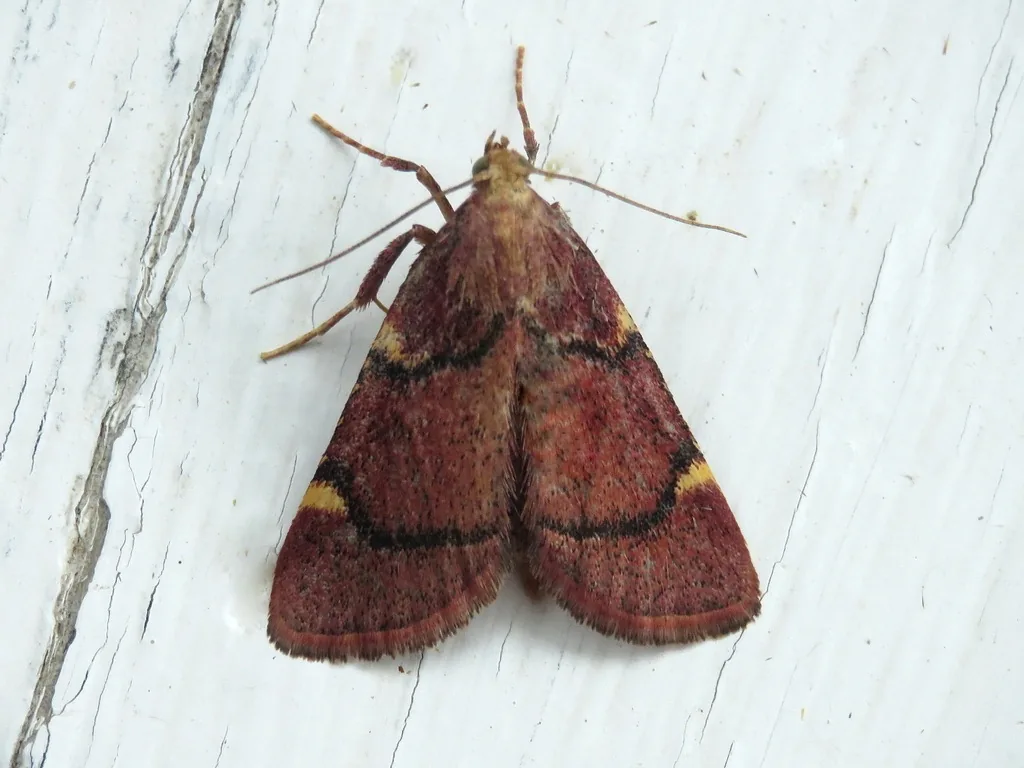
- The moths emerge in May, having overwintered as pupae.[1]
Look-alikes
| Look-alike | How to tell them apart |
|---|---|
| Spruce tip moth | The spruce tip moth (Epinotia radicana) is a much smaller spruce feeder, under 1 cm when grown, pinkish with orange stripes and a brown head, that feeds in the opening buds in late spring; the spruce needleworm is a tan, black-headed caterpillar up to 20 mm long on the needles in summer.[3][1] |
| Western spruce budworm | The spruce needleworm is restricted to spruce and is rated innocuous, whereas the western spruce budworm is the most destructive forest defoliator in western North America and occurs principally on Douglas-fir and true firs.[1][2] |
Where it lives
It occurs from the Atlantic coast west to Alberta and the central interior of British Columbia; Natural Resources Canada records it from British Columbia east to Newfoundland.[2][1]
Biology and life cycle
The spruce needleworm is restricted to spruce, including Engelmann and white spruce; the USDA manual records it principally on spruce and names black spruce on the prairies.[1][2]
In British Columbia the moth overwinters as a pupa, the adults emerge in May, caterpillars are present from June to August, and pupation takes place in August. In Manitoba and Saskatchewan the USDA manual says it is presumed to have a two-year life cycle.[1][2]
It belongs to a pyralid genus of several species, two or more of which feed on the foliage of trees.[2]
Damage and signs
Health risk
The sources treat it only as a spruce needle feeder and mention no effect on people.[1][2]
Control
Prevention
No control is needed on a landscape spruce; the insect is uncommon and innocuous, and the only damage the sources describe is top defoliation of black spruce on the prairies by a group of insects of which this is one.[1][2]
Common questions
- What is the tan, black-headed caterpillar on my spruce?
- A tan caterpillar up to 20 mm long with dark brown stripes and a black head, feeding on spruce needles between June and August, is the spruce needleworm.[1]
- Will it hurt the tree?
- Natural Resources Canada rates it rather uncommon and innocuous. The one setting where it counts is in Manitoba and Saskatchewan, where it joins other insects in defoliating black spruce tops.[1][2]
- Does it feed on fir or pine?
- No; Natural Resources Canada says it is restricted to spruce.[1]
Sources
- Natural Resources Canada, Canadian Forest Service, “Spruce needleworm, paler dolichomia moth, Trees, insects and diseases of Canada's forests.” tidcf.nrcan.gc.ca/en/insects/factsheet/1000128 (accessed 2026-11-10)
- USDA Forest Service, “Western Forest Insects, Miscellaneous Publication 1339 (R. L. Furniss and V. M. Carolin, November 1977; scanned copy).” archive.org/details/CAT78702369 (accessed 2026-11-10)
- Natural Resources Canada, Canadian Forest Service, “Spruce tip moth; redstriped needleworm, Trees, insects and diseases of Canada's forests.” tidcf.nrcan.gc.ca/en/insects/factsheet/11014 (accessed 2026-11-10)
- iNaturalist, “Hypsopygia thymetusalis taxon page (order and family).” www.inaturalist.org/taxa/496625 (accessed 2026-11-10)