On this page
How to identify it
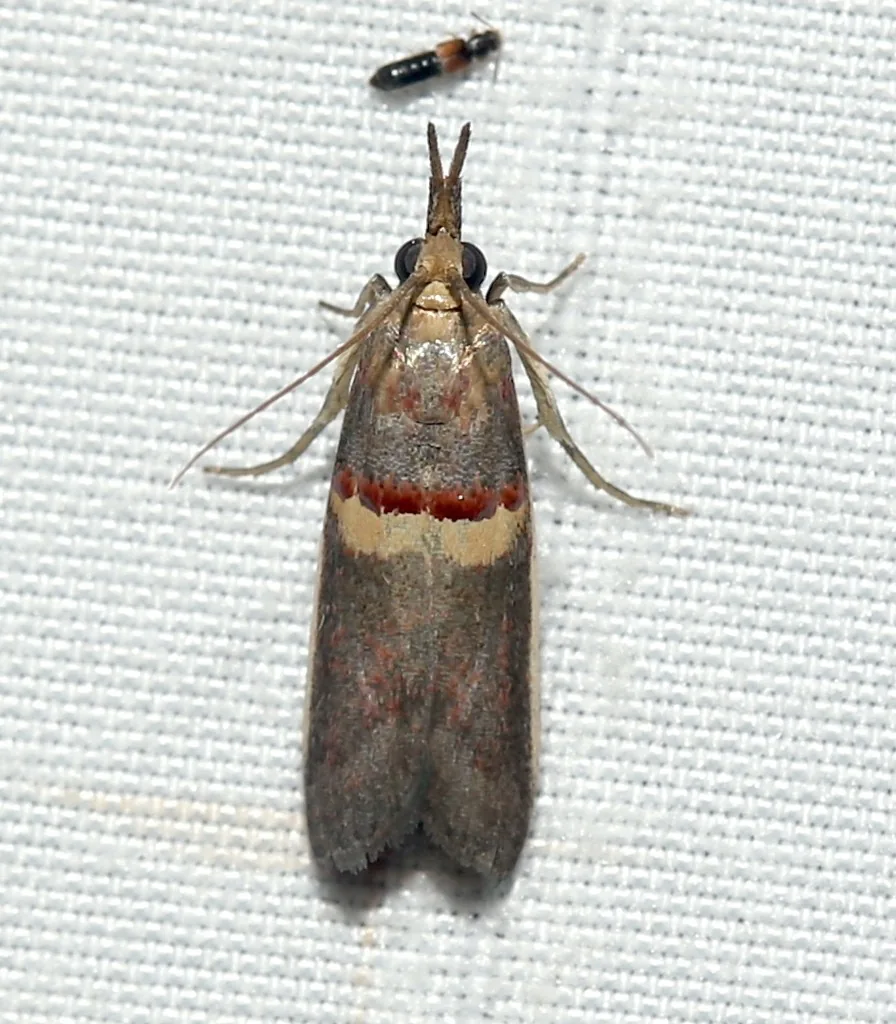
- The adult is a small gray or brownish-gray moth, about 1 inch across with wings spread. Each forewing has a white stripe along the front edge and an orange band across its inner third, and the mouthparts stick forward so the head seems to end in a snout.[2][1]
- Newly hatched caterpillars are white or cream with a black head. Grown caterpillars are about half an inch long and pink, reddish pink or tan above, with a black or yellow head, and they wriggle violently when disturbed.[2][1]
- Eggs are tiny and elliptical, glistening white when laid and turning pink and then gray before they hatch. They are laid singly or in small clumps on or near the pods.[2][1]
- Infested pods have an entrance hole, and silk and droppings inside contaminate the beans.[2][1]
Look-alikes
| Look-alike | How to tell them apart |
|---|---|
| Other caterpillars in lima beans | Several other caterpillars feed on lima beans and are often confused with the pod borer, but they do not look alike and each has its own feeding habits that identify it.[2] |
Where it lives
It occurs around the world. In the United States it was first reported damaging lima beans in California in 1885, and by the 1960s it had been recorded in several states from the Pacific to the Atlantic coast. It has been found in every county of California and has seriously injured bush lima beans in the Columbia Basin.[2][1]
Biology and life cycle
Lima beans are its main crop host. It also damages other beans, though it is seldom a pest of snap beans, and it breeds on wild plants, especially lupines, wild peas and locoweed; wild lupines seem to act as a reservoir.[2][1]
Caterpillars spend the winter in cocoons in the soil of old bean fields and pupate during the winter. In California, moths appear from March, and the first generation develops on wild annual hosts such as lupines from March to June.[2][1]
From June to December, two to four more generations develop on lima beans and perennial lupines; the Pacific Northwest handbook counts three to four generations a year in southern California.[2][1]
A female lives about 19 days on average and lays about 33 eggs. The young caterpillar chews a hole into the pod and feeds on the immature beans; when grown it leaves the pod and burrows half an inch to 9 inches into the soil to spin its cocoon.[2]
Development is slow and variable: a full life cycle takes from two to almost ten months, longer in cool weather. Males are drawn to the female sex pheromone, which can be used to trap them, though a European lure blend caught no moths in Taiwan.[2][1][3]
Damage and signs
- Only the caterpillar does damage. Pods may drop while still immature, the beans inside are eaten, and damaged beans have to be sorted out; silk and droppings can get loads rejected by processors.[2][1]
- Bush varieties, which set their pods high on the plant, usually have the most wormy pods, and vine types that set pods low have the fewest, apparently because the caterpillars crawl toward the light at the outside of the plant.[2]
- Damage can be heavy. A 1946 survey of 12 bean fields in Ventura County, California, found 4 to 8 percent of pods infested, and in one 60-acre field 48 percent of pods were infested and the whole crop was plowed under.[2]
Health risk
These sources treat it only as a crop pest and do not describe any harm to people.[2][1]
Control
Prevention
Plant early so the crop matures before pod borer numbers build up, and rotate crops where this pest is a problem. Late-planted beans have historically had more injury, though field experiments have given mixed results.[1][2]
Vine-type limas that set pods low on the plant usually have fewer wormy pods than bush types.[2]
Traps and physical control
Fall plowing at least 8 inches deep can help destroy overwintering caterpillars. In USDA tests, covering the cocoons with 6 or more inches of soil kept a large share of the moths from emerging.[1][2]
Biological control
Several native parasites attack it, but in the USDA study none of them reduced its numbers effectively.[2]
Pesticides
Carbaryl is the home-garden insecticide listed in the Pacific Northwest handbook; follow the label for beans.[1]
Common questions
- What is the pink caterpillar inside my lima bean pods?
- It is likely the lima bean pod borer. Its caterpillars turn pink or tan as they grow, feed on the beans inside the pod, and wriggle violently when disturbed.[1][2]
- Why do my bush limas have more wormy pods than vine-type limas?
- Bush types set their pods high on the plant, where the light-seeking caterpillars find them most easily, while vine types that set pods low usually have the fewest wormy pods.[2]
Sources
- Pacific Northwest Pest Management Handbooks (Oregon State, Washington State and University of Idaho Extension), “Bean, lima-Lima bean pod borer (Pacific Northwest Insect Management Handbook).” pnwhandbooks.org/insect/vegetable/vegetable-pests/hosts-pests/bean-lima-lima-bean-pod-borer (accessed 2026-11-09)
- USDA Agricultural Research Service (scan hosted by AgEcon Search, University of Minnesota), “Biology and Control of the Lima-Bean Pod Borer in Southern California, Technical Bulletin 1321 (M. W. Stone, 1965).” ageconsearch.umn.edu/record/171230/files/tb1321.pdf (accessed 2026-11-09)
- Bioorganic and Medicinal Chemistry (via NCBI PubMed), “Optimization of blends of synthetic pheromone components for trapping male limabean pod borers (Etiella zinckenella) (M. Toth, N. S. Talekar and G. Szocs; Bioorganic and Medicinal Chemistry 4(3): 495-497, 1996; abstract).” pubmed.ncbi.nlm.nih.gov/8733632/ (accessed 2026-11-09)
- iNaturalist, “Etiella zinckenella taxon page (order and family).” www.inaturalist.org/taxa/126738 (accessed 2026-11-09)