On this page
How to identify it
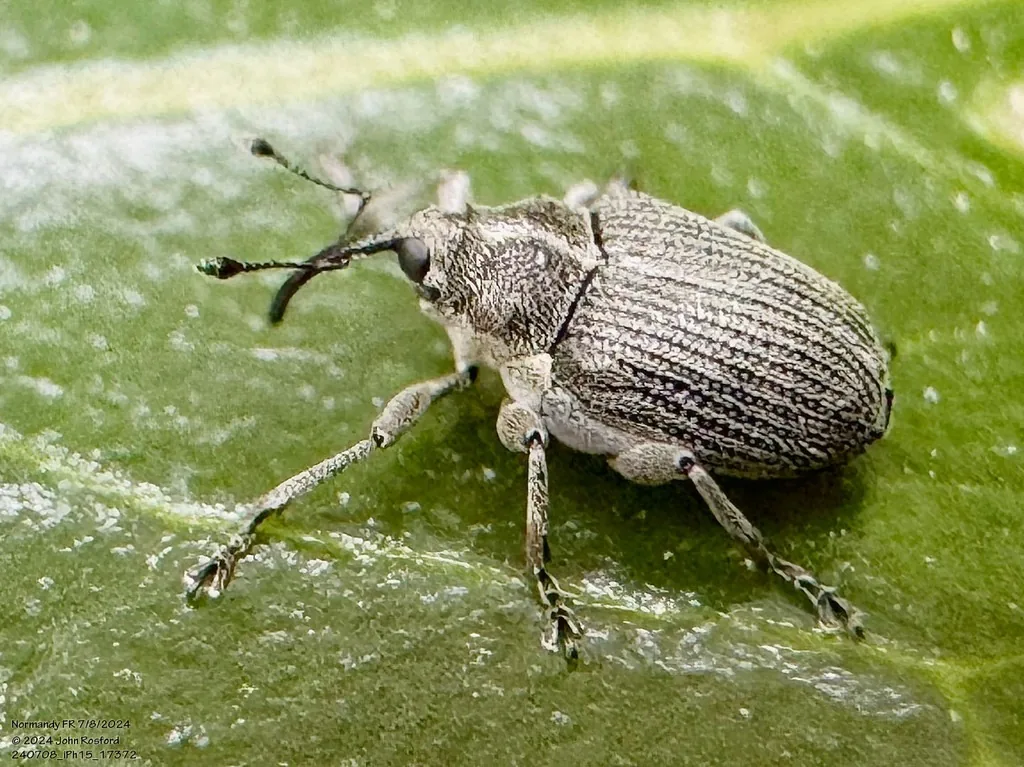
- The adult is a small weevil about 4 mm (1/6 inch) long, ash gray to black, with the long, trunk-like snout typical of weevils.[1]
- The larvae are white, legless and C-shaped, and they are found only inside the seed pods.[1]
- Much of the older literature, and the Pacific Northwest handbook, call it Ceutorhynchus assimilis.[2][1]
Where it lives
A trans-Palearctic species found from the Iberian Peninsula and Ireland to Korea and Mongolia, it has been introduced to and established in North America. It is a canola pest in the Pacific Northwest and in Canada, where it has been studied from the western provinces to Quebec.[2][1][3]
Biology and life cycle
It feeds on plants of the mustard family (Brassicaceae). Adults attack nearly all of its genera, and it is recorded as a pest of cabbage, oilseed rape, turnip, radish and mustard crops, though some species such as black mustard and white mustard are avoided.[2]
Adults that spent the winter move into canola about when it starts to flower. Its larvae develop inside the pods and feed on the seeds; larval development takes a few months.[1][2]
New adults emerge in late summer and early autumn and feed for a short time before entering winter dormancy. In later-planted fields, these summer adults feed directly on green pods.[2][1]
Weedy relatives of canola can also host the larvae. In Quebec they completed development in bird rape (Brassica rapa) and in wild radish pods.[3]
Small parasitic wasps attack it. Trichomalus perfectus is an important natural enemy, and in western Canada the weevil has been parasitized by Trichomalus lucidus and species of Chlorocytus and Pteromalus.[3]
Damage and signs
- Larval feeding in the pods destroys seeds and can cause up to 35 percent yield loss in canola. Overwintered adults feeding on flower buds can cause the buds to blast.[1]
- The weevils can also carry (vector) Alternaria leaf spot on canola pods, a disease common in Canada that is moving into the Palouse region of the Pacific Northwest.[1]
- It is a serious pest of oilseed rape, while its effect on cabbage and other vegetables is smaller because only the seeds, not the leaves, are damaged.[2]
Health risk
It is a seed-feeding crop pest, and none of these sources describes any risk to people.[1][2][3]
Control
Sanitation
Because larvae can also develop in wild mustard-family weeds such as bird rape and wild radish, rotating crops alone may not be enough, and managing these weeds should be considered; wild mustards also feed pollinators, so weigh their value before removing them.[3]
Traps and physical control
Sample adults in canola with a sweep net. The Pacific Northwest handbook's threshold is 20 or more adults collected in ten 180-degree (side-to-side) sweeps.[1]
Biological control
Parasitic wasps, especially Trichomalus perfectus, are important natural enemies of the weevil. For organic growers, the Pacific Northwest handbook lists the insect-killing fungus Beauveria bassiana and azadirachtin, both OMRI-listed.[3][1]
Pesticides
Where sweep counts reach the threshold, the Pacific Northwest handbook lists foliar sprays of pyrethroids such as bifenthrin, deltamethrin, gamma-cyhalothrin, lambda-cyhalothrin and zeta-cypermethrin, and a chlorantraniliprole plus lambda-cyhalothrin product, as well as an imidacloprid seed treatment. Follow the label for timing, preharvest intervals and limits.[1]
Common questions
- Is the cabbage seedpod weevil a problem in home vegetable gardens?
- It attacks most mustard-family plants, including cabbage, turnip and radish, and it lives in gardens and allotments as well as fields. Because its grubs eat only seeds, not leaves, it does much less harm to cabbage and other vegetables than to oilseed crops like canola.[2]
- When should canola growers check for it?
- Overwintered adults move into canola near flowering. The Pacific Northwest handbook calls for control when ten side-to-side sweeps of a net collect 20 or more weevils.[1]
- Why do I see two scientific names for it?
- It has long been reported as Ceutorhynchus assimilis, and some guides, including the Pacific Northwest handbook, still use that name. The current name is Ceutorhynchus obstrictus.[2][1]
Sources
- Pacific Northwest Pest Management Handbooks (Oregon State University, Washington State University and University of Idaho Extension), “Canola-Cabbage seedpod weevil (Pacific Northwest Insect Management Handbook).” pnwhandbooks.org/insect/legume-grass-field-seed/canola/canola-cabbage-seedpod-weevil (accessed 2026-11-09)
- Wellcome Open Research (Wellcome Trust), full text in PubMed Central (PMC13153772), “Telnov et al. (Darwin Tree of Life). The genome sequence of the cabbage seedpod weevil, Ceutorhynchus obstrictus (Marsham, 1802). Wellcome Open Research (2026).” pmc.ncbi.nlm.nih.gov/articles/PMC13153772/ (accessed 2026-11-09)
- Insects (MDPI), full text in PubMed Central (PMC10380682), “Desroches, Moisan-De Serres, Rodrigue, Labrie and Lucas. Trophic Interactions of Ceutorhynchinae spp. (Coleoptera: Curculionidae) with Their Host Plants (Brassicaceae) and Their Parasitoids in the Agroecosystem of Quebec, Canada. Insects 14: 607 (2023), doi:10.3390/insects14070607.” doi.org/10.3390/insects14070607 (accessed 2026-11-09)
- iNaturalist, “Ceutorhynchus obstrictus taxon page (order and family).” www.inaturalist.org/taxa/269049 (accessed 2026-11-09)