On this page
How to identify it
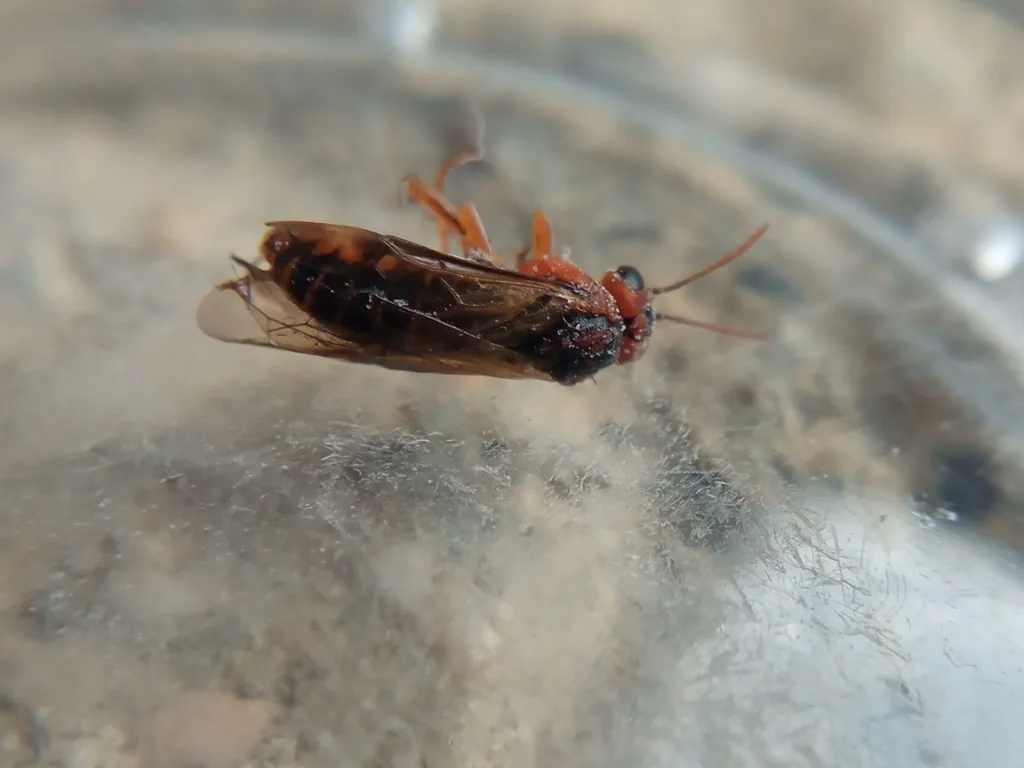
- Adults look like small flies but are wasps about 3/16 inch (4 to 5 mm) long, reddish-yellow with yellow legs, slightly smaller than the European apple sawfly. They are seen in pear flowers around bloom, feeding on pollen and nectar.[1][3][2]
- Larvae are cream to yellowish-gray with a reddish-brown to black head, about 1/3 inch (8 to 12 mm) when mature, and are found inside fruitlets, not on leaves.[1][3]
- Infested fruitlets are deformed and swollen with blemished skin and a round hole near the calyx surrounded by black decay and wet frass.[1][2]
- Compared with codling moth, the damage shows weeks earlier, the frass is wetter and darker, and the larva is smaller, darker and has seven pairs of prolegs instead of four.[1]
Look-alikes
| Look-alike | How to tell them apart |
|---|---|
| Pear slug (pear sawfly) | Caliroa cerasi, also called pear sawfly, is a slug-like larva that skeletonizes leaves in summer; the pear fruit sawfly feeds only inside fruitlets in spring. Utah State uses the name pear fruit sawfly to keep the two apart.[1][3] |
| European apple sawfly | A close relative with the same habit on apples; apples show a spiral scar from early larval feeding, while pears attacked by the pear fruit sawfly are scarred and drop without the spiral.[3] |
| Codling moth | Codling moth injury appears weeks later, its frass is drier and lighter, and the larva is larger and paler with only four pairs of prolegs.[1] |
Where it lives
Native to parts of Asia; found in Pennsylvania and Maryland in the mid-1960s, confirmed in 2005 on pears at the USDA Appalachian Fruit Research Station at Kearneysville, reported from Virginia and Ontario, and first identified in Utah in 2015, where it is an infrequent pest.[3][1]
Biology and life cycle
The only host is pear (Pyrus communis). Adults emerge from the soil starting at the pear prebloom stage, most of them over five to seven days, and spend the day in the flowers feeding on pollen and nectar. Nearly all are females that reproduce without mating.[1][2][3]
Each female lays a single egg in the skin of a flower near the center of the calyx, in up to 40 flowers, at late bloom. The egg hatches in one to two weeks and the larva tunnels into the fruitlet, first beneath the surface and then to the center to eat the seeds; it may leave and attack a second fruit, and can enter and exit several fruits over 20 to 34 days while passing through five instars.[1][3][2]
Mature larvae drop to the ground from late May to mid June, burrow 2 to 7 inches into the soil and spin a silky cocoon. They stay there until the following spring, when they pupate and emerge; about a quarter remain in the soil for an extra year. There is one generation a year.[1][2][3]
Damage swings from year to year with the previous year's population, how well adult flight lines up with pear bloom, the size of the fruit set and winter conditions. Early-blooming varieties are more susceptible.[1]
Damage and signs
- Only the fruit is attacked. Tunneled fruitlets become deformed and swollen, show a round exit hole near the calyx with black decay and wet frass, and most drop before June drop.[1][3]
- Losses in Utah have been minor, but heavily infested European orchards have reported losses of up to 70 percent, mostly along the borders.[1]
Health risk
None of the sources mentions any effect on people; the adult is a small fly-like wasp that feeds on pollen and nectar, and the larva lives inside the fruit.[1][3]
Control
Prevention
Monitor from March or April at three-day intervals through bloom by shaking branches over white cardboard or a cloth tray to catch the adults, then inspect fruitlets for holes, oozing and frass. Base any treatment on last year's damage, this year's crop load and the presence of adults at the flowers; there is no established threshold. With a heavy fruit set the damage may simply be absorbed by thinning. Late-blooming varieties such as Anjou, Bosc, Comice, Magness, Orient and Seckel may be less affected, although this has not been tested.[1][2]
Sanitation
Where practical, tilling or cultivating between the rows in autumn exposes the cocoons to birds, beetles and winter cold.[1][2]
Biological control
In Italian research, soil applications of the nematodes Heterorhabditis bacteriophora and Steinernema carpocapsae made just before the larvae drop (late May to early June) stopped adult emergence the next year. Nematodes need consistently moist soil at and after application, which may make them impractical in dry climates.[1][2]
Pesticides
The target is the adult, in the prebloom (delayed dormant) or petal-fall window. No product is labeled specifically for this pest in Utah, but growers there report that a single delayed-dormant spray of horticultural oil at 2 percent mixed with a broad-spectrum insecticide labeled for pear (carbaryl, a pyrethroid or diazinon) cut their losses by about 90 percent. For organic orchards, oil alone at the delayed-dormant stage is the option. Products used at these timings against other pests have also worked in Ontario.[1][2]
When to call a professional
Commercial pear growers should coordinate the prebloom spray with their other dormant-season treatments and with pollinator protection; a university fruit specialist can confirm the identification, since the insect is still uncommon in most of the country.[1][3]
Common questions
- My little pears have a hole near the bottom and are oozing black goo. Codling moth?
- Probably not this early. Pear fruit sawfly damage appears weeks before codling moth, the frass is wetter and darker, and the larva inside is smaller and darker with seven pairs of prolegs rather than four.[1]
- Is this the same as the pear sawfly that eats leaves?
- No. The leaf-feeding pear sawfly is the pear slug, Caliroa cerasi. The pear fruit sawfly, Hoplocampa brevis, feeds only inside fruitlets in spring, which is why Utah State gives it a separate name.[1][3]
- When should I spray, if at all?
- Decide from last year's damage and this year's crop load. The spray targets adults at the prebloom (delayed dormant) stage or at petal fall; Utah growers use oil plus a labeled broad-spectrum insecticide at delayed dormant, or oil alone for organic orchards.[1][2]
Sources
- Utah State University Extension, Utah Plant Pest Diagnostic Laboratory and IPM Program, “Pear Fruit Sawfly (Murray and Davis, October 2019).” extension.usu.edu/planthealth/research/pear-fruit-sawfly.php (accessed 2026-11-10)
- Utah State University Extension, Integrated Pest Management Program, “Pear Fruit Sawfly (Utah Pests fruit fact sheet).” extension.usu.edu/planthealth/ipm/notes_ag/fruit-pear-fruit-sawfly.php (accessed 2026-11-10)
- Virginia Tech, Virginia Fruit (Department of Entomology), “Pear Sawfly, Hoplocampa brevis (Foerster) (Virginia Fruit insect pages).” www.virginiafruit.ento.vt.edu/pearsawfly.html (accessed 2026-11-10)
- iNaturalist, “Hoplocampa brevis taxon page (order and family).” www.inaturalist.org/taxa/1084136 (accessed 2026-11-10)