On this page
How to identify it
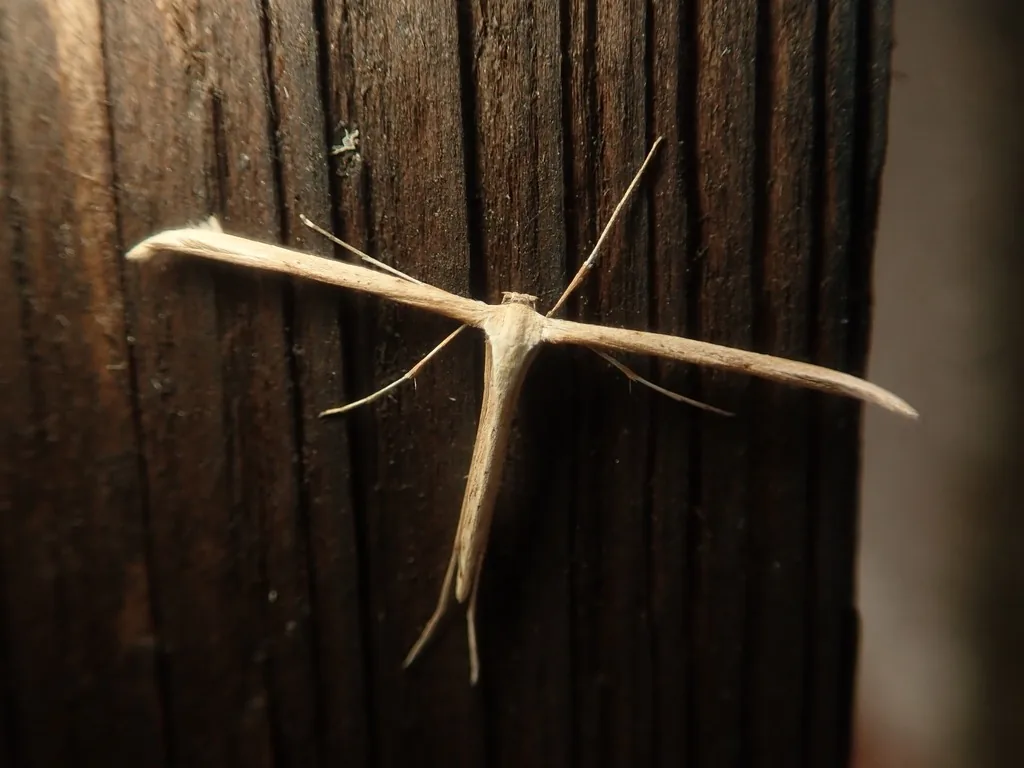
- At rest the moth forms a T: narrow, tightly rolled wings stick straight out from a slim body that stands on very long, spindly legs.[1][2]
- When the wings open, deep slits along their edges split them into feathery plumes.[1][2]
- Mostly tan or brown, with a long, thin abdomen. Missouri's conservation department gives a wingspan of 1/2 to 1 1/2 inches and Ohio's wildlife division 1/2 to 1 inch. Flight is weak and fluttery.[1][2]
- Caterpillars vary in color and often carry long, fine hairs or bristles. The many species are hard to tell apart.[1]
Look-alikes
| Look-alike | How to tell them apart |
|---|---|
| Artichoke plume moth | One member of this family, with its own page: buff to brownish-buff with a wingspan of 3/4 to 1 1/4 inches, its fore and hind wings split into lobes so it seems to have several pairs of wings. It is a pest of globe artichokes. The many other plume moth species are hard to tell apart.[4][5][1] |
Where it lives
Plume moths are found statewide in Missouri, and Ohio's wildlife division counts about 20 species in that state, out of nearly 150 in North America north of Mexico. GBIF's public U.S. records since 1990 for the family (about 22,800) come from 49 states on the map, most from California, Texas and New York.[1][2][8]
Biology and life cycle
Adults are active day and night. Many come to lights at night and are found the next morning resting on walls or other structures nearby; by day others sit on plants and flowers. Adults feed on nectar and pollen.[1][2]
Caterpillars feed on flowers and leaves, either tying leaf shelters or boring into stems. As a group they use more than 20 plant families, especially the sunflower family (including ragweed and thistles), wild grapes and morning glories.[1][2]
Some are specialists. In Florida, the caterpillar of the plume moth Trichoptilus parvulus was found feeding on a sundew, a carnivorous plant, eating its sticky stalked glands, its leaf blades and even insects the plant had trapped. In Japan, the caterpillars of another plume moth feed on the flowers, fruits and buds of a sundew that closes its flowers quickly when they are damaged.[6][7]
In Missouri adults have been seen from February to December, mostly spring through fall. Some species overwinter as adults; some pupate below ground or in leaf litter, others hang as bare pupae the way butterflies do or spin cocoons. There can be several broods a year.[1]
Both caterpillars and adults are camouflaged to look like small sticks or bits of grass.[1]
Damage and signs
- Caterpillars sometimes chew the leaves of garden plants such as geraniums and snapdragons. Missouri's conservation department says they rarely cause much trouble.[1]
- The artichoke plume moth is the exception in farm fields. Its larvae feed on any part of the artichoke plant, and the economic damage comes when they feed on the flower buds and make them unmarketable; it has three to four overlapping generations a year.[4][5]
- A few plume moths are used for biological control of invasive plants.[1]
Health risk
The sources describe no bites, stings or other effects on people.[1][2]
Control
Prevention
Usually none is needed. Missouri's conservation department says the caterpillars rarely cause much trouble, even though they sometimes chew geraniums and snapdragons.[1]
Sanitation
Artichoke growers are the exception. UC IPM says cutting plants off 2 or 3 inches below the soil, shredding the tops and working them into the soil can cut artichoke plume moth infestations by about 95%, though moths flying in from other fields make the effect temporary.[4]
Common questions
- What is the T-shaped moth on my house?
- A plume moth. They rest with narrow rolled wings held straight out from the body and stand on long, thin legs, often near a porch light that attracted them overnight.[1][2]
- Are plume moths harmful?
- The sources report no harm to people. Caterpillars occasionally feed on garden flowers like geraniums and snapdragons but rarely cause much trouble; the artichoke plume moth is a pest of artichoke crops.[1][4]
- Do plume moth caterpillars really eat carnivorous plants?
- Some do. A plume moth caterpillar in Florida was found eating a sundew's sticky glands, leaves and even the insects the plant had caught.[6]
Sources
- Missouri Department of Conservation, “Plume Moths (Field Guide).” mdc.mo.gov/discover-nature/field-guide/plume-moths (accessed 2026-11-11)
- Ohio Department of Natural Resources, Division of Wildlife, “Moths of Ohio Field Guide (Publication 5467).” dam.assets.ohio.gov/image/upload/ohiodnr.gov/documents/wildlife/backyard-wildlife/Moths%20of%20Ohio%20Field%20Guide%20pub5467.pdf (accessed 2026-11-11)
- iNaturalist, “Pterophoridae taxon page (order and family).” www.inaturalist.org/taxa/47404 (accessed 2026-11-11)
- University of California Statewide IPM Program, “Artichoke Plume Moth (Artichoke Pest Management Guidelines).” ipm.ucanr.edu/agriculture/artichoke/artichoke-plume-moth/ (accessed 2026-11-11)
- Pacific Northwest Pest Management Handbooks (Oregon State, Washington State and University of Idaho Extension), “Artichoke (globe artichoke)-Artichoke plume moth.” pnwhandbooks.org/insect/vegetable/vegetable-pests/hosts-pests/artichoke-globe-artichoke-artichoke-plume-moth (accessed 2026-11-11)
- Science, via PubMed, “Caterpillar feeding on a sundew plant (Eisner and Shepherd 1965).” pubmed.ncbi.nlm.nih.gov/17743971/ (accessed 2026-11-11). Cited from the PubMed abstract.
- Biology Letters, via PubMed, “Rapid flower closure of Drosera tokaiensis deters caterpillar herbivory (Tagawa et al. 2022).” pubmed.ncbi.nlm.nih.gov/36285463/ (accessed 2026-11-11). Cited from the PubMed abstract.
- Global Biodiversity Information Facility (GBIF), “Pterophoridae: occurrence records in the U.S., 1990-2026 (GBIF occurrence search).” api.gbif.org/v1/occurrence/search?taxonKey=8863&country=US&hasGeospatialIssue=false&occurrenceStatus=PRESENT&year=1990%2C2026&facet=stateProvince&facetLimit=400&limit=0 (accessed 2026-11-11). State counts are records reported (iNaturalist research-grade, museum specimens, surveys), not abundance.