On this page
How to identify it
- The grown caterpillar is 2 to 2 1/2 inches (50 to 62 mm) long, hairless and chalky bluish or greenish white, with a small yellow head.[3][2]
- Four large coral-red knobs, black at the base, stand on the second and third thoracic segments, and one large yellow knob sits on top of the eighth abdominal segment. The sides carry black spots ringed with blue, and the hind proleg has a blackish C-shaped mark.[2][3]
- Winter cocoons are tough and light-colored, wrapped inside a leaf whose stem is bound to the twig with a strong band of silk, so the cocoon dangles after the leaves fall.[3][1]
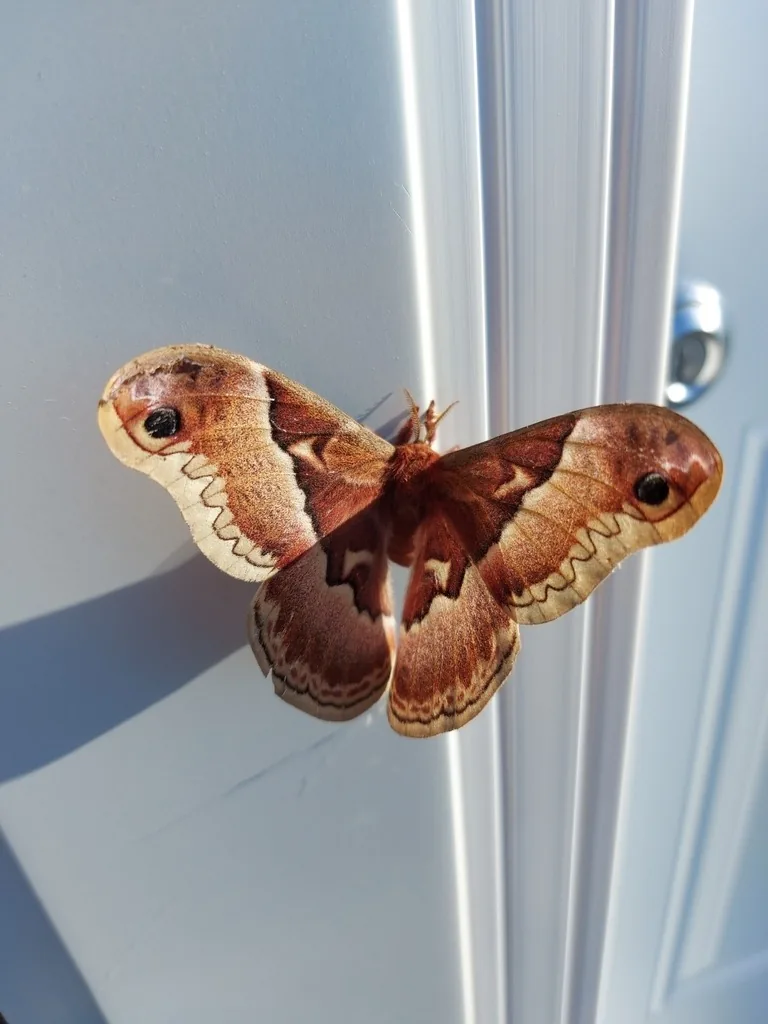
- Adults have a wingspan of about 3 inches. Males are almost black with a light brown border; females are reddish-brown to reddish-purple with light brown borders, a wavy white line across the middle, an angular white spot on each wing and an eyespot near each forewing tip.[1][3]
Look-alikes
| Look-alike | How to tell them apart |
|---|---|
| Tuliptree silkmoth (Callosamia angulifera) | Less common; both sexes look much like the female promethea but are browner.[1] |
| Cecropia moth caterpillar (Hyalophora cecropia) | Pea-green with a bluish tinge and a green head with two black spots on each side; the four thoracic knobs and the red, yellow and blue knobs along the body all carry short black spines.[3] |
Where it lives
Most of the eastern United States and southern Canada, in forests, forest edges and woodlots. In Ohio it is most common in the southern part of the state but probably occurs statewide.[3][1]
Biology and life cycle
Caterpillars are present from May to September, with two generations in the South and one in the North.[2]
The insect spends the winter as a pupa in its leaf-wrapped cocoon hanging from a twig; in Ohio the cocoons are easy to find in winter, especially on or near sassafras and wild black cherry.[3][1]
Females come readily to lights, but males do not. Males fly mainly in the late afternoon looking for newly emerged females, and their fast flight makes them look like swallowtail butterflies.[1]
Damage and signs
Health risk
The caterpillar is hairless, and none of the sources reports stings or other effects on people.[2][3][1]
Control
Prevention
None of the sources gives a control step; Ohio describes it as a native silkmoth of forests and woodlots whose hanging cocoons are readily found in winter on or near sassafras and wild black cherry.[1]
Common questions
- What is the big blue-green caterpillar with red knobs on my lilac or cherry?
- Likely a promethea moth caterpillar: chalky blue-green and hairless, with four red knobs near the front and one yellow knob near the rear.[2][3]
- What are the curled leaves hanging from my sassafras in winter?
- They may be promethea cocoons. The caterpillar wraps its cocoon in a leaf and binds the leaf stem to the twig with silk, so it hangs on through winter.[3][1]
- Why does the moth look so different from the pictures?
- The sexes differ: males are almost black with a light brown border, females reddish-brown with white markings.[1]
Sources
- Ohio Department of Natural Resources, Division of Wildlife, “Moths of Ohio Field Guide (Publication 5467).” dam.assets.ohio.gov/image/upload/ohiodnr.gov/documents/wildlife/backyard-wildlife/Moths%20of%20Ohio%20Field%20Guide%20pub5467.pdf (accessed 2026-11-10)
- USDA Forest Service, Forest Health Technology Enterprise Team, “Caterpillars of Eastern Forests, FHTET-96-34 (D. L. Wagner, V. Giles, R. C. Reardon and M. L. McManus, November 1997; scanned copy).” archive.org/details/caterpillarsofea001997 (accessed 2026-11-10)
- USDA Forest Service, “Eastern Forest Insects, Miscellaneous Publication 1175 (W. L. Baker, 1972; scanned copy).” archive.org/details/easternforestins1175bake (accessed 2026-11-10)
- iNaturalist, “Callosamia promethea taxon page (order and family).” www.inaturalist.org/taxa/81580 (accessed 2026-11-10)