On this page
How to identify it
- Caterpillars are small, about 3/8 inch when grown, and dark green to reddish brown with many conspicuous white spots.[2][1][3]
- They feed inside messy silk webbing that ties the flower heads together, and they pupate in that webbing.[1][2][3]
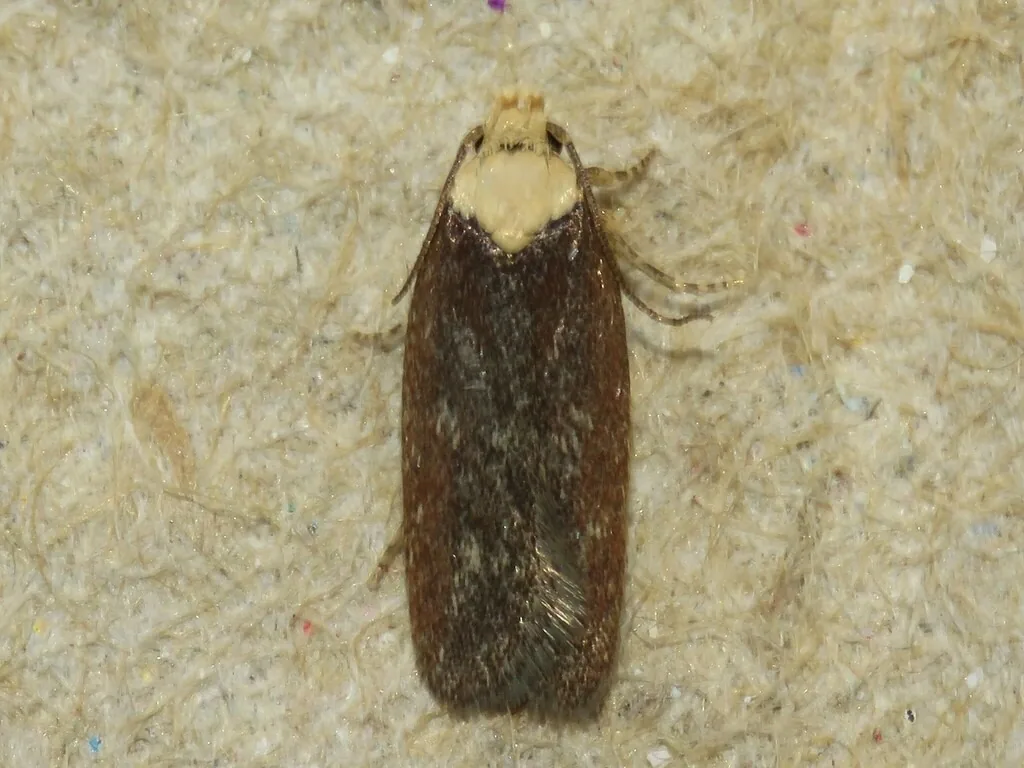
- Adults are about 3/8 inch long. The wings are purplish gray to purplish brown and fold back along the body, and the head and thorax are pale.[2][3][1]
- The name comes from its link to the flower clusters, or umbels, of carrot-family plants.[2]
Look-alikes
Where it lives
It is native from western Europe through Russia to China. In North America it was first documented around 2008 to 2009 in southern Canada and the northeastern United States, and it has since spread through much of the East and into the Midwest, with reports from Wisconsin (2018), Iowa and Ohio (a new state record in 2023).[2][1][3]
Biology and life cycle
The caterpillars feed on the flowers and unripe seeds of carrot-family plants: dill, carrot, celery, parsley, parsnip, coriander, fennel, caraway and cumin. They may also feed on the leaves.[1][3]
Dozens of caterpillars can feed on a single flower head.[2]
They pupate inside the webbing, and the adult moths emerge a short time later.[2][1][3]
Damage and signs
- Feeding and webbing can make herbs like dill unusable.[2]
- So far, Wisconsin's damage reports have all been on dill. Because the caterpillars attack flowers, the impact on carrot, celery and parsnip crops will likely be minor; crops grown for seed, such as dill, fennel and coriander, stand to lose the most.[2]
- In Iowa, caterpillars were found on dill grown to feed black swallowtail caterpillars.[1]
- It is not yet clear whether it will become a serious pest or an occasional irritation for gardeners, though Ohio State notes that some states have already reported it as a serious pest.[1][3]
Health risk
Iowa State, UW-Madison and Ohio State describe damage to carrot-family plants only and mention no risk to people.[1][2][3]
Control
Traps and physical control
Cut out and destroy infested flower heads.[2]
Pesticides
On herbs, insecticidal soap and neem oil are low-impact products expected to help control it if needed.[2]
Common questions
- What is webbing up my dill flowers?
- Small caterpillars, green to reddish brown with white spots, feeding inside webbed dill or fennel flower heads are likely purple carrot-seed moth larvae.[1][2][3]
- Will purple carrot-seed moth hurt my carrots?
- Probably not much. The caterpillars feed on flowers and seeds, so the impact on carrots, celery and parsnips is expected to be minor; dill, fennel and coriander grown for seed are most at risk.[2]
- Should I report it?
- There are no federal, state or local regulations on this moth, but Ohio State and UW-Madison have asked people to report suspected finds with photos to help document its spread.[3][2]
Sources
- Iowa State University Extension and Outreach, Yard and Garden, “Purple Carrot-seed Moth: A New Invasive Insect in Iowa (S. Bielicke and L. Iles, September 4, 2020).” yardandgarden.extension.iastate.edu/article/2020/09/purple-carrot-seed-moth-new-invasive-insect-iowa (accessed 2026-11-08)
- University of Wisconsin-Madison Insect Diagnostic Lab, “Purple Carrot Seed Moth Appears in Wisconsin (P. J. Liesch, July 23, 2018).” insectlab.russell.wisc.edu/2018/07/23/purple-carrot-seed-moth/ (accessed 2026-11-08)
- The Ohio State University Plant and Pest Diagnostic Clinic, “Purple Carrot-Seed Moth from OH: New State Record (S. Basnagala, 2023).” ppdc.osu.edu/news/purple-carrot-seed-moth-oh-new-state-record (accessed 2026-11-08)
- iNaturalist, “Depressaria depressana taxon page (order and family).” www.inaturalist.org/taxa/354722 (accessed 2026-11-08)