On this page
How to identify it
- The wingspan is about 3/4 to 1 3/16 inches.[1][2]
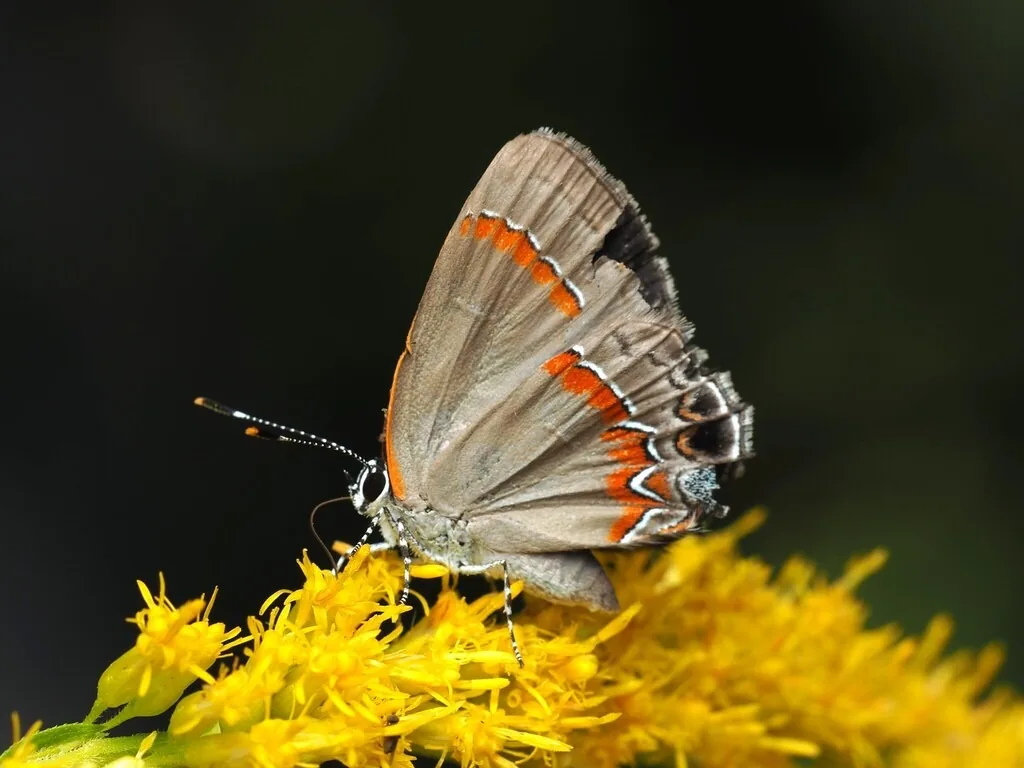
- The underside is tannish gray with a white line edged by a wide red-orange band; each hindwing has two tails and an eyespot between them.[1][2]
- The upper side is blackish brown, and females often show iridescent blue, especially in spring.[2]
- Caterpillars are brownish, up to about 1/2 inch, with a faint stripe down the back and a coat of short hairs.[1][2]
Where it lives
Found from Maryland to southeast Kansas and eastern Texas and throughout Florida, straying north to Wisconsin and Minnesota; in Missouri mostly south of the Missouri River.[1][2]
Biology and life cycle
There are several broods, flying from about May to October in the north and year-round in Florida; Missouri reports three broods from mid-April into October.[1][2]
Females lay single eggs under dead leaves on the ground near host plants, and the caterpillars overwinter.[1][2]
Perching adults rub their hindwings, and the tails and eyespot form a false head that draws predators away from the real one.[1]
Damage and signs
- No damage: the caterpillars feed mostly on fallen, decaying leaves of sumac, wax myrtle, oaks and mallows on the ground, occasionally on live leaves.[2]
Health risk
Control
Prevention
No control is needed; the caterpillars eat leaf litter, and adults visit flowers and moist ground.[2]
Common questions
Sources
- University of Florida IFAS Extension (EDIS, Featured Creatures), “Red-Banded Hairstreak, Calycopis cecrops (EENY-108).” ask.ifas.ufl.edu/publication/IN265 (accessed 2026-10-16)
- Missouri Department of Conservation, “Red-Banded Hairstreak (Field Guide).” mdc.mo.gov/discover-nature/field-guide/red-banded-hairstreak (accessed 2026-10-16)
- iNaturalist, “Calycopis cecrops taxon page (order and family).” www.inaturalist.org/taxa/122281 (accessed 2026-10-06)