On this page
How to identify it
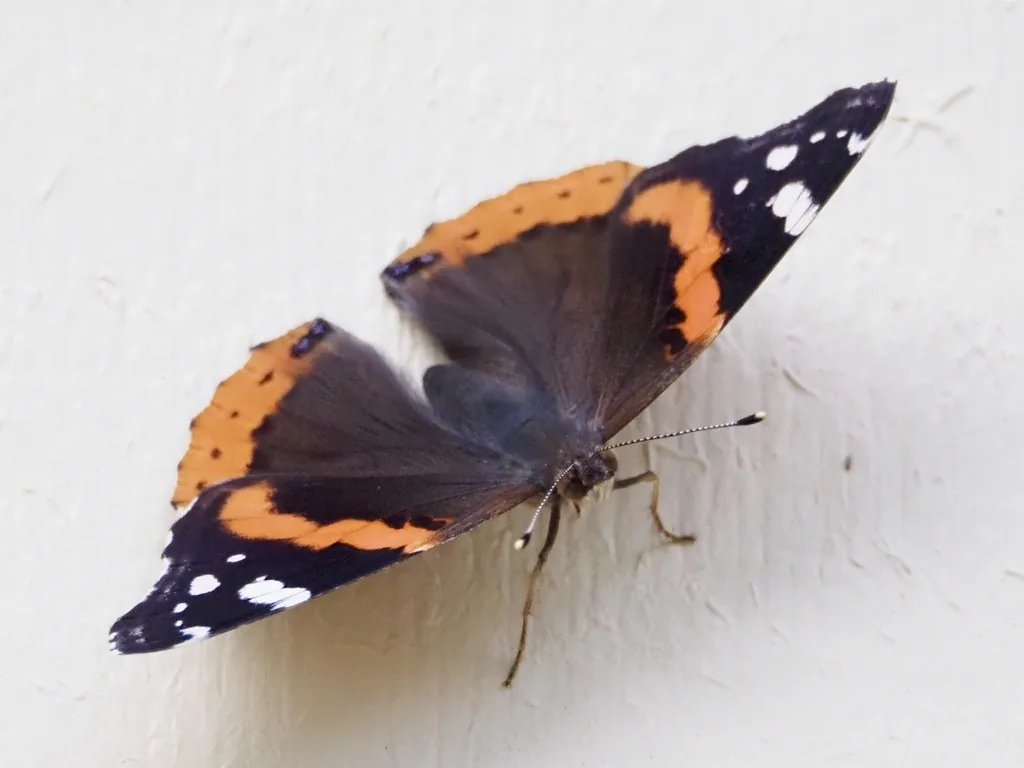
- Wingspan is about 1 3/4 to 2 1/2 inches; the upper side is black with an orange-red forewing band, white spots near the forewing tips and an orange-red band along the hindwing edge.[1][2]
- Underneath, the hindwing is dark and marbled and the forewing shows red, white and blue markings.[1][2]
- Caterpillars, up to about 1 1/2 to 2 inches long, vary from pale brown to black with small spots and rows of branched spines, and the head is black.[1][2]
- It flies quickly and erratically.[2]
Look-alikes
| Look-alike | How to tell them apart |
|---|---|
| Painted lady | Orange and black with white wingtip spots too, but without the red admiral's bold red bands on a black background.[2] |
Where it lives
Throughout much of the United States, from northern Canada to Central America and on other continents; in Missouri it is seen statewide from March into November.[1][2]
Biology and life cycle
Adults overwinter in the southern part of the range and recolonize the north each spring, sometimes in mass migrations.[1][2]
There are two generations a year in the north and four or more in the southern United States.[1]
Females lay single eggs on nettle-family plants, and caterpillars fold or tie leaves with silk into shelters.[1][2]
Adults prefer tree sap, rotting fruit and dung to flower nectar, and males perch in late afternoon defending territories.[1][2]
Damage and signs
Health risk
Control
Prevention
Common questions
- What is the black butterfly with orange stripes?
- Often a red admiral: black wings with orange-red bands and white spots near the tips.[1][2]
- What do red admiral caterpillars eat?
- Nettle-family plants such as stinging nettle and false nettle.[1][2]
- Why do they land on rotting fruit?
- Adults prefer sap, fermenting fruit and dung to nectar.[1][2]
Sources
- University of Florida IFAS Extension (EDIS, Featured Creatures), “Red Admiral, Vanessa atalanta rubria (EENY-446).” ask.ifas.ufl.edu/publication/IN810 (accessed 2026-10-16)
- Missouri Department of Conservation, “Red Admiral (Field Guide).” mdc.mo.gov/discover-nature/field-guide/red-admiral (accessed 2026-10-16)
- iNaturalist, “Vanessa atalanta taxon page (order and family).” www.inaturalist.org/taxa/49133 (accessed 2026-10-06)