On this page
How to identify it
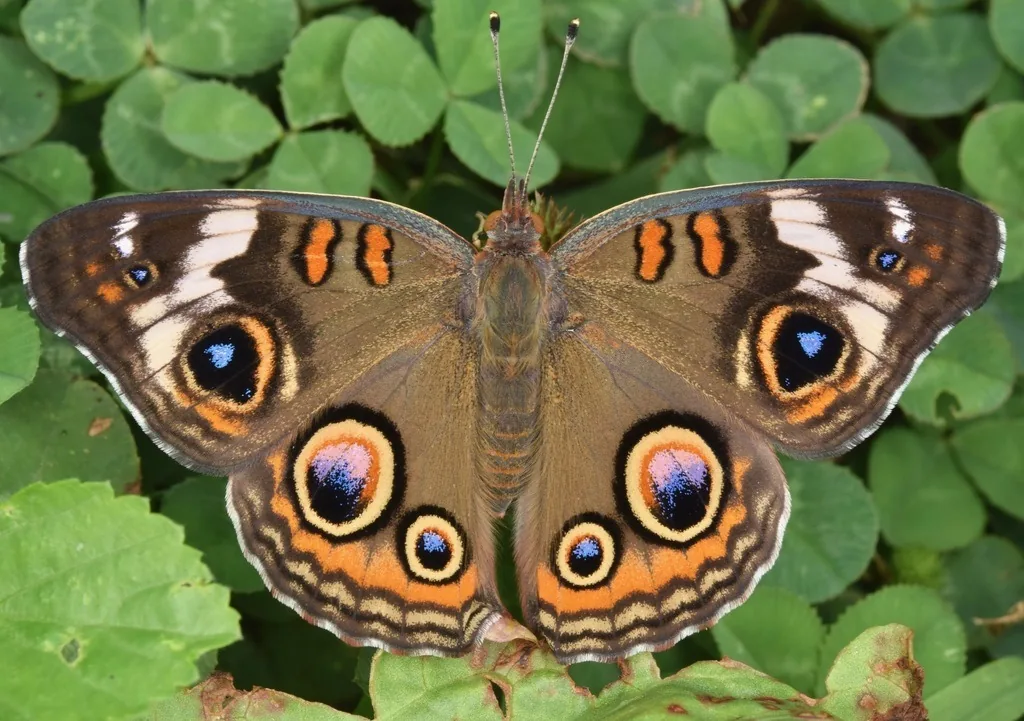
- Wingspan is about 1 1/2 to 2 1/2 inches (45 to 70 mm), and all four wings carry eyespots.[1][2]
- The forewing has two orange bars and an off-white band that touches a large eyespot; the hindwing has two large eyespots and an orange border.[1][2]
- Caterpillars are bluish black with yellow to orange stripes and spots and many short, branched, metallic blue-black spines; the head is black with an orange top.[1][2]
Look-alikes
| Look-alike | How to tell them apart |
|---|---|
| White peacock | A pale southern butterfly with much smaller eyespots and a point on the hindwing.[2] |
Where it lives
A year-round resident across the southern United States that spreads north each year, sometimes into southern Canada; it cannot survive typical Missouri winters.[1][2]
Biology and life cycle
There are several generations a year; in fall huge numbers migrate south into peninsular Florida to overwinter.[1][2]
Adults fly low and fast and perch on low plants or bare ground, and males chase other insects from their territory.[1][2]
Females lay single green eggs on host-plant leaves and buds, and caterpillars feed alone.[1][2]
Numbers swing widely: common some years and almost absent in others.[2]
Damage and signs
Health risk
Control
Prevention
No control is needed; feeding on garden snapdragons or plantain weeds is minor.[1][2]
Common questions
Sources
- University of Florida IFAS Extension (EDIS, Featured Creatures), “Common Buckeye, Junonia coenia Hübner (EENY-426).” ask.ifas.ufl.edu/publication/IN801 (accessed 2026-10-16)
- Missouri Department of Conservation, “Common Buckeye (Field Guide).” mdc.mo.gov/discover-nature/field-guide/common-buckeye (accessed 2026-10-16)
- iNaturalist, “Junonia coenia taxon page (order and family).” www.inaturalist.org/taxa/48505 (accessed 2026-10-06)