On this page
How to identify it
- Full-grown caterpillars are about 1 1/4 inches long, salmon red with four broken white stripes along the body, many small black spines and a pair of black-knobbed horns at the front.[1]
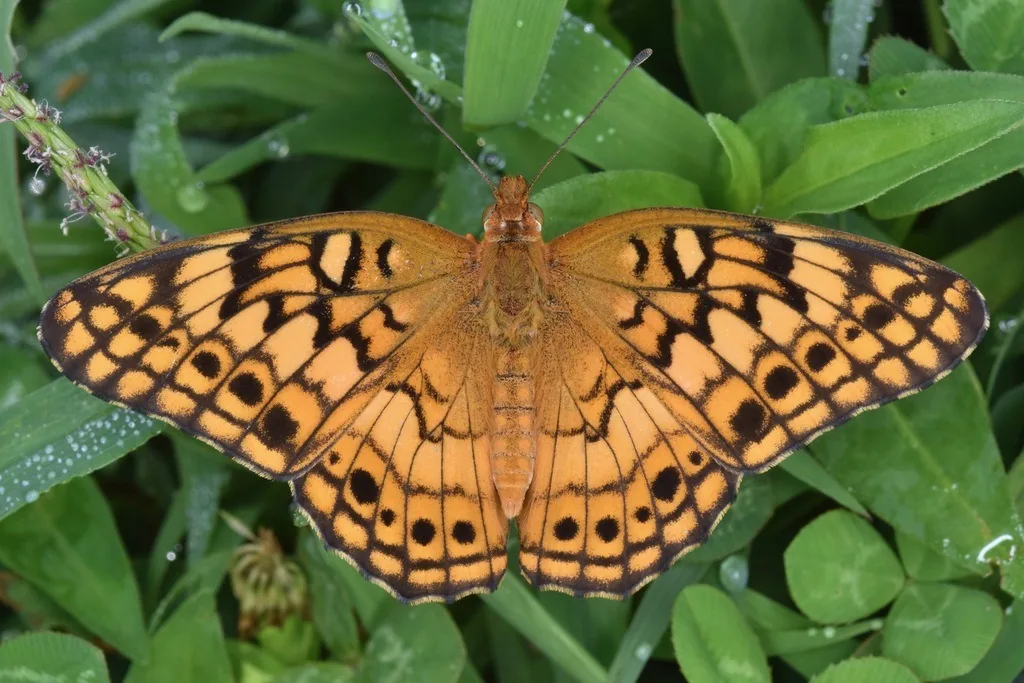
- The butterfly is tawny orange above with thick dark veins and markings and black spots near the edge; the underside of the hind wing is mottled, without silver spots, and the wingspan is about 1 3/4 to 3 1/8 inches.[3]
- Adults fly low and somewhat erratically and are hard to approach.[2]
Look-alikes
| Look-alike | How to tell them apart |
|---|---|
| Other fritillaries | The variegated fritillary's hind-wing underside is mottled and lacks silver spots.[3] |
Where it lives
Ranges from South America through Central America and Mexico into the southern United States and regularly spreads north through most of the country except the Pacific Northwest; it is found throughout Florida, though UF/IFAS notes it is not a regular garden visitor there.[3][2]
Biology and life cycle
Eggs are laid singly on the stems and leaves of host plants, and the caterpillars eat both leaves and flowers.[3]
Caterpillars are present from June to October in Missouri, with several generations a year: about three broods from April to October in the north and four in the south, where adults fly from February or March into November or December.[1][3]
Damage and signs
Health risk
It feeds only on plants; none of the sources reports any harm to people or pets.[1][3]
Control
Prevention
Usually no management is needed; Butterflies and Moths of North America reports no management needs for this species.[3]
Common questions
- What is the spiny red caterpillar on my pansies?
- A salmon-red caterpillar about 1 1/4 inches long with white stripes, small black spines and two black-knobbed horns at the front is a variegated fritillary caterpillar.[1]
- Should I get rid of variegated fritillary caterpillars?
- Usually not; it is at most an occasional minor pest of pansies and violets, and no management is normally needed.[3]
Sources
- University of Missouri Extension, “Caterpillars in Your Yard and Garden (IPM1019), page 49: variegated fritillary.” extension.missouri.edu/publications/ipm1019/49 (accessed 2026-10-17)
- UF/IFAS Extension, Florida-Friendly Landscaping Program, “Variegated Fritillary (Florida-Friendly Landscaping butterfly guide).” ffl.ifas.ufl.edu/butterflies/Butterfly/Details/39 (accessed 2026-10-17)
- Butterflies and Moths of North America, “Variegated Fritillary, Euptoieta claudia (species account).” www.butterfliesandmoths.org/species/Euptoieta-claudia (accessed 2026-10-17)
- iNaturalist, “Euptoieta claudia taxon page (order and family).” www.inaturalist.org/taxa/68244 (accessed 2026-10-06)