On this page
How to identify it
- The wingspan is about 1 3/4 to 2 2/5 inches; wings are orange-brown with black margins and white spots near the forewing tips, and the forewing edge is slightly notched.[1][2]
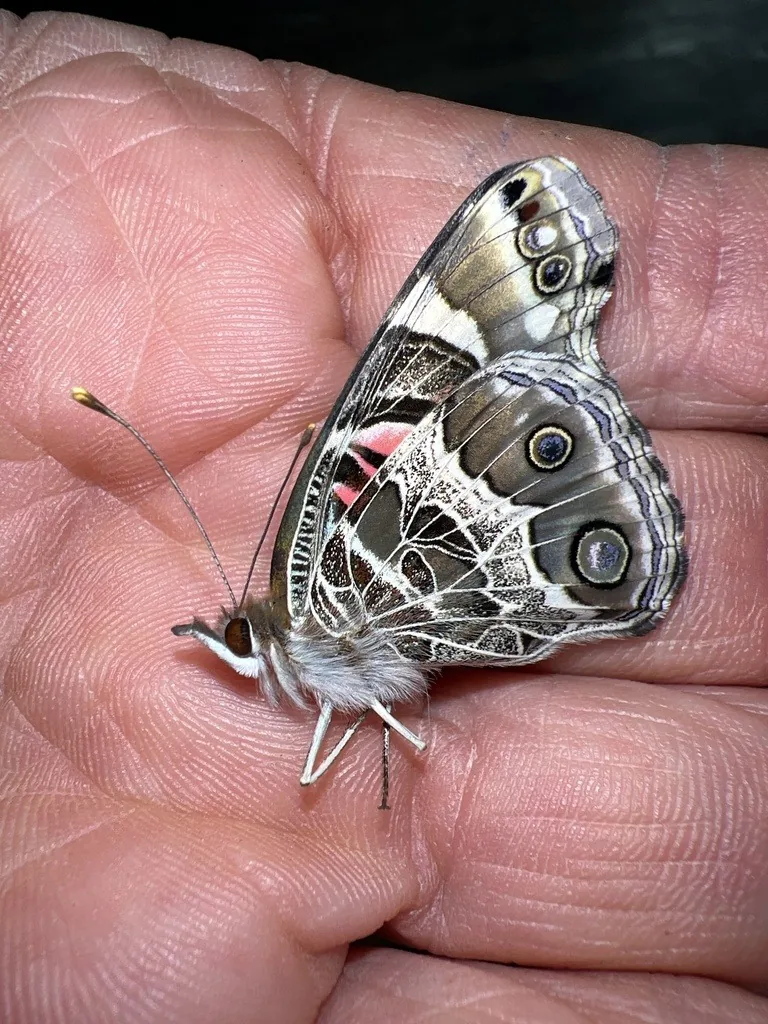
- Under each hindwing are two large eyespots, compared with four small ones on the painted lady.[2]
- Caterpillars are black with yellowish crossbands, black spines and white side spots, and make nests on their host plants.[1][2]
Look-alikes
| Look-alike | How to tell them apart |
|---|---|
| Painted lady | Very similar, but has four small eyespots under the hindwing instead of two large ones.[2] |
Where it lives
Ranges from southern Canada through the United States to northern South America.[1]
Biology and life cycle
There are multiple generations a year; adults overwinter in the southern United States and repopulate northern areas each spring.[1]
Early-season adults are larger and brighter than late-season ones.[1]
Damage and signs
- No damage: caterpillars feed on everlasting or cudweed herbs and their aster-family relatives, living in nests on the host leaves.[1]
Health risk
Control
Prevention
No control is needed; it is a common butterfly of lawns, weedy areas and gardens.[1]
Common questions
- How do I tell an American lady from a painted lady?
- Look under the hindwing: two large eyespots on the American lady, four small ones on the painted lady.[2]
Sources
- University of Florida IFAS Extension (EDIS, Featured Creatures), “American Lady, American Painted Lady, Vanessa virginiensis (EENY-449).” ask.ifas.ufl.edu/publication/IN823 (accessed 2026-10-16)
- Missouri Department of Conservation, “American Lady (Field Guide).” mdc.mo.gov/discover-nature/field-guide/american-lady (accessed 2026-10-16)
- iNaturalist, “Vanessa virginiensis taxon page (order and family).” www.inaturalist.org/taxa/48549 (accessed 2026-10-06)