On this page
How to identify it
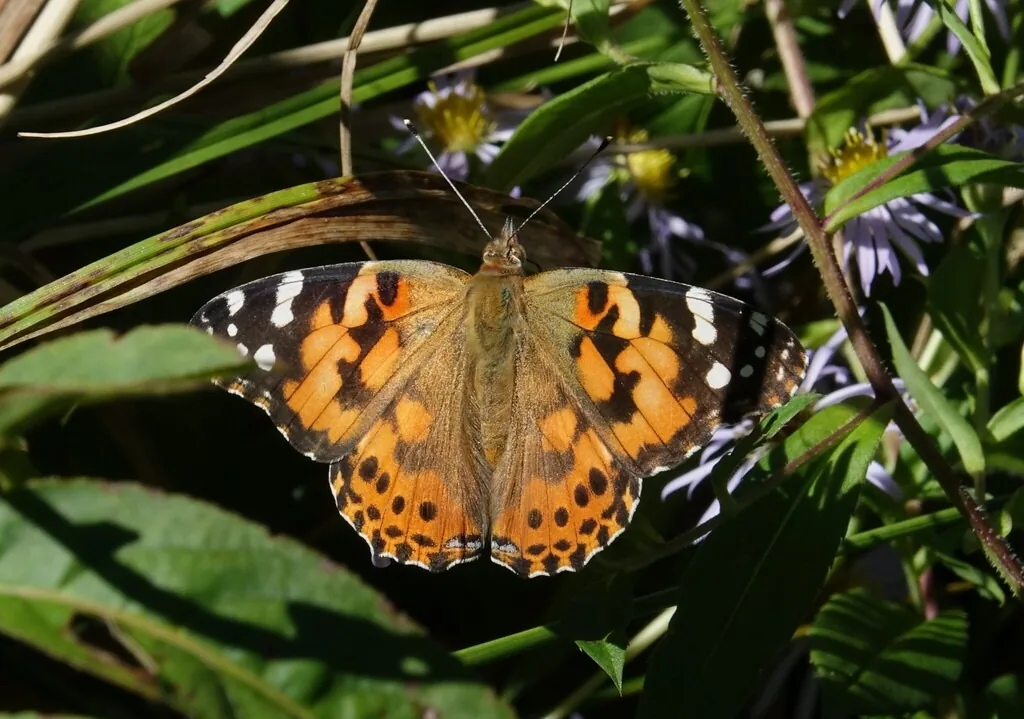
- Wingspan is about 1 3/4 to 2 1/2 inches; from above it is orange and black with dark wingtips spotted white.[1]
- The brown underside has a white cobweb pattern and four small eyespots on each hindwing.[1]
- Caterpillars are spiny, brown-black to greenish yellow or lavender with yellow markings, and often hide in a silk-tied leaf tent.[1][3]
Look-alikes
| Look-alike | How to tell them apart |
|---|---|
| American lady | Very similar; the American lady has two large eyespots under each hindwing instead of four small ones.[1] |
| Red admiral | Black with bold orange-red bands rather than mostly orange.[1] |
Where it lives
Found nearly worldwide except South America and Antarctica; it arrives in Missouri in late March and flies until November.[1]
Biology and life cycle
Adults can't survive cold winters, so they migrate to warmer regions in fall and return in spring, with several generations each summer.[1][2][3]
Numbers swing dramatically: an Iowa survey counted 747 in one September 2017 survey versus 21 the year before.[2]
Caterpillars hatch three to five days after eggs are laid and pupate on or off the host plant.[3]
Damage and signs
Health risk
Control
Prevention
Plants tolerate low levels of feeding, and no management is usually needed.[3]
Common questions
- Why are there so many orange butterflies this fall?
- In good years painted ladies build up over summer and gather on fall flowers before migrating south.[2]
- What do painted lady caterpillars eat?
- Mostly thistles, plus many plants in the aster, mallow and legume families.[1][3]
- How do I tell a painted lady from an American lady?
- Count the eyespots under the hindwing: four small on the painted lady, two large on the American lady.[1]
Sources
- Missouri Department of Conservation, “Painted Lady (Field Guide).” mdc.mo.gov/discover-nature/field-guide/painted-lady (accessed 2026-10-16)
- Iowa State University Extension and Outreach (Yard and Garden), “It Was a Very Good Year for Painted Lady Butterflies (September 15, 2017).” yardandgarden.extension.iastate.edu/article/2017/09/it-was-very-good-year-painted-lady-butterflies (accessed 2026-10-16)
- Utah State University Extension (Integrated Pest Management), “Painted Lady (Larvae), Vanessa cardui (hemp pests).” extension.usu.edu/planthealth/ipm/notes_ag/hemp-painted-lady.php (accessed 2026-10-16)
- iNaturalist, “Vanessa cardui taxon page (order and family).” www.inaturalist.org/taxa/48548 (accessed 2026-10-06)