PestControlBasics
Menu

Question Mark

Polygonia interrogationis[3]

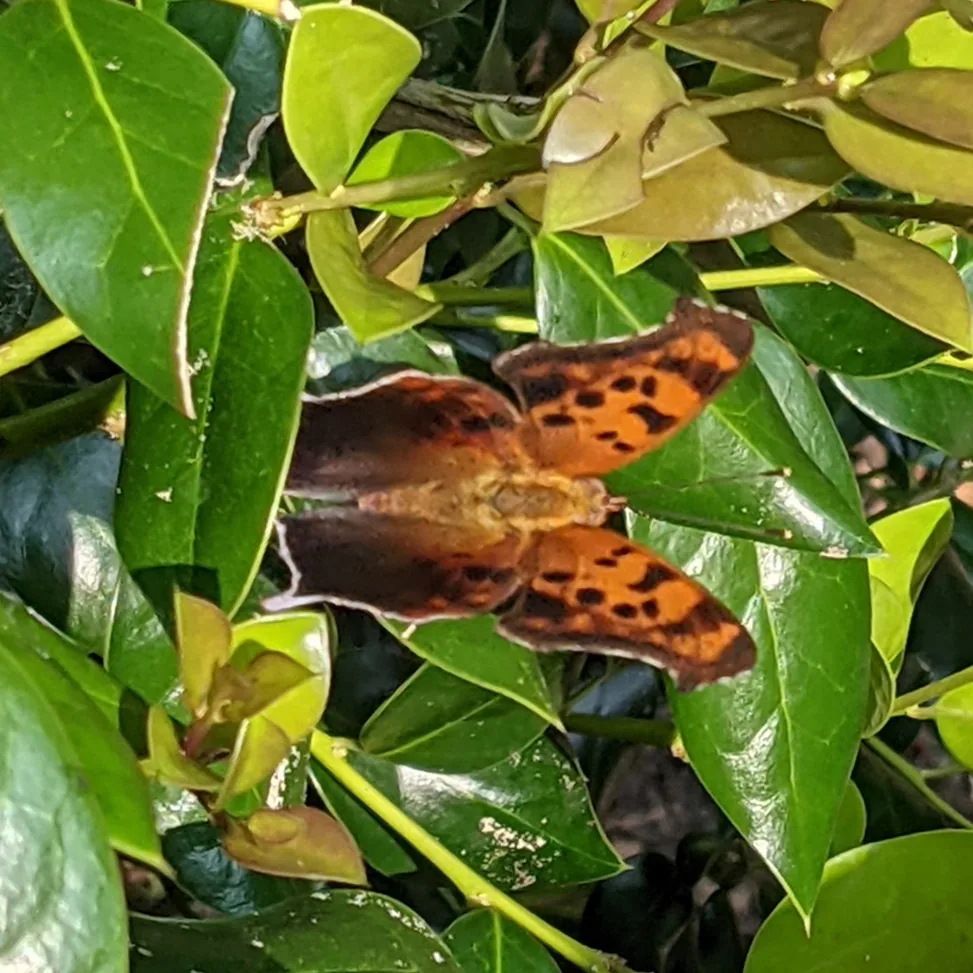
The question mark is an orange-and-black butterfly with ragged wing edges and a silver question-mark symbol under each hindwing; its spiny caterpillars feed on elm, hackberry and nettles.[1][2]

Group
Insect
Order
Lepidoptera
Family
Nymphalidae
US records
40 states
Sources
3 cited
Updated
2026-10-16
Orange question mark butterfly with black spots and ragged wing edges on leaves
Orange question mark butterfly with black spots and ragged wing edges on leaves. (c) stephen, some rights reserved (CC BY) — via iNaturalist, CC BY 4.0
On this page
  1. Identification
  2. Look-alikes
  3. Where it lives
  4. Biology
  5. Damage and signs
  6. Health risk
  7. Control
  8. Related profiles
  9. Common questions
  10. Sources

How to identify it

  • Adults span about 2 to 2 1/2 inches, orange with dark spots above and powdery white margins; a silver curved line with a dot under the hindwing gives the name.[1][2]
  • Caterpillars grow to about 1.4 inches, black to yellowish or reddish brown with light lines and rows of branched spines.[1][2]

Look-alikes

Look-alikeHow to tell them apart
Eastern commaThe question mark is the only Missouri anglewing with a dot next to the silver curve on the hindwing underside.[2]

Where it lives

Found in forests, roadsides, parks and residential areas; adults fly April to November in Missouri.[2]

US map: public records from 40 states since 1990 (GBIF).

Biology and life cycle

There are summer and winter color forms; adults rarely visit flowers, instead feeding at mud, rotting fruit and sap.[1][2]

Damage and signs

  • Caterpillars feed on elm, hackberry and nettles; feeding is not a concern.[2]

Health risk

None to people or pets.[1][2]

Control

Prevention

No control is needed.[1][2]

Common questions

Why is it called a question mark?
For the silver question-mark-shaped mark under its hindwings.[1][2]
What do the caterpillars eat?
Elm, hackberry and nettles.[2]
Why is it on my rotting fruit?
Adults feed on rotting fruit, sap and damp soil more than flowers.[2]

Sources

  1. University of Florida IFAS Extension (EDIS, Featured Creatures), “Question Mark, Polygonia interrogationis (EENY-506/IN908).” ask.ifas.ufl.edu/publication/IN908 (accessed 2026-10-15)
  2. Missouri Department of Conservation, “Question Mark (Field Guide).” mdc.mo.gov/discover-nature/field-guide/question-mark (accessed 2026-10-15)
  3. iNaturalist, “Polygonia interrogationis taxon page (order and family).” www.inaturalist.org/taxa/58579 (accessed 2026-10-06)

Updated 2026-10-16. Built from sourced records. Spot an error? Tell us.