On this page
How to identify it
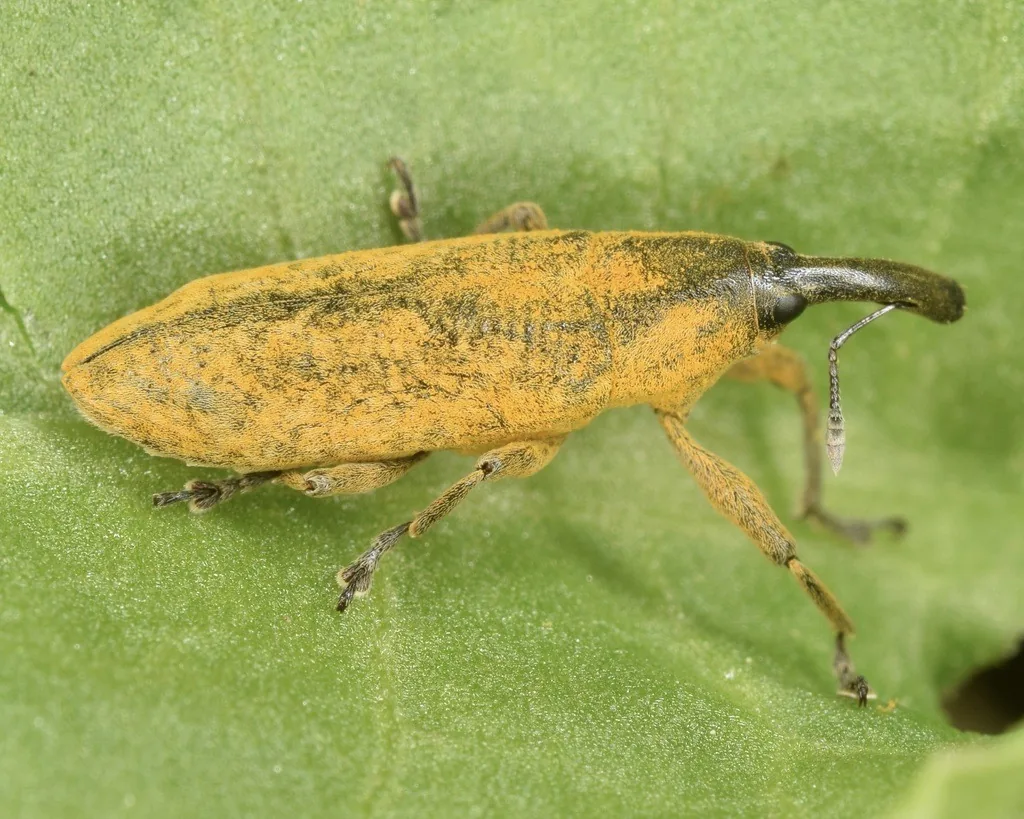
- A large weevil, about 13 to 19 mm (1/2 to 3/4 inch) long, with a long, cylindrical body and an obvious snout that curves downward. The antennae are elbowed and clubbed.[1][2]
- Young adults are coated with a dusty yellow or orange powder (a bloom) that rubs off easily. Older beetles that have lost it look brownish black.[1][2]
- The larvae are legless white grubs with a brown head, and they are found only in the stalks of weedy hosts, never in rhubarb.[1]
Look-alikes
| Look-alike | How to tell them apart |
|---|---|
| Lixus mucidus | A very similar relative, one of about 30 Lixus species north of Mexico. It apparently has a rust-colored bloom rather than bright yellow, and a shallower, less obvious dip on the back where the thorax meets the wing covers.[2] |
Where it lives
Native to North America, it is found from New England west to Idaho and south to Florida and Louisiana, and it occurs in Missouri.[1][2]
Biology and life cycle
Besides rhubarb, it feeds on docks (Rumex), sunflowers, thistles and other plants in the buckwheat and sunflower families.[1][2]
Adults spend the winter in plant debris and other sheltered spots, become active in late spring and show up on the leaves of rhubarb and weedy hosts.[1]
Eggs laid in rhubarb do not survive because the fast-growing stalk crushes them. Females lay successfully in the stalks of other hosts, where larvae hatch in about 7 to 10 days and tunnel down toward the crown.[1]
The larvae pupate in the soil at the base of the host plant, and new adults emerge a few weeks later, feeding until cool weather sends them into winter shelter. There is one generation a year.[1]
Damage and signs
- Adults notch the edges of rhubarb leaves and stalks and chew shallow round or oval pits in the stalks where they feed and lay eggs. The damage often goes unnoticed until drops of gummy sap ooze from these spots.[1]
- Tough scars form in the stalks, and dark streaks may appear later as decay sets into the wounds.[2][1]
Health risk
It is a plant-feeding weevil, and neither source describes any risk to people.[1][2]
Control
Prevention
No suitable organic or biological controls are available, and none are needed: this is only a sporadic pest of rhubarb, cultural controls handle it easily, and Virginia Cooperative Extension does not recommend insecticides for it in home gardens or commercial plantings.[1]
Sanitation
In midsummer, remove dock, thistle and sunflower growing near the rhubarb to destroy the larvae developing in their stalks. In fall, clear dried rhubarb leaves and other debris from the planting to reduce the adults that overwinter there.[1]
Traps and physical control
Hand-pick adults when you see them resting on the leaves. Disturbed beetles drop off the plant quickly, so hold a bucket underneath to catch them.[1]
Common questions
- What are the oozing pits on my rhubarb stalks?
- Shallow round or oval pits with drops of gummy sap are typical rhubarb curculio feeding and egg-laying sites. Dark streaks may follow as decay develops in the wounds.[1]
- Will grubs develop inside my rhubarb?
- No. Eggs laid in rhubarb are crushed by the growing stalk; the grubs develop only in weeds such as dock, thistle and sunflower.[1]
- Should I spray rhubarb for curculios?
- No. Hand-picking adults and removing weedy hosts and fall debris keep this sporadic pest in check, and insecticides are not recommended for it.[1]
Sources
- Virginia Cooperative Extension (Virginia Tech), via VTechWorks, “Rhubarb Curculio, ENTO-430 (T. Dellinger and E. Day, 2015).” hdl.handle.net/10919/75428 (accessed 2026-11-09)
- Missouri Department of Conservation, “Rhubarb Weevil (Field Guide).” mdc.mo.gov/discover-nature/field-guide/rhubarb-weevil (accessed 2026-11-09)
- iNaturalist, “Lixus concavus taxon page (order and family).” www.inaturalist.org/taxa/224031 (accessed 2026-11-09)