On this page
How to identify it
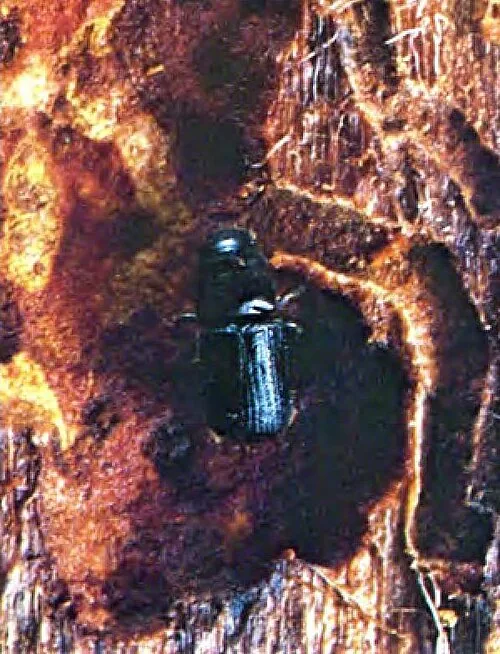
- Newly emerged adults are shiny dark brown to black, about a quarter inch long and an eighth of an inch wide, with females slightly larger than males. Eggs are oblong, pearly white and less than a sixteenth of an inch; larvae are legless, grublike and more or less translucent, sometimes tinted reddish-brown by gut contents.[1]
- Look for boring dust in bark crevices and around the base of the tree, ranging from brownish red to nearly white, and for pitch tubes where resin has solidified at the entrance holes. Pitch tubes are larger on trees with few attacks, and both signs are freshest during the attack period from late September to early November.[1]
- The egg gallery meanders upward in the phloem, lightly scoring the outer wood, with eggs in small niches alternately on either side. It is usually about 12 inches long, occasionally up to 4 feet, and the male packs the first few inches with boring dust as it lengthens.[1]
Look-alikes
| Look-alike | How to tell them apart |
|---|---|
| Mountain pine beetle (Dendroctonus ponderosae) | Often in the same southwestern trees; where mountain pine beetle is abundant the roundheaded pine beetle may be pushed down to the first few feet of the bole, and on trees over 18 inches in diameter the roundheaded beetle may take the bole below 12 feet while other Dendroctonus work above it.[1] |
| Western pine beetle (Dendroctonus brevicomis) | Another southwestern associate in ponderosa pine; the roundheaded pine beetle is distinguished by its late-fall attack period and winter in the egg stage.[1] |
| Pine engraver (Ips pini) | Ips species often fill in after the roundheaded pine beetle attacks first, as happened in the most recent southern New Mexico outbreak.[1] |
Where it lives
The southwestern United States and Mexico. Outbreaks are documented from southern New Mexico, with the largest covering 150,000 acres from Mayhill to Ruidoso, and from a recreation area on the Toiyabe National Forest in Nevada. In the United States it principally attacks ponderosa pine and has also been collected from limber pine; from Mexico southward it infests several pines, including Mexican white, Chihuahua, Montezuma and Nicaragua pine. Recent Mexican work describes it as colonizing around 18 pine species, preferentially Pinus hartwegii, from the United States to Central America, and ranks it among the five most critical primary forest pests in Mexico.[1][3][2]
Biology and life cycle
Most beetles in the United States complete a generation in a year, with about 10 percent of the brood taking two (more in Nevada). Adults emerge and fly from late September to late November, with the heaviest daily emergence in late October and early November, and attack green trees within a few days.[1]
Females bore through the outer bark into the phloem and build the egg gallery. Galleries of early-attacked trees are essentially complete by early December; those attacked in November are only partly built, and construction between December and February happens only when bark temperatures allow, picking up a little in March and April.[1]
Egg hatch generally starts in mid-March and is essentially finished by late April. The youngest larvae make small feeding galleries in the phloem while older ones bore into the drier outer bark, widening tunnels that end in pupal chambers. Larvae develop quickly through the third instar, then the fourth instar develops slowly and does not pupate until late July or early August. Adults are present from mid-August and stay in the tree two to three months before flying.[1]
Low winter temperatures matter less than you would expect: overwintering eggs survive down to minus 25 degrees F, though such cold kills many of the few larvae that hatched before winter.[1]
Brood density varies with aspect and height on the tree. One study found higher densities on north sides in spring that evened out by emergence, another found south sides produced more beetles on average, and beetle production was greater at 10 feet above ground than at 1.5 feet.[1]
Damage and signs
- Foliage of attacked trees begins fading to light green as early as May of the year after attack and is straw brown by mid-July; by December, 14 months after attack, most killed trees have dropped their needles, though a few stay green for 12 to 16 months despite boring dust and pitch tubes on the bark.[1]
- Outbreaks develop on poorer sites and ridgetops. In southern New Mexico, trees of all crown and diameter classes were killed in groups of 3 to more than 100, and a 1971 survey estimated 400,000 infested pole-sized ponderosa pines on 150,000 acres; in Nevada, infestations were mostly in trees over 20 inches in diameter, in single trees or groups rarely exceeding 15.[1]
- The beetle may kill up to half the trees in pure ponderosa pine stands and up to half the pine in mixed conifer stands, leaving Douglas-fir dominant; sites that fire and logging had converted to ponderosa pine may revert to Douglas-fir as the pine is killed and understory seedlings are released. Not every attacked tree dies: trees that are not attacked all the way around, or not above 7 feet, may survive, and as many as 15 percent of attacked trees do not receive a lethal number of attacks.[1]
Health risk
A forest insect with no reported effect on people; the leaflet describes damage to pines only.[1]
Control
Prevention
Thinning stands is the first measure the leaflet gives private landowners for reducing the number of trees killed and protecting high-value trees.[1]
Sanitation
Eliminate infested trees by felling them and then burning or chemically treating the material, so the brood does not emerge. Trap trees felled in late September, just before the flight, may work but the leaflet says the technique needs more study.[1]
Biological control
Natural enemies take a real share of the brood. The red-bellied clerid is the most important predator in New Mexico, its larvae eating beetle larvae, pupae and new adults; a predaceous ostomid beetle feeds on eggs and larvae; a braconid wasp in the genus Coeloides is the most abundant parasite; two internal nematode parasites often halve the egg production of infested females; and woodpeckers can take heavy tolls on individual trees.[1]
When to call a professional
For thinning prescriptions and for any protective spray on uninfested high-value trees, including currently registered products, rates and methods, contact the regional Forest Service or state forest service pest control office rather than relying on the leaflet's 1977 chemical guidance.[1]
Common questions
- When does this beetle attack?
- Late September to late November, with peak emergence in late October and early November. That late flight, and spending the winter mostly as eggs, is what sets it apart from every other Dendroctonus in the United States.[1]
- My pine has pitch tubes but is still green. Is it dead?
- Not necessarily, and you may not know for a while. Foliage usually starts fading in May of the year after attack, but a few attacked trees remain green for 12 to 16 months, and trees not attacked all the way around or not above 7 feet can survive.[1]
- Is it the same beetle killing pines in Mexico?
- Yes. Mexican researchers rank it among the five most critical primary forest pests there, where it colonizes around 18 pine species and prefers Pinus hartwegii; its dispersal and colonization are mediated by semiochemicals, which is why recent work has focused on its olfactory genes and its calls.[2][3]
Sources
- USDA Forest Service, Rocky Mountain Forest and Range Experiment Station, “Forest Insect & Disease Leaflet 155: Roundheaded Pine Beetle (Massey, Lucht and Schmid, 1977).” www.fs.usda.gov/foresthealth/docs/fidls/FIDL-155-RoundheadedPineBeetle.pdf (accessed 2026-11-10)
- Scientific Reports (Nature Portfolio), “Torres-Huerta, Segura-Leon, Aragon-Magadan and Gonzalez-Hernandez (Colegio de Postgraduados, Mexico). Identification and motif analyses of candidate nonreceptor olfactory genes of Dendroctonus adjunctus Blandford from the head transcriptome. Scientific Reports 10 (2020) 20695, PMID 33244016.” pubmed.ncbi.nlm.nih.gov/33244016/ (accessed 2026-11-10)
- Insects (MDPI), open access via PubMed Central, “Acoustic Communication in Dendroctonus adjunctus Blandford (Curculionidae: Scolytinae): Description of Calls. Insects 15 (2024), PMC11277085.” pmc.ncbi.nlm.nih.gov/articles/PMC11277085/ (accessed 2026-11-10)
- iNaturalist, “Dendroctonus adjunctus taxon page (order and family).” www.inaturalist.org/taxa/269482 (accessed 2026-11-10)