On this page
How to identify it
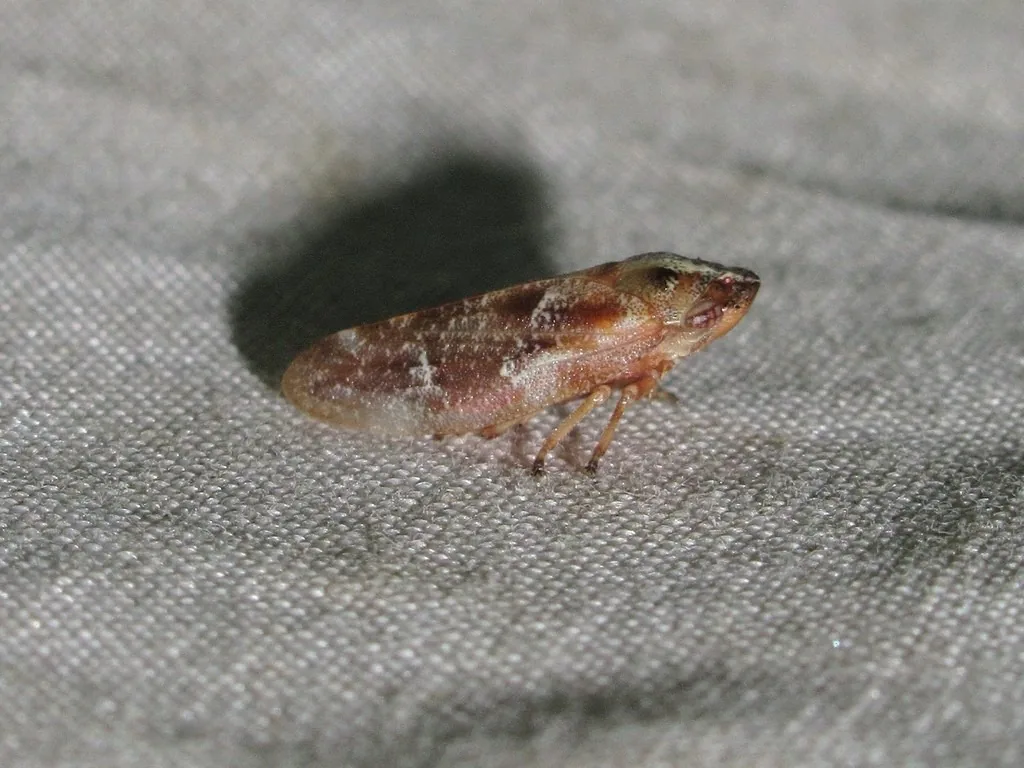
- Adults are boat-shaped, tan with whitish markings and about 0.3 to 0.4 inch long, with a white arrow-shaped mark on top of the head and body.[1][2]
- Young nymphs in spittle masses on ground plants have bright scarlet abdomens edged in black and jet-black heads; the last nymphal stage is dark brown.[2]
- On pines, the first sign is one or more reddish-brown dead branch tips (flagging) in the upper crown; scraping the bark of those shoots shows tan or brown feeding scars.[2]
Look-alikes
| Look-alike | How to tell them apart |
|---|---|
| Pine spittlebug | Its nymphs make their spittle on the pine twigs themselves; Saratoga spittlebug nymphs feed on plants of the forest floor.[1] |
Where it lives
Native from Maine to Minnesota and in the southern parts of the adjacent Canadian provinces, wherever its pine hosts grow.[2]
Biology and life cycle
There is one generation a year. Eggs laid under bud scales or in needle sheaths spend the winter on the pines.[1][2]
Nymphs hatch in early May, drop to the ground and feed under spittle on brambles, hawkweed and other plants, then mainly on sweetfern; up to 50 can share one large spittle mass.[1][2]
Adults move up to pines in late June or July and feed on twig sap into fall, with most injury from mid-July to mid-August.[1][2]
Damage and signs
- Red pine is the preferred host, followed by jack pine; Scots pine is occasionally injured, and white pine is fed on but seldom badly damaged.[2]
- Feeding punctures restrict the flow of nutrients so branches die; continued heavy feeding causes top kill, crooked stems and dead trees, mainly on pines 2 to 15 feet tall.[2]
- UMass notes that at least 3 years of heavy feeding are needed to kill a tree and that it is unlikely on ornamental pines in well-managed plantings.[1]
Health risk
Control
Prevention
Sweetfern is the key alternate host; the Forest Service rates pine planting sites by how much of the ground cover is sweetfern versus other host plants.[2]
Biological control
Hot, dry weather and spring frosts kill many young nymphs; parasitic flies have parasitized up to half the adults, but no natural enemy is an effective control.[2]
Common questions
- Why are branch tips dying at the top of my young red pine?
- Saratoga spittlebug feeding is one cause; look for brown feeding scars under the bark of the dead shoots.[2]
- Where are the Saratoga spittlebug's spittle masses?
- Not on the pines: the nymphs make their spittle on sweetfern, brambles and other plants on the ground.[1][2]
Sources
- UMass Extension Landscape, Nursery and Urban Forestry Program (Landscape Insect & Mite Guide), “Aphrophora cribrata and Aphrophora saratogensis (Pine Spittlebugs).” www.umass.edu/agriculture-food-environment/landscape/publications-resources/insect-mite-guide/aphrophora-cribrata-aphrophora-saratogensis (accessed 2026-10-16)
- USDA Forest Service (Forest Insect & Disease Leaflets), “Saratoga Spittlebug (FIDL 3, revised Nov. 1978).” www.fs.usda.gov/foresthealth/docs/fidls/FIDL-03-SaratogaSpittlebug.pdf (accessed 2026-10-16)
- iNaturalist, “Aphrophora saratogensis taxon page (order and family).” www.inaturalist.org/taxa/213967 (accessed 2026-10-06)