On this page
How to identify it
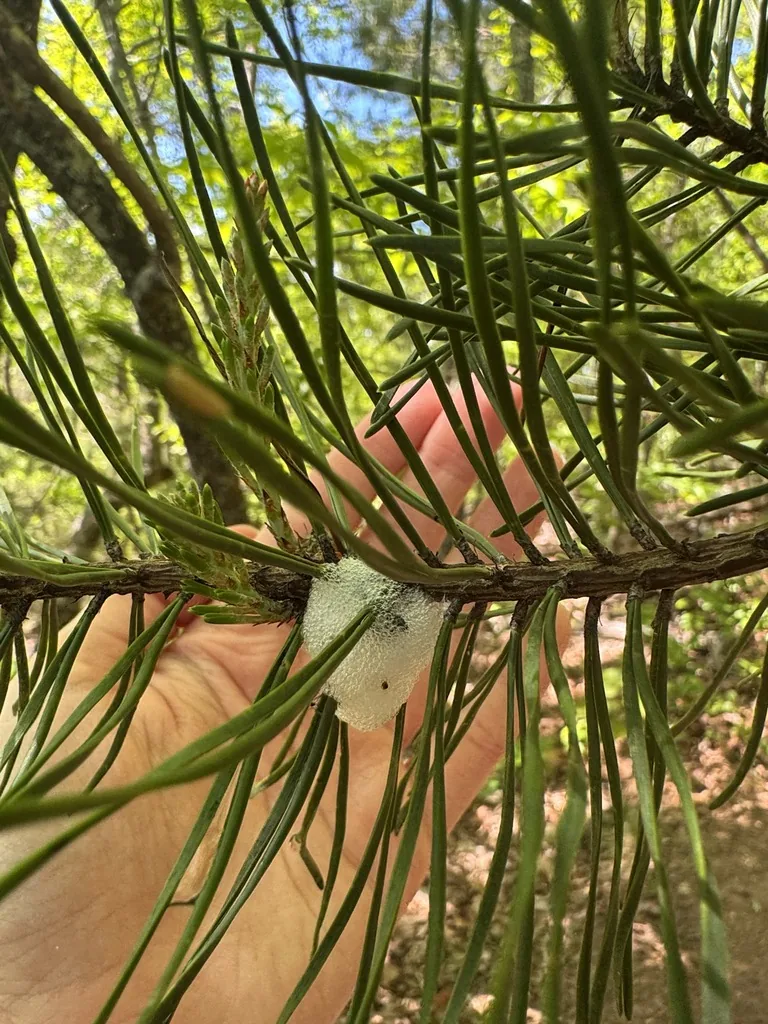
- In spring, look for white, frothy spittle masses on pine shoots and the trunk; several nymphs may feed inside one mass.[1][2]
- Nymphs under the spittle are black with whitish abdomens.[2]
- Adults are about 1/4 inch long and tan, with two irregular whitish bands on each wing; they do not make spittle.[1][2]
Look-alikes
| Look-alike | How to tell them apart |
|---|---|
| Saratoga spittlebug | A related pine spittlebug whose nymphs feed on sweetfern, brambles and hawkweed instead of the pines the adults attack.[1] |
Where it lives
Found throughout the eastern United States and parts of Canada; in Maryland the spittle masses show up in May and June.[1][2]
Biology and life cycle
Females lay eggs in the bark of twigs, and the eggs spend the winter there; nymphs hatch in spring and feed on twig sap under their spittle.[1]
Adults feed on the same twigs from July into September, excreting honeydew that can fall as a fine mist and grow black sooty mold.[1][2]
There is one generation a year in the northern part of its range.[1]
Damage and signs
- Scotch pine is the preferred host, but it also feeds on eastern white, pitch, Virginia, jack, loblolly and Japanese pines, and UMass lists fir, Douglas-fir, hemlock and spruce.[1][2]
- Heavy infestations can kill twigs and branches, and several years of heavy feeding in a row can kill Scotch pine.[1][2]
- In 1927, pine spittlebugs killed 70 percent of the Scotch pines in one Pennsylvania plantation.[1]
Health risk
Control
Traps and physical control
In light infestations, destroy the nymphs in their spittle by hand.[2]
Pesticides
Where needed, Maryland suggests spraying the spittle masses with a contact insecticide when they are first noticed.[2]
Common questions
Sources
- UMass Extension Landscape, Nursery and Urban Forestry Program (Landscape Insect & Mite Guide), “Aphrophora cribrata and Aphrophora saratogensis (Pine Spittlebugs).” www.umass.edu/agriculture-food-environment/landscape/publications-resources/insect-mite-guide/aphrophora-cribrata-aphrophora-saratogensis (accessed 2026-10-16)
- University of Maryland Extension (Home and Garden Information Center), “Spittlebugs on Trees and Shrubs (updated Feb. 28, 2023).” extension.umd.edu/resource/spittlebugs-trees-and-shrubs (accessed 2026-10-16)
- iNaturalist, “Aphrophora cribrata taxon page (order and family).” www.inaturalist.org/taxa/213963 (accessed 2026-10-06)