On this page
How to identify it
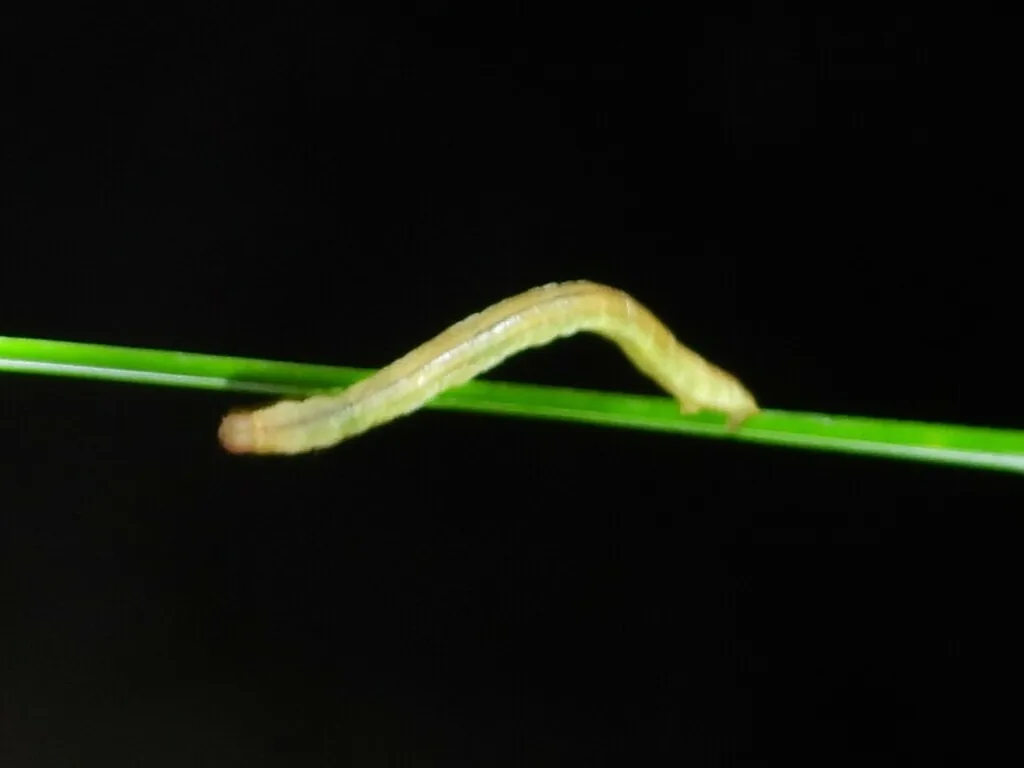
- It is a small, slender inchworm: up to 15 to 20 mm in the Canadian and conifer-guide measurements, and under 2 cm (about 3/4 inch) in the geometroid guide.[1][2][3]
- The body is yellowish to rusty brown with a dark middorsal stripe and conspicuous pinkish red rings, or bands, near the rear edge of each segment. It may be flushed with pink underneath, especially around the prolegs.[1][2][3]
- A pale or light yellow stripe runs along a raised ridge (flange) low on each side. The head is reddish orange to brownish yellow and unmarked.[1][2][3]
Where it lives
It is found across Canada, from British Columbia east to Newfoundland, and in the eastern United States through New England and New York south to the mountains of North Carolina. Records farther south, from Florida, need confirmation. Habitats include pine barrens, woodlands, forests and plantations.[1][3]
Biology and life cycle
Hosts are conifers: fir, larch, pine and spruce in the East, and lodgepole pine and Douglas-fir above all in British Columbia, along with spruces, western hemlock, true firs and ponderosa pine.[1][2][3]
There is one generation a year. The pupa overwinters in the soil or leaf debris, the moths fly from June to late July in Canada, and caterpillars feed from June into late September or October before pupating.[1][2][3]
Because full-grown caterpillars turn up over about five months and on many different trees, the USDA Forest Service authors suggest future research may show that the small pine looper is really a group of several species.[2]
Damage and signs
Health risk
These caterpillars are tiny needle feeders, and none of the three forest-insect sources mentions any effect on people or pets.[1][2][3]
Control
Prevention
No treatment is called for. Natural Resources Canada considers the small pine looper innocuous, and the USDA Forest Service guides give no control advice.[3][1][2]
Common questions
- What is the tiny pink-banded inchworm on my pine?
- One candidate is the small pine looper, a slender yellowish inchworm under an inch long with pinkish red bands on each segment and a dark stripe down its back.[1][2]
- When are small pine loopers active?
- Caterpillars feed from June into September or October. The pupa spends the winter in the soil or debris, and in Canada the moths fly from June to late July.[2][3]
Sources
- USDA Forest Service, Forest Health Technology Enterprise Team, “Geometroid Caterpillars of Northeastern and Appalachian Forests, FHTET-2001-10 (D. L. Wagner, D. C. Ferguson, T. L. McCabe and R. C. Reardon, September 2001; scanned copy).” archive.org/details/geometroidcaterp00wagn (accessed 2026-11-09)
- USDA Forest Service, Forest Health Technology Enterprise Team, “Small pine looper (Eupithecia palpata), from Caterpillars on the Foliage of Conifers in the Northeastern United States, FHTET-2004-01 (C. T. Maier, C. R. Lemmon, J. M. Fengler, D. F. Schweitzer and R. C. Reardon, 2004), Bugwood wiki archive.” wiki.bugwood.org/Archive:Caterpillars/Eupithecia_palpata (accessed 2026-11-09)
- Natural Resources Canada, Canadian Forest Service, “Small pine looper, Trees, insects and diseases of Canada's forests.” tidcf.nrcan.gc.ca/en/insects/factsheet/8718 (accessed 2026-11-09)
- iNaturalist, “Eupithecia palpata taxon page (order and family).” www.inaturalist.org/taxa/219820 (accessed 2026-11-09)