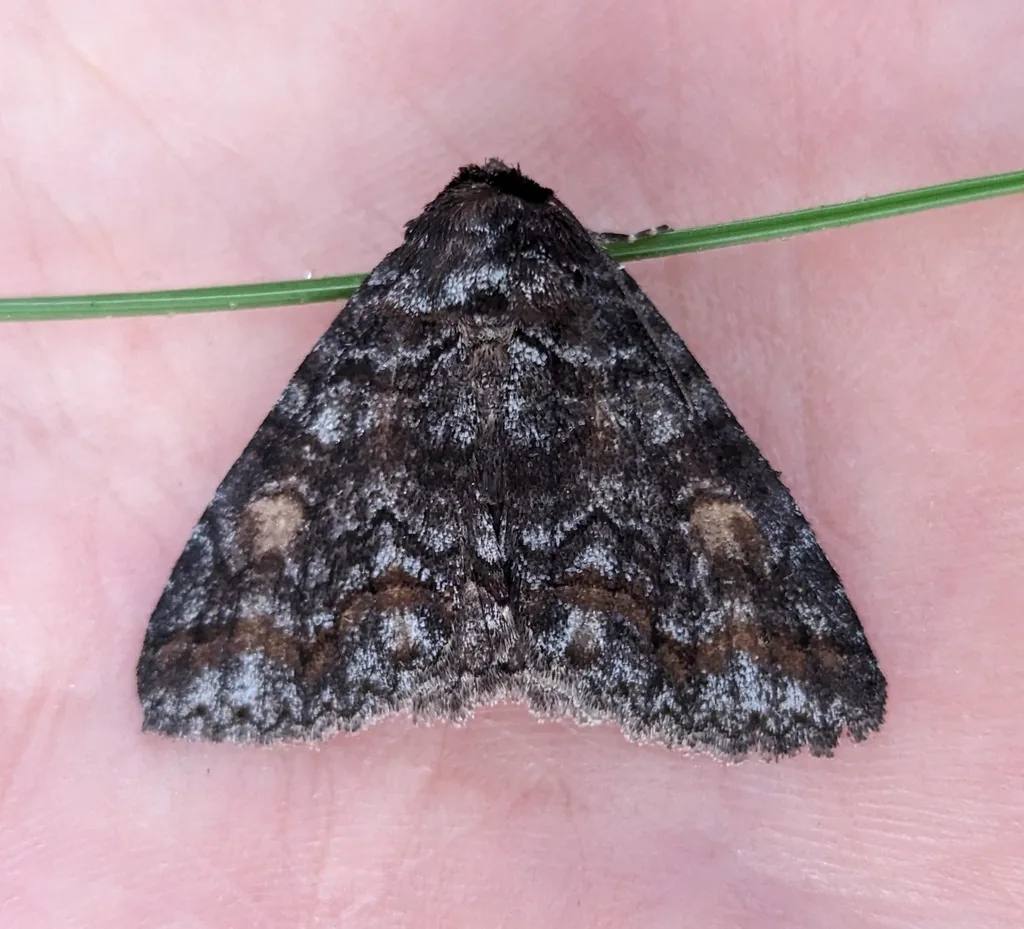
On this page
How to identify it
- The caterpillar is long and slender, rusty brown (the usual color) to purplish brown or dark gray, and reaches about 30 to 35 millimeters (about 1 1/4 inches).[2][1]
- The head is mottled gray or brown, with a prominent white mark or chevron on each side of the top.[2][1]
- A pair of bumps (tubercles) sits on a ridge across the top of the eighth abdominal segment, near the rear. Down the back runs a broken, wavy stripe edged with beaded white lines, with a pale Y-shaped mark at the rear edge of each abdominal segment.[1][2]
- The first two pairs of middle prolegs are smaller than the rest, and the hindmost prolegs point backward.[2][1]
Look-alikes
| Look-alike | How to tell them apart |
|---|---|
| Other Zale caterpillars on pines | Several Zale species look alike and are hard to separate because their pattern and color vary. The pine false looper is usually the most evenly colored and the smallest when grown. Zale largera, which eats jack pine in northern New England, appears to be a separate species.[1] |
Where it lives
The USDA Forest Service guide covers it among the conifer caterpillars of the northeastern United States. In Canada it is recorded from New Brunswick, Quebec and Ontario to western Canada.[1][2]
Biology and life cycle
Eastern white pine is the main host. Natural Resources Canada also lists jack pine, red pine and shore pine, while the northeastern guide says other pines are eaten only rarely.[1][2]
There is one generation a year. The pupa spends the winter in the soil, and moths come out in May.[1][2]
Caterpillars feed alone and move freely on the needles from June to August, with grown caterpillars in June and July, and pupate in August.[2][1]
Damage and signs
- The caterpillars eat pine needles but are solitary feeders. Natural Resources Canada describes the species as a common, innocuous defoliator.[2]
Health risk
The sources describe it only as a pine-feeding caterpillar; they mention no harm to people.[1][2]
Control
Prevention
Neither source recommends any control; Natural Resources Canada calls this caterpillar innocuous.[2][1]
Common questions
- What is the brown caterpillar that looks like bark on my white pine?
- In early summer, a likely candidate is the pine false looper. Its grown caterpillar is rusty brown to gray with a pair of bumps near the rear end, and it appears to mimic bark.[1][2]
- Does the pine false looper hurt pine trees?
- Natural Resources Canada describes it as a common, innocuous solitary defoliator.[2]
Sources
- USDA Forest Service, Forest Health Technology Enterprise Team, “Pine false looper (Zale duplicata), from Caterpillars on the Foliage of Conifers in the Northeastern United States, FHTET-2004-01 (C. T. Maier, C. R. Lemmon, J. M. Fengler, D. F. Schweitzer and R. C. Reardon, 2004), Bugwood wiki archive.” wiki.bugwood.org/Archive:Caterpillars/Zale_duplicata (accessed 2026-11-09)
- Natural Resources Canada, Canadian Forest Service, “Pine zale, Trees, insects and diseases of Canada's forests.” tidcf.nrcan.gc.ca/en/insects/factsheet/10577 (accessed 2026-11-09)
- iNaturalist, “Zale duplicata taxon page (order and family).” www.inaturalist.org/taxa/233930 (accessed 2026-11-09)