On this page
How to identify it
- Grown caterpillars are 20 to 24 millimeters (about 1 inch) long, with a reddish brown to brownish yellow head and a dark brown body marked with two rows of cream-colored spots on each segment of the back. Young caterpillars have pale brown or yellowish orange bodies and dark heads.[1][2]
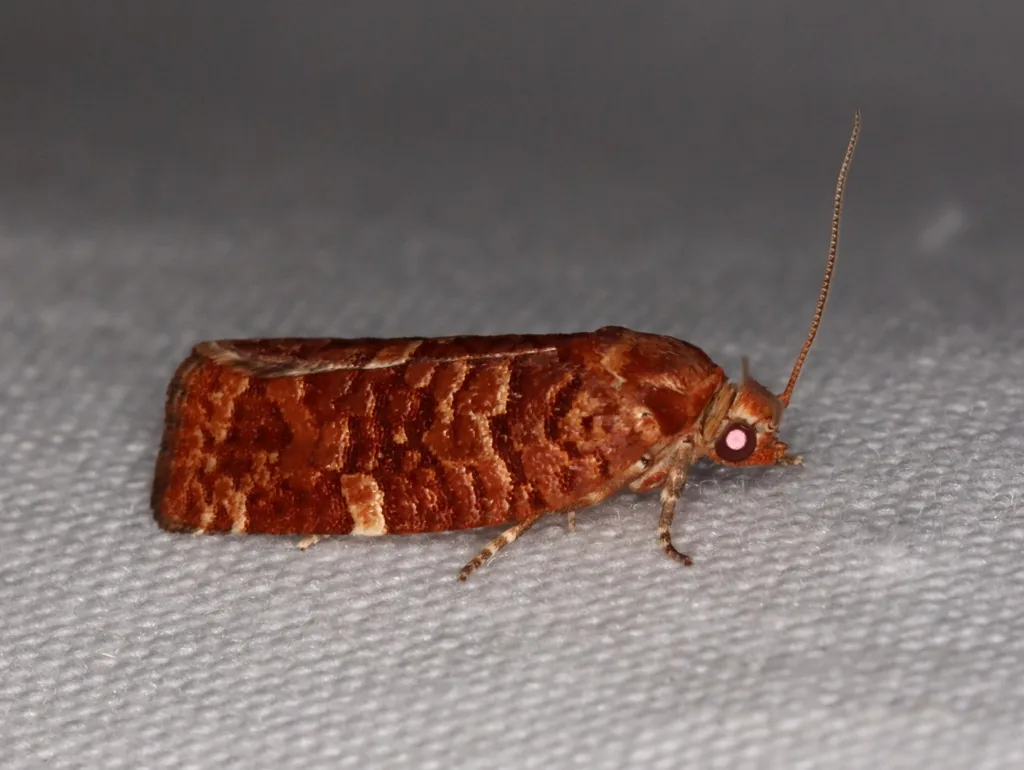
- The moth has a wingspan of 18 to 24 millimeters, slightly smaller than the spruce budworm. Its forewings are reddish brown with silvery white spots and markings, and at rest the wings are held like a tent over the body.[1][2]
- The eggs are light green and laid in two or three overlapping rows on the flat side of a needle.[1][2]
- Signs on the tree: silk strands hanging from the foliage in spring, needles chewed off at the base and tangled in loose webbing along the shoots, and needles that turn reddish brown, so trees look scorched by midsummer.[1][2]
Look-alikes
| Look-alike | How to tell them apart |
|---|---|
| Eastern spruce budworm | The two look nearly identical and their ranges overlap; the jack pine budworm was long treated as a pine form of spruce budworm. Jack pine budworm moths are slightly smaller with a reddish rather than smoky gray base color, and its young caterpillars cannot mine old needles the way spruce budworm caterpillars can.[1] |
Where it lives
It lives wherever its main host, jack pine, grows: from central Alberta east through the southern boreal forest to the Maritime provinces, and south into the U.S. states bordering the Great Lakes. An isolated population in the Middle Atlantic and northeastern states, C. pinus maritima, feeds on Virginia pine and pitch pine; little is known of its status.[1][2]
Biology and life cycle
Jack pine is the main host. Red pine and eastern white pine are also eaten, and occasionally Scots and mugo pine. Lodgepole pine is listed too, and spruce, larch and balsam fir growing among jack pine can be fed on during outbreaks.[1][2]
There is one generation a year. Moths lay egg masses of about 30 to 60 eggs on the needles from late July to mid-August. The eggs hatch in 1 to 2 weeks, and the tiny caterpillars do not feed: they crawl to sheltered spots under bark and cone scales and spend the winter in small silk cases.[1][2]
They come out between mid-May and mid-June, two to three weeks before the buds open. Because they cannot mine old needles, they depend on the pollen cones (male flowers) to survive this period, and several may share one cone. As new shoots grow they move to the fresh needles and build loose silk feeding shelters.[1][2]
Caterpillars finish growing in about 6 weeks, in July, and often pupate inside their shelters. Moths emerge within about 2 weeks and can be carried many kilometers on air currents above the canopy.[2][1]
Outbreaks are short because the budworm needs pollen cones and defoliated trees produce fewer of them. As numbers fall, natural enemies, especially parasitic insects, help end the outbreak.[1]
Damage and signs
- Feeding kills twigs and buds, reduces cone production and can strip the tops of trees. Severe defoliation can cut tree growth by up to half, but most trees recover within a few years.[2][1]
- Dominant trees are seldom killed; losses are greater among smaller, suppressed trees. Trees are more likely to die when outbreaks come with drought or with other defoliators such as the jack-pine sawfly or pine tussock moth.[1][2]
- The worst damage is in jack pine stands that are understocked, overstocked or overmature, or growing on poor sites. Stands of red, white or Scots pine can be damaged when an outbreak starts in nearby jack pine.[2][1]
Health risk
The sources describe it only as a pine-feeding caterpillar; they mention no harm to people.[1][2]
Control
Prevention
Keep pine stands vigorous and well stocked. Older, thinly stocked stands on poor sites are the most likely to be defoliated, and in forests shorter harvest rotations are recommended.[2][1]
Biological control
More than 50 kinds of parasitic insects attack the jack pine budworm. Ants and spiders eat small caterpillars that drop while looking for food, and birds may help in small, isolated stands.[2]
Pesticides
Insecticides are sometimes needed, mostly as aerial sprays during large outbreaks. Consult a state or federal forest pest specialist or a local tree care professional for currently registered products.[2][1]
Common questions
- Why do my jack pines look scorched red in July?
- Jack pine budworm is a common cause. The caterpillars cut new needles off at the base and tie them up in silk, and the clipped needles dry and turn reddish brown, giving the tree a scorched look.[1][2]
- Will jack pine budworm kill my trees?
- Usually not. Most trees recover within a few years, and large trees are seldom killed. Smaller, suppressed trees die more often, and top-killing is common after outbreaks.[1][2]
- Is it the same as the spruce budworm?
- No. It was once treated as a pine-feeding form of spruce budworm, but it was described as a separate species in 1953, and genetic analysis shows it is quite distinct.[2][1]
Sources
- Natural Resources Canada, Canadian Forest Service, “Jack pine budworm (V. G. Nealis, revised 2024), Trees, insects and diseases of Canada's forests.” tidcf.nrcan.gc.ca/en/insects/factsheet/12024 (accessed 2026-11-09)
- USDA Forest Service, “Jack-Pine Budworm, Forest Pest Leaflet 7 (H. O. Batzer and I. Millers, revised November 1970).” www.fs.usda.gov/foresthealth/docs/fidls/FIDL-07-JackPineBudworm.pdf (accessed 2026-11-09)
- iNaturalist, “Choristoneura pinus taxon page (order and family).” www.inaturalist.org/taxa/216809 (accessed 2026-11-09)