On this page
How to identify it
- Mature caterpillars are about 15 to 25 millimeters (roughly 3/5 to 1 inch) long, gray-green to almost black, with a reddish-brown to black head and rear plate. They live inside rolled or tied aspen leaves.[1][2]
- Young caterpillars are tiny and pale yellow or green with a light brown head, feeding in groups between leaves webbed flat together and skeletonizing them.[1][2]
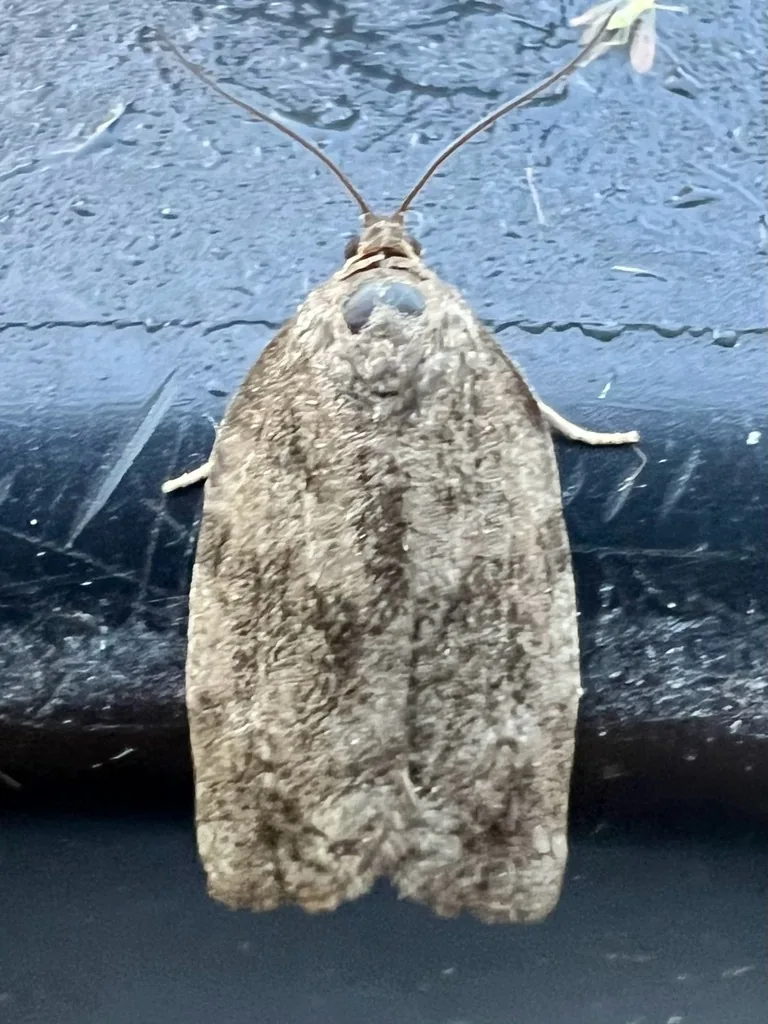
- The moth has a wingspan of 25 to 35 millimeters (about 1 to 1-3/8 inches). Its forewings are gray to brownish gray with darker, variable markings; Natural Resources Canada describes darker inner and outer patches divided by a middle band.[1][2]
- Eggs are pale green, scale-like and laid in flat masses of 60 to 450 with overlapping rows like fish scales, on the upper sides of aspen leaves.[1][2]
Look-alikes
| Look-alike | How to tell them apart |
|---|---|
| Forest tent caterpillar and western tent caterpillar | These also defoliate aspen, sometimes in the same outbreak. Large aspen tortrix caterpillars are the ones hidden inside rolled or silk-tied leaves.[1][2] |
| Spruce budworm | A relative with the same shelter-building habit that feeds on conifers, tying needles together with silk because it cannot roll them.[2] |
Where it lives
Its range follows quaking aspen: across Canada from Labrador and Nova Scotia, through the northeastern and north central United States and interior Alaska, and down the Rocky Mountains, at higher elevations, to northern Arizona and New Mexico.[1][2]
Biology and life cycle
Quaking aspen is the main host, along with bigtooth aspen and balsam poplar. When aspen is stripped, the caterpillars also feed on cottonwoods, birches, willows, alders and chokecherry.[1][2]
There is one generation a year. Moths fly in late June and July, and females lay flat egg clusters on aspen leaves. Eggs hatch in July, and the young larvae feed in groups.[1][2]
In August the small larvae move to bark crevices or under moss at the base of the tree, spin silk shelters and spend the winter there. By mid-May they climb back into the crowns and mine the buds, then roll or tie leaves together and feed inside.[1][2]
They pupate in the rolled leaves in mid to late June, and moths emerge about 10 days later, often leaving empty pupal cases sticking out of the leaf clumps. During outbreaks huge numbers of moths gather at lights on summer nights.[1][2]
Outbreaks usually last two or three years and then end suddenly, mainly because the larvae eat all the foliage and starve. More than 20 species of parasitic insects, predators such as ants, wasps and ground beetles, diseases, birds and late spring frosts also kill them.[1][2]
Damage and signs
- Early signs are patches of skeletonized leaves and rolled leaves. Heavily infested trees turn thin-crowned and yellow-brown, can be stripped completely, and get covered in silk webbing, which can also drape understory plants; masses of silk and frass collect on shrubs below.[1][2]
- Defoliation rarely kills healthy aspen, which usually grows a second, smaller set of leaves later in summer. Repeated defoliation slows growth, and old trees and trees on poor soils, near construction or otherwise stressed may lose their tops or die.[2][1]
- In campgrounds and around homes the stripped trees, caterpillars and webbing are unsightly and a nuisance, and dead trees can become a hazard.[1]
Health risk
The sources describe the caterpillars and webbing as a nuisance in recreation areas and around homes but do not describe any health risk to people.[1]
Control
Prevention
Most outbreaks are short-lived and are usually left to run their course; aspen tolerates the damage and long-term effects are usually minor. Keeping stands vigorous, and in forests replacing old stands with young aspen, makes trees more tolerant.[1][2]
Biological control
Natural enemies, including parasitic insects, predators, diseases and birds, help keep numbers in check. Where control is needed, the biological insecticide Bacillus thuringiensis is effective.[1]
Pesticides
At heavily used recreation sites or homes in wildland areas, direct control may be needed. Several insecticides are effective; check with your local extension office or state or federal forest health specialists for currently registered products.[1]
When to call a professional
A local tree care professional can help decide whether treatment is needed and apply products where only licensed applicators are allowed.[2]
Common questions
- Will large aspen tortrix kill my aspen trees?
- Usually not. Defoliation rarely kills healthy aspen, and trees often grow new leaves later in the summer. Old or stressed trees are most at risk.[2][1]
- Why are my aspen leaves rolled up with a dark caterpillar inside?
- That is the typical sign of large aspen tortrix: the caterpillars roll or tie aspen leaves together with silk and feed inside the shelter.[1][2]
Sources
- USDA Forest Service, “Large Aspen Tortrix, Forest Insect & Disease Leaflet 139 (W. M. Ciesla and J. J. Kruse, revised 2009).” www.fs.usda.gov/foresthealth/docs/fidls/FIDL-139-LargeAspenTortrix.pdf (accessed 2026-11-09)
- Natural Resources Canada, Canadian Forest Service, “Large aspen tortrix (V. G. Nealis, revised 2024), Trees, insects and diseases of Canada's forests.” tidcf.nrcan.gc.ca/en/insects/factsheet/12016 (accessed 2026-11-09)
- iNaturalist, “Choristoneura conflictana taxon page (order and family).” www.inaturalist.org/taxa/216805 (accessed 2026-11-09)