On this page
How to identify it
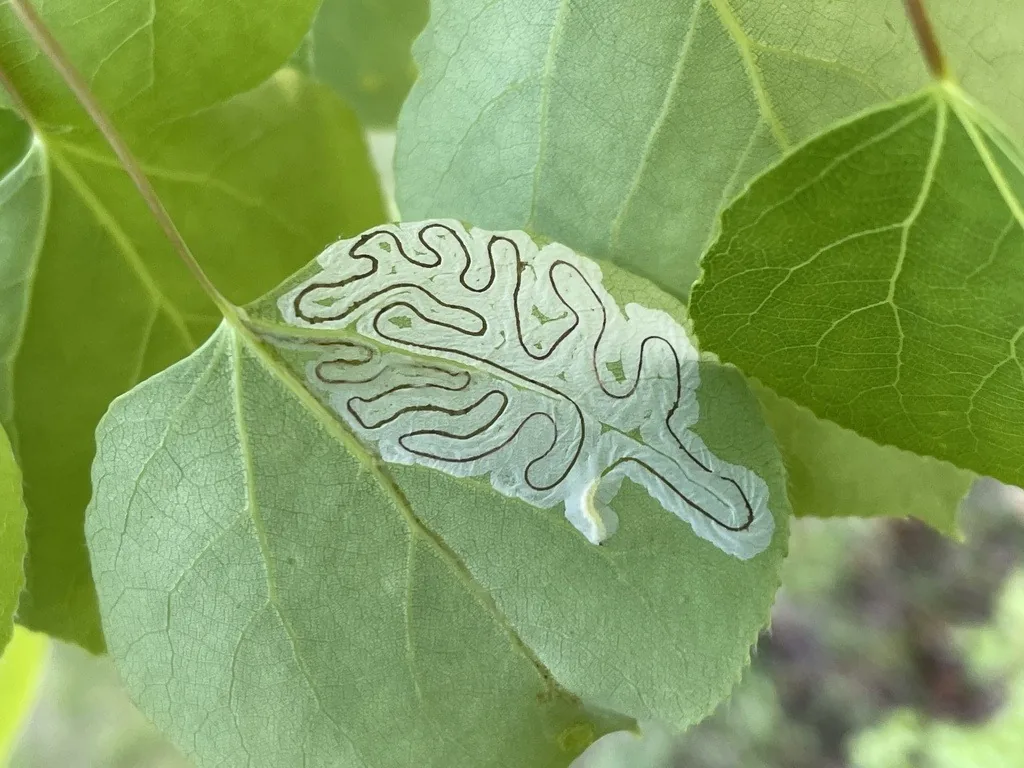
- The clearest sign is a winding, snake-like mine, usually on one side of the leaf's midrib, with a thin black line of droppings down its center. Mined leaves look silvery.[1]
- Larvae are small, white and very flat, reaching about 5 millimeters long, and live inside the mine.[1]
- Adults are minute white moths with faint brown or blackish markings on narrow, lance-shaped wings. In spring they are often seen resting on the sides of houses, windows and cars.[1]
Where it lives
It occurs across the continent on trembling aspen and is found throughout Alaska wherever poplars grow. Outbreaks happen in Alaska, along the Alaska Highway in Canada and in the western United States, including the Rocky Mountains, but rarely in eastern North America.[1][6]
Biology and life cycle
There is one generation a year. The adults spend the winter as moths, and the moths come out, mate and feed for about two weeks in early spring, starting before aspen buds open.[1]
Where the moths spend the winter has been studied in interior Alaska: they were found in a supercooled state in the leaf litter, more often under white spruce than under aspen or other hardwoods. A Forest Service leaflet also reports them under the bark scales of trees.[3][1]
Females lay single eggs on the edges of newly opened aspen leaves and fold the leaf edge over each egg. Usually one or two eggs are laid per leaf, but up to seven have been found during outbreaks. The moths feed from the small nectar glands on some aspen leaves, yet lay fewer eggs on those leaves, which improves their offspring's survival.[1][5]
The larvae bore into the leaf and feed just under the surface. Research in Alaska found they eat the contents of the outer cell layer on the top and bottom of the leaf and leave the green tissue in between intact. They pass through four larval stages and pupate inside the mine, and new moths emerge in late August and September.[1][2]
Besides trembling aspen, hosts in Alaska include balsam poplar and occasionally willow and ornamental trees and shrubs in the genus Prunus.[1]
Damage and signs
- Most of the feeding is done by older larvae within about two weeks. Heavily mined leaves dry out, turn brown and drop early; in one Alaska study they fell about four weeks sooner than lightly mined leaves.[1][2]
- Mining on the underside of the leaf, where the pores (stomata) are, cuts photosynthesis and disrupts the leaf's water balance. Heavily damaged leaves have lost up to 75 percent of their ability to photosynthesize, and reducing the miners in experiments increased aspen growth.[2][4][1]
- For most trees the most obvious effect is cosmetic, but slower growth, branch dieback and top-kill are suspected results of years of repeated damage.[1]
Health risk
These sources treat it only as a leaf pest of aspen and poplar and do not mention any harm to people; the moths are minute and rest on buildings in spring.[1]
Control
Prevention
Keep yard trees healthy with proper watering, fertilizing, planting and pruning to reduce the impact of insect pests in general. There is no effective control for large-scale forest outbreaks.[1]
Traps and physical control
For severely infested, high-value yard trees, pruning may help as long as the infested leaves and branches are removed or destroyed.[1]
Biological control
Disease, parasitoid wasps and predators cause most outbreak collapses, and larvae even eat each other when mines cross. Cold, wet years may also lower populations, while warm, dry years favor leaf miners.[1][6]
Pesticides
Contact insecticides do not work against the larvae during their most damaging stage because they are protected inside the leaf. Some systemic insecticides can be effective; ask your local Cooperative Extension office for recommendations.[1]
Common questions
- Why do my aspen leaves look silvery with squiggly lines?
- Winding silvery trails with a thin black line in the middle are mines made by aspen leaf miner larvae feeding just under the leaf surface.[1]
- What are the tiny white moths on my house in spring?
- In areas with aspen leaf miner, the minute white adult moths are often seen resting on the sides of homes, windows and cars in early spring before aspen leaves come out.[1]
Sources
- USDA Forest Service, Alaska Region, State and Private Forestry, “Aspen Leaf Miner, R10-PR-14 (J. Kruse, A. Ambourn and K. Zogas, June 2007).” www.fs.usda.gov/media/40727 (accessed 2026-11-09)
- Oecologia (via NCBI PubMed), “Impact of epidermal leaf mining by the aspen leaf miner (Phyllocnistis populiella) on the growth, physiology, and leaf longevity of quaking aspen (D. Wagner et al.; Oecologia 157(2): 259-267, 2008; abstract).” pubmed.ncbi.nlm.nih.gov/18523809/ (accessed 2026-11-09)
- Environmental Entomology (via NCBI PubMed), “Overwintering physiology and microhabitat use of Phyllocnistis populiella (Lepidoptera: Gracillariidae) in interior Alaska (D. Wagner et al.; Environmental Entomology 41(1): 180-187, 2012; abstract).” pubmed.ncbi.nlm.nih.gov/22525074/ (accessed 2026-11-09)
- Tree Physiology (via NCBI PubMed), “The leaf miner Phyllocnistis populiella negatively impacts water relations in aspen (D. Wagner, J. M. Wheeler and S. J. Burr; Tree Physiology 40(5): 580-590, 2020; abstract).” pubmed.ncbi.nlm.nih.gov/31728531/ (accessed 2026-11-09)
- Oecologia (via NCBI PubMed), “Parental resource and offspring liability: the influence of extrafloral nectar on oviposition by a leaf-mining moth (B. Mortensen, D. Wagner and P. Doak; Oecologia 172(3): 767-777, 2013; abstract).” pubmed.ncbi.nlm.nih.gov/23223861/ (accessed 2026-11-09)
- Proceedings of the Royal Society B (via NCBI PubMed), “Contrasting effects of climate warming on hosts and parasitoids: insights from Rocky Mountain aspen leaf miners and their parasitoids (A. A. Shah et al.; Proceedings of the Royal Society B 292: 20242679, 2025; abstract).” pubmed.ncbi.nlm.nih.gov/40132629/ (accessed 2026-11-09)
- iNaturalist, “Phyllocnistis populiella taxon page (order and family).” www.inaturalist.org/taxa/180712 (accessed 2026-11-09)