On this page
How to identify it
- The shelter is the easiest thing to spot: two leaves bound together face to face with silk webbing, forming a flattened case. Young caterpillars instead feed inside a rolled-up leaf.[2][1]
- The caterpillars are translucent gray-green and grow to about 25 to 33 millimeters (roughly 1 to 1-1/4 inches) long.[1][2]
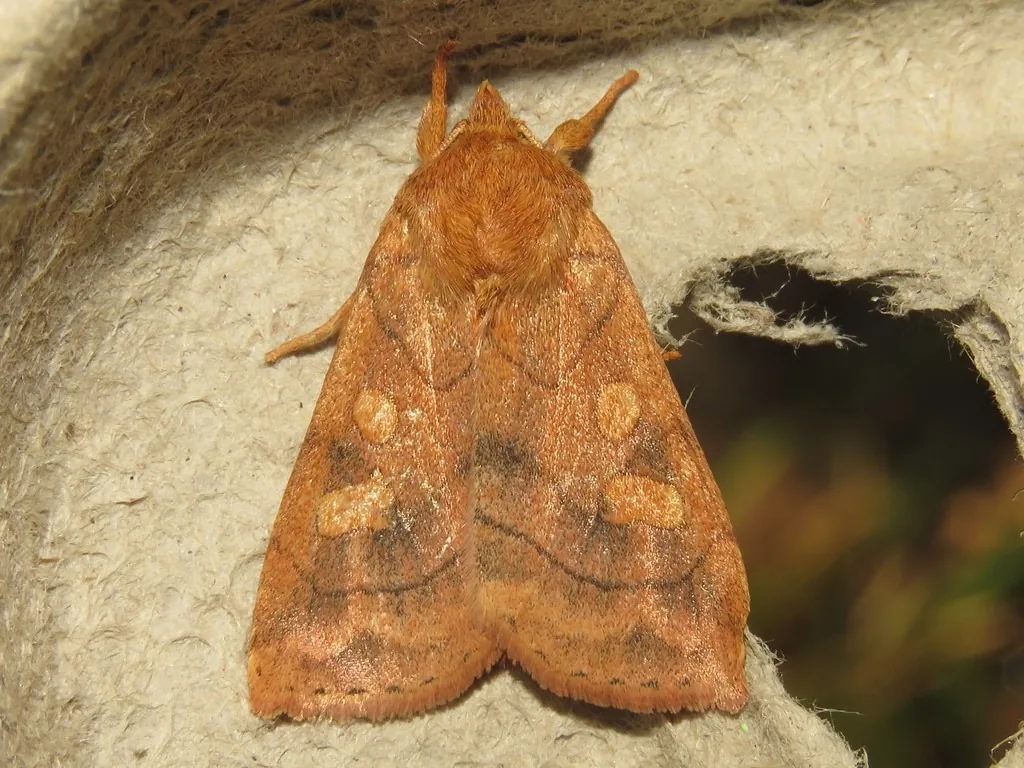
- The moth is light brown with a wingspan of 30 to 40 millimeters (about 1-1/4 to 1-1/2 inches). Each wing has two thin brown lines and two light brown, sometimes white, spots; the wings have a hairy fringe at the back and the head is covered in buff fuzz.[1][2]
Look-alikes
| Look-alike | How to tell them apart |
|---|---|
| Large aspen tortrix | Another aspen defoliator; twoleaf tier outbreaks have often happened together with large aspen tortrix outbreaks, which can make it hard to tell how much damage each caused.[2][1] |
Where it lives
It is native to North America and occurs in Canada through much of the range of aspen and cottonwood, mainly in the Prairie provinces, Ontario and Quebec.[1][2]
Biology and life cycle
Trembling aspen and cottonwood are the preferred hosts, and the caterpillars also feed on other hardwoods growing with them.[1][2]
Caterpillars hatch in mid-May as the new leaves unfold and pass through six stages, usually between May and mid-July. Young ones feed on the inside of a rolled leaf, then move outside to feed on leaf edges and surfaces, and older ones build the two-leaf shelter.[1][2]
Full-grown caterpillars drop to the ground and burrow into the soil to pupate. Moths emerge about three weeks later and can be found from late June to late September.[1][2]
Females lay their eggs on or very near the ground shortly after emerging.[1]
Outbreaks have been recorded in Ontario in the late 1950s, the early 1970s and as recently as the mid-1990s. They usually end quickly because large numbers of parasites and other natural factors bring the population down.[1][2]
Damage and signs
Health risk
The sources describe it only as a leaf feeder on aspen and cottonwood; they mention no harm to people.[1][2]
Control
Prevention
No specific control measures are recommended. The damage is relatively minor and outbreaks are normally short-lived.[1][2]
Biological control
Parasites usually cause outbreaks to collapse on their own.[1]
Common questions
- Why are pairs of aspen leaves stuck together with a caterpillar inside?
- That is the typical shelter of the aspen twoleaf tier: older caterpillars tie the flat surfaces of two leaves together with silk and feed inside.[1][2]
- Should I spray for aspen twoleaf tier?
- Neither source recommends it. No specific control is recommended because damage is relatively minor and outbreaks end quickly.[1][2]
Sources
- Ontario Ministry of Natural Resources, “Aspen twoleaf tier (forest health pests, diseases and severe weather conditions).” www.ontario.ca/page/aspen-twoleaf-tier (accessed 2026-11-09)
- Natural Resources Canada, Canadian Forest Service, “Aspen twoleaf tier, Trees, insects and diseases of Canada's forests.” tidcf.nrcan.gc.ca/en/insects/factsheet/9949 (accessed 2026-11-09)
- iNaturalist, “Enargia decolor taxon page (order and family).” www.inaturalist.org/taxa/219124 (accessed 2026-11-09)