On this page
How to identify it
- Grown caterpillars are about 11 to 15 millimeters long and green, close to the color of balsam fir needles. Newly hatched larvae are about 1 millimeter long and pale green with a dark brown or black head.[1][2]
- Despite the name, the head of an older caterpillar is usually not black: it ranges from greenish or reddish to orange-brown or dark brown, often with two dark marks on each side, and the shield behind it is greenish brown with a dark brown border. The dark brown form is common in the north.[2][1]
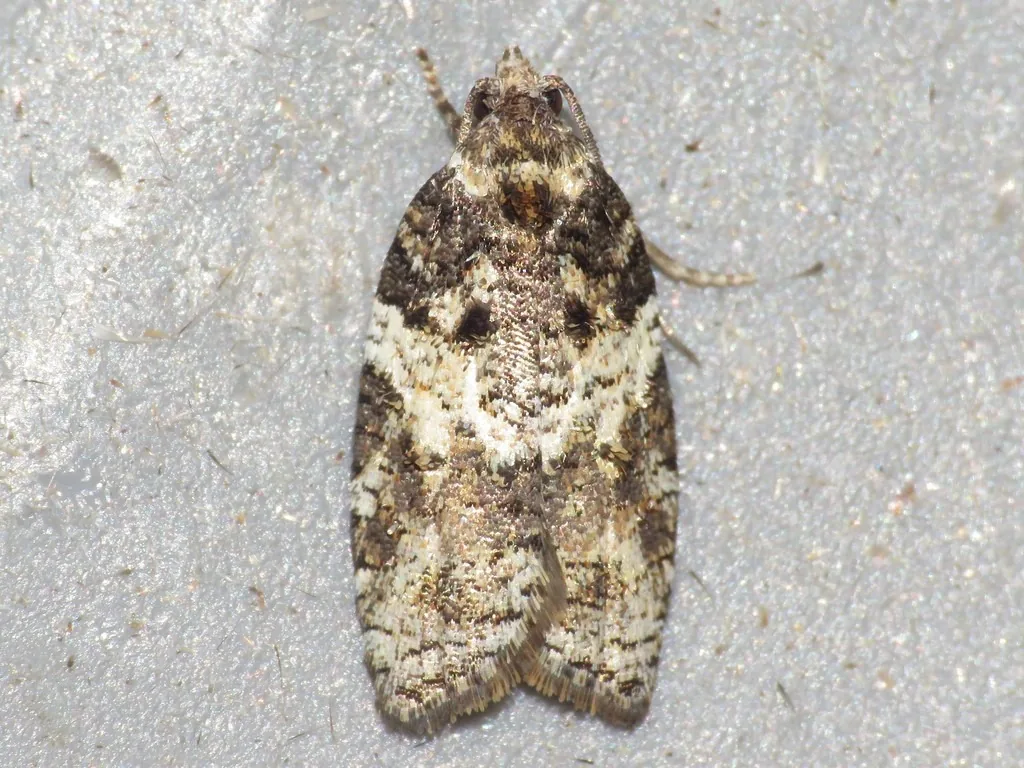
- The adults are so variable that the species name, variana, refers to it. Some are plain gray with a lighter band across the middle of the forewing; others are ocher with bands and mottled markings.[1]
- Near maturity the caterpillar lives in a shelter of needles webbed together on the new shoots.[2][1]
Look-alikes
| Look-alike | How to tell them apart |
|---|---|
| Eastern spruce budworm | The spruce budworm feeds on the same fir and spruce stands, and outbreaks of the two often happen at the same time, which makes it hard to tell which insect caused the damage.[1] |
| Hemlock looper | Hemlock looper outbreaks can also hit the same stands at the same time.[1] |
| Western blackheaded budworm | Western populations, once thought to be the same species, are now treated as a separate species, Acleris gloverana, whose host in the west is western hemlock rather than balsam fir.[1] |
Where it lives
It lives in spruce-fir forests across Canada east of the Rocky Mountains to Newfoundland and Labrador, and in similar forests in the northeastern United States. Serious outbreaks happen mostly in the moist maritime forests of Atlantic Canada where balsam fir dominates.[1]
Biology and life cycle
The main hosts are balsam fir and white spruce. Red spruce, black spruce, larch and eastern hemlock can also be hosts.[1][2]
There is one generation a year. From late summer to early fall, females lay oval eggs one at a time on the undersides of needles at branch tips in the upper crown and cover each with a tuft of scales from the abdomen. The egg spends the winter on the needle.[1][2]
Eggs hatch in May to early June and the larvae bore into the buds. As the shoots flush, they chew needles off at the base and web them together into a compact feeding shelter; late in their development they feed more openly, and at high densities they also eat older needles.[1]
The larvae pupate in their last shelter in late August, and the moths fly through September. Females attract males with a sex pheromone, and the moths can disperse long distances, which helps explain why outbreaks are short.[1]
The main component of the sex pheromone has been identified as (E)-11,13-tetradecadienal, which alone was very attractive to males in traps.[3]
Damage and signs
- Defoliation appears suddenly. The first sign is a red tinge on the outer branches of the upper crown, caused by needles the larvae cut loose to build their shelters; it is more obvious on balsam fir than on spruce.[1]
- Trees seldom die unless heavy defoliation lasts more than two years or comes on top of another defoliator such as the spruce budworm. Outbreaks are confined to mature stands, where they can cause some top-kill and a temporary slowdown in growth; unlike its western relative, it does not seriously damage young stands.[1]
- In Europe, a 2019 plant-health review listed it among nine non-European Acleris species reported as pests and found that these non-European species meet the criteria for quarantine pests in the European Union.[4]
Health risk
These forestry sources treat it only as a defoliator of conifers and do not mention any harm to people.[1][2]
Control
Prevention
Monitoring relies on sampling eggs and on pheromone traps for the moths.[1][3]
Biological control
Parasitic insects and generalist predators such as ants and migratory songbirds attack it, and their delayed, combined effect is thought to bring each outbreak to an end.[1]
Pesticides
Because defoliation is brief and mature trees rarely die, Natural Resources Canada says large-scale pesticide applications are hard to time and usually unnecessary.[1]
Common questions
- Why are the tops of my fir trees turning red in early summer?
- A sudden red tinge on the outer branches of the upper crown is the first sign of eastern blackheaded budworm feeding, caused by needles the larvae cut loose for their shelters. Other defoliators such as the spruce budworm can be in the same stands.[1]
- Does the eastern blackheaded budworm kill trees?
- Rarely. Tree death is uncommon unless heavy defoliation lasts more than two years or happens alongside other defoliators such as the spruce budworm.[1]
Sources
- Natural Resources Canada, Canadian Forest Service, “Eastern blackheaded budworm (V. G. Nealis), Trees, insects and diseases of Canada's forests.” tidcf.nrcan.gc.ca/en/insects/factsheet/11941 (accessed 2026-11-09)
- USDA Forest Service FHTET and Connecticut Agricultural Experiment Station (hosted by the University of Georgia Center for Invasive Species and Ecosystem Health), “Eastern Blackheaded Budworm (Acleris variana), from Caterpillars on the Foliage of Conifers in the Northeastern United States, FHTET-2004-01 (C. T. Maier et al., 2004), Bugwood wiki archive.” wiki.bugwood.org/Archive:Caterpillars/Eastern_Blackheaded_Budworm_(Acleris_variana) (accessed 2026-11-09)
- Journal of Chemical Ecology (via NCBI PubMed), “(E)-11,13-tetradecadienal: major sex pheromone component of the eastern blackheaded budworm, Acleris variana (G. Gries et al.; Journal of Chemical Ecology 20(1): 1-8, 1994; abstract).” pubmed.ncbi.nlm.nih.gov/24241694/ (accessed 2026-11-09)
- EFSA Journal (via NCBI PubMed), “Pest categorisation of non-EU Acleris spp. (EFSA Panel on Plant Health; EFSA Journal 17(10): e05856, 2019; abstract).” pubmed.ncbi.nlm.nih.gov/32626141/ (accessed 2026-11-09)
- iNaturalist, “Acleris variana taxon page (order and family).” www.inaturalist.org/taxa/212353 (accessed 2026-11-09)