On this page
How to identify it
- Long legs, a round head and an abdomen that tapers to a point; many species have patterned wings or bodies.[3][2]
- Biting Symphoromyia snipe flies are medium to large, about 3/10 to 3/5 inch (8 to 15 mm) long. The thorax is brown, gray or black with yellow or orange markings, and the abdomen is gray, black, or black and yellow.[2]
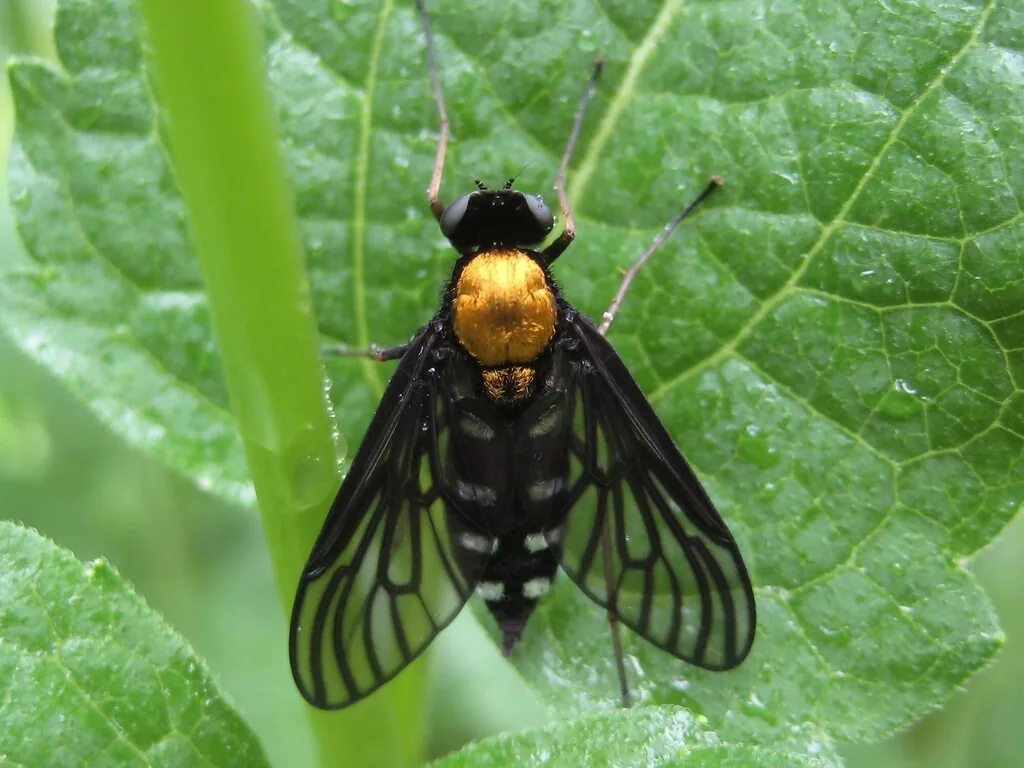
- The golden-backed snipe fly of eastern wetlands is about half an inch long, with a gold thorax, white chevrons on the abdomen and smoky, patterned wings; males have much larger eyes than females. Rhagio snipe flies are brownish with spotted wings and are called down-looker flies for their head-down perch.[3]
- Snipe flies fly slowly and often run off on foot when disturbed.[3]
Look-alikes
| Look-alike | How to tell them apart |
|---|---|
| Deer flies | Deer flies are close relatives of the biting snipe flies and feed in a very similar way. Colorado State covers both as daytime biters.[1][2] |
| Crane flies | Crane flies also have long legs. A snipe fly has a round head and a tapering abdomen and often rests head-down on a leaf.[3] |
| Stable fly | Another daytime biter, but it looks like a house fly; Colorado State's biting-fly guide covers both.[2] |
Where it lives
Snipe flies occur in both the East and the West. Biting Symphoromyia species live near forested areas at higher elevations, as in Colorado, and have been studied in California; some species bite people in parts of the eastern US as well. The golden-backed snipe fly lives around wetlands east of the Great Plains. GBIF holds about 27,000 US records of the family since 1990 from 43 states, counting the District of Columbia, most from Ohio, Virginia and New York.[1][2][3][5][8]
Biology and life cycle
Adults have piercing mouthparts that they use either to prey on other insects, mainly smaller flies, or to take a blood meal from vertebrates. The golden-backed snipe fly takes aphids and other small insects.[3]
Symphoromyia females feed on mammal blood during the day. They bite bison heavily in summer after the bison shed their winter coats, and also feed on deer, cattle, horses, dogs and people.[1][2][3]
Studies with traps baited with carbon dioxide found several Symphoromyia species that were host specific for Columbian black-tailed deer, and trap catches mirrored the flies caught attacking the deer.[6]
In Italy, a Symphoromyia snipe fly caught while feeding on a person was carrying a mammal chewing louse on its legs, the first record of a louse hitching a ride on a snipe fly.[7]
Larvae are predators. Most live in moist soil, moss, rotting wood or decaying plant matter; a few are aquatic, and some western larvae dig cone-shaped pits in loose soil to trap insects, like antlions. Little is known about the life cycle of the biting species.[1][2][3]
Damage and signs
Health risk
Colorado State says Symphoromyia bites usually land on the face, neck and hands and are painful, and droplets of blood can pool at the bite. A severe allergic reaction to Symphoromyia bites in one person was reported in the Journal of Medical Entomology in 1979. Only some snipe fly species bite people.[2][4][3]
Control
Keep them out
Keep door and window screens in good repair, or keep doors and windows shut, since these flies sometimes come indoors.[2]
Sanitation
Colorado State also recommends clearing possible development sites such as garbage, rotting fruit, animal waste and carcasses from around the home.[2]
Traps and physical control
Sticky fly-paper ribbons can catch the few that get inside.[2]
Pesticides
Colorado State says chemical control usually isn't necessary for Symphoromyia.[2]
Where sources disagree
Which animals they bite: Colorado State lists bison, deer, cattle, horses, dogs and people as Symphoromyia hosts, while carbon dioxide trap studies found several Symphoromyia species host specific for black-tailed deer. Both can be true, since different species in the genus differ.[2][6]
Where people get bitten: Colorado State places the biting species near forests at higher elevations, while the UW-Milwaukee Field Station says females of some species bite people in the West and in parts of the eastern United States.[1][2][3]
Common questions
- What fly bit me in the mountains and left a drop of blood?
- In western high country it may have been a Symphoromyia snipe fly. They feed by day, often on the face, neck or hands, and blood can pool at the bite.[1][2]
- Are snipe flies dangerous?
- Bites can be painful, and a severe allergic reaction has been reported in one case. Many snipe flies hunt insects instead, and only some species bite people.[2][4][3]
- Do I need to spray for snipe flies?
- Colorado State says chemical control usually isn't necessary; screens, closed doors and fly paper deal with the few that come inside.[2]
Sources
- Colorado State University Extension, “Biting Flies, Fact Sheet.” extension.colostate.edu/resource/biting-flies/ (accessed 2026-11-11)
- Colorado State University Agricultural Biology, “Biting flies (IPM pests).” agsci.colostate.edu/agbio/ipm-pests/biting-flies/ (accessed 2026-11-11)
- University of Wisconsin-Milwaukee Field Station, “Snipe Fly (Family Rhagionidae), Bug of the Week (K. Redmond, 'the BugLady').” uwm.edu/field-station/bug-of-the-week/snipe-fly/ (accessed 2026-11-11). University field station's natural-history column
- Journal of Medical Entomology, via PubMed, “A case of severe human allergic reaction to bites of Symphoromyia (Diptera: Rhagionidae) (Turner 1979).” pubmed.ncbi.nlm.nih.gov/448692/ (accessed 2026-11-11). Short case note; cited from the PubMed record (title).
- Proceedings and Papers of the California Mosquito Control Association, via PubMed, “Snipe flies (Symphoromyia) attacking man and other animals in California (Hoy and Anderson 1966).” pubmed.ncbi.nlm.nih.gov/5964229/ (accessed 2026-11-11). Cited from the PubMed record (title).
- Journal of Medical Entomology, via PubMed, “Contributions of CO2-baited Malaise-type traps to the knowledge of hematophagous and oestrid flies parasitizing cervid hosts (Anderson 2022).” pubmed.ncbi.nlm.nih.gov/35863983/ (accessed 2026-11-11). Cited from the PubMed abstract.
- Journal of Insect Science, via PubMed, “First report of phoresy on snipe flies: the chewing louse Damalinia meyeri on Symphoromyia immaculata (Romiti et al. 2026).” pubmed.ncbi.nlm.nih.gov/41531199/ (accessed 2026-11-11). Cited from the PubMed abstract.
- Global Biodiversity Information Facility (GBIF), “Rhagionidae: US occurrence records since 1990 by state (GBIF occurrence search API).” api.gbif.org/v1/occurrence/search?taxonKey=5587&country=US&hasGeospatialIssue=false&occurrenceStatus=PRESENT&year=1990%2C2026&facet=stateProvince&facetLimit=400&limit=0 (accessed 2026-11-11). State counts are records reported (iNaturalist research-grade, museum specimens, surveys), not abundance.
- iNaturalist, “Rhagionidae taxon page (order and family).” www.inaturalist.org/taxa/60470 (accessed 2026-11-11)