On this page
How to identify it
- Caterpillars are banded black and white when young and yellow and black as they mature, with a reddish-orange head and two pairs of reddish-orange prolegs. They move like inchworms, arching the back, and reach about 1 inch (25 mm).[1][2]
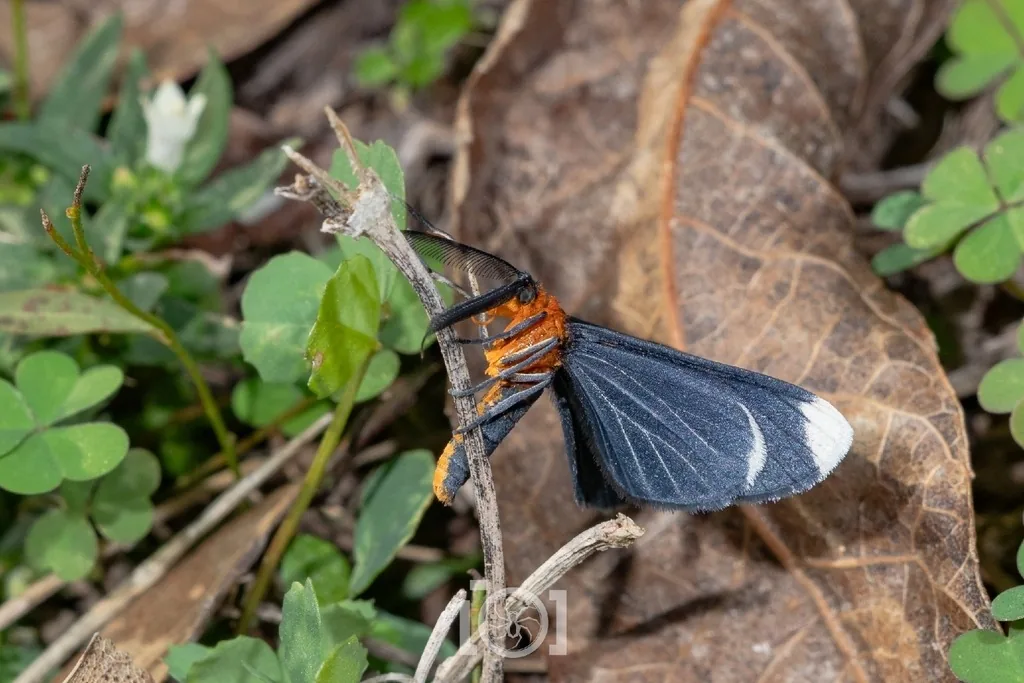
- The adult is a day-flying moth with black or dark brown wings, usually with a white or yellow patch at each forewing tip, and a rusty brown to orange thorax. Wingspread is a little over 1 inch.[1][2]
- Both sexes have feathery antennae, and males have a tuft of rusty orange hairs at the tip of the black abdomen.[1]
- Eggs are tiny (about 0.7 mm), oval, salmon-colored to yellow with a pebbled surface, laid one at a time where a leaf stalk meets the stem.[1][2]
Look-alikes
| Look-alike | How to tell them apart |
|---|---|
| Cankerworms and other inchworms | Look for the snowbush spanworm's bold yellow-and-black (or black-and-white) bands, reddish-orange head, and its habit of feeding in groups on snowbush.[1] |
Where it lives
Ranges from the southern part of North America through South America and the Lesser Antilles, and is found across the southern United States, including Florida and Texas. It has been found as far north as Wisconsin, well outside its usual range.[1][2]
Biology and life cycle
Eggs hatch in about six days. The caterpillars molt about six times, start feeding at the top of the shrub and work their way down, and finish growing in up to 18 days.[1][2]
They pupate in the leaf litter or soil under the plant, or in leaves webbed together on the shrub, in a loose cocoon. The brown pupa is about 3/8 inch long, and the moth emerges in up to a week.[1][2]
Females release a pheromone that draws males. In Florida the moths have been collected in every month, so caterpillars can be active year-round, and repeated generations can hit the same hedge.[1][2]
Snowbush (Breynia) is the main host in Florida. Otaheite gooseberry, snow-on-the-mountain and a few other plants have also been recorded as hosts.[1][2]
Damage and signs
- Large numbers can defoliate snowbush. Once the leaves are gone, the caterpillars may chew the bark off the twigs, damage that looks like rabbit feeding, and this can girdle stems so the leaves above them die.[1][2]
- Snowbush is a vigorous grower and usually recovers with little or no help, but badly stripped shrubs can take a month or more to recover and may look poor for several months. In a 2005 outbreak in Collier County, Florida, many 3- to 5-foot hedges were stripped.[1][2]
Health risk
The colorful caterpillars may look alarming, but they pose little risk to people.[1]
Control
Prevention
Plant a mix of shrubs rather than a solid snowbush hedge, or choose shrubs that are not hosts; a monoculture of snowbush risks extensive damage in an outbreak.[1]
Traps and physical control
Hand-pick caterpillars, or prune off the tips of heavily infested branches as soon as chewing starts, before the caterpillars spread through the shrub. After an outbreak, cut girdled stems back below the damage to encourage regrowth.[1][2]
Pesticides
If treatment is needed, Bacillus thuringiensis (Bt) controls the caterpillars well; chlorantraniliprole and spinosad also work. Follow the label, and do not use caterpillar insecticides in a pollinator garden where you want other caterpillars to survive.[1]
Common questions
- Will my snowbush hedge die?
- Usually not. Snowbush is a vigorous grower and generally recovers, though stems girdled by bark feeding may die back and need pruning, and stripped shrubs can take a month or more to recover.[1]
- Are the black moths with white wing tips harmful?
- No. The white-tipped black is the day-flying adult of the snowbush spanworm, and the moths can be an attractive addition to a pollinator garden.[1]
Sources
- University of Florida/IFAS Extension (Featured Creatures), “Snowbush spanworm (larva), white-tipped black (adult), Melanchroia chephise (Stoll), EENY-812 (K. McCormick and A. Dale; May 2024).” journals.flvc.org/edis/article/view/127464 (accessed 2026-11-09)
- Florida State Horticultural Society (Proceedings), “Caterpillar outbreaks: defoliation by the royal poinciana caterpillar (Melipotis acontioides) and the snowbush caterpillar (Melanchroia chephise) in Naples, Florida (D. L. Caldwell; Proc. Fla. State Hort. Soc. 120:360-362, 2007).” journals.flvc.org/fshs/article/view/86254 (accessed 2026-11-09)
- iNaturalist, “Melanchroia chephise taxon page (order and family).” www.inaturalist.org/taxa/321697 (accessed 2026-11-09)