On this page
How to identify it
- The caterpillar is highly variable: red, pink, brown or tawny tinged with rose, and heavily speckled with tiny ivory-white granules, often with a faint blackish stripe along the side. The head is orange-brown.[2][3]
- Two long, curved, black spiny horns stand on the second thoracic segment, and the spines along the back of the abdomen are much longer than on other eastern oakworms; the rest of the spines point backward.[2][3]
- Full-grown caterpillars are about 1.5 to 2 inches (38 to 50 mm) long.[3]
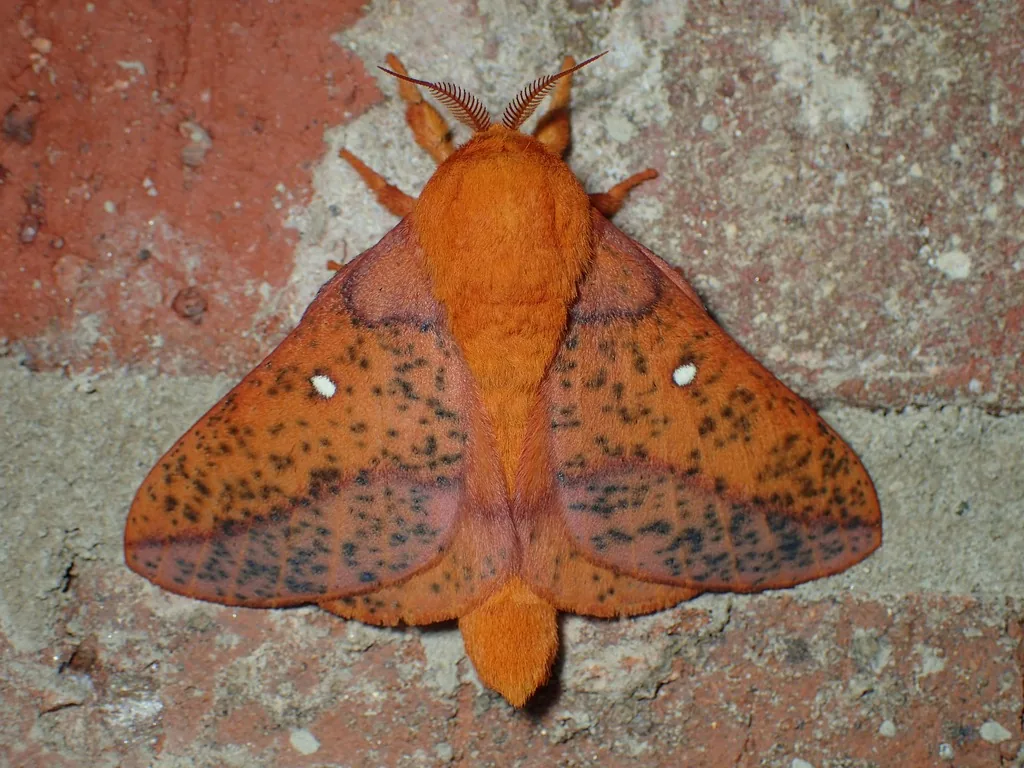
- The adult is a royal moth about 2 inches across (Ohio gives 1.6 to 2.8 inches). Its forewings resemble the orangestriped oakworm moth's but are darker and more heavily speckled, with the outer part often tinged lilac.[3][1]
Look-alikes
| Look-alike | How to tell them apart |
|---|---|
| Orangestriped oakworm (Anisota senatoria) | Caterpillar charcoal black with orange-yellow stripes and a black head, and its abdominal spines are relatively small.[2] |
| Pink-striped oakworm (Anisota virginiensis) | Caterpillar has broad pink to red stripes along the back and lower sides, finely speckled white, and shorter abdominal spines than the spiny oakworm.[2] |
| Large-eyed oakworm (Anisota fuscosa) | A related species found in Louisiana and Texas.[2] |
Where it lives
Southern Canada and New England south to Georgia and west to Kansas. It is most abundant in oak forests and other oak-dominated habitats and less common in towns with large oaks; in Ohio it is most common in the south and in the Oak Openings region west of Toledo.[3][1]
Biology and life cycle
There is one generation a year. The Forest Service gives adults in June and July; caterpillars are reported from July into the fall (July to September in Eastern Forest Insects, August to November in Caterpillars of Eastern Forests).[3][2]
Young caterpillars feed in groups and become solitary in the later stages. When grown they go into the ground to pupate without spinning a cocoon, and the winter is spent there as a pupa.[2][3]
Populations go through boom and bust cycles for reasons that are not well understood.[1]
Damage and signs
- The caterpillars eat oak leaves, and hazelnut is also a preferred host; Ohio also reports basswood.[2][3][1]
- Groups can be numerous enough to defoliate young trees, but the trees normally suffer no lasting damage because the caterpillars do not stay abundant in one place for long. The species is normally not very abundant, though outbreaks covering hundreds of acres have been recorded.[1][3]
Health risk
The sources describe the spiny oakworm only as a leaf feeder on oaks and hazelnut and do not report stings or other effects on people.[1][2][3]
Control
Prevention
Control is usually unnecessary: outbreaks are short-lived in any one place, and defoliated trees normally suffer no lasting damage.[1]
Common questions
- What are the pinkish spiny caterpillars eating my oak in late summer?
- Likely spiny oakworms. They are tawny to pink with white specks, two long black horns near the front and long back spines, and they feed in groups on oak leaves.[2][3][1]
- Will spiny oakworms kill my oak?
- Normally not. They can strip young trees in an outbreak year, but Ohio DNR says the trees normally suffer no lasting damage.[1]
- How is it different from the orangestriped oakworm?
- The orangestriped oakworm is black with orange-yellow stripes and short spines; the spiny oakworm is reddish to tawny, speckled white, with much longer back spines.[2]
Sources
- Ohio Department of Natural Resources, Division of Wildlife, “Moths of Ohio Field Guide (Publication 5467).” dam.assets.ohio.gov/image/upload/ohiodnr.gov/documents/wildlife/backyard-wildlife/Moths%20of%20Ohio%20Field%20Guide%20pub5467.pdf (accessed 2026-11-10)
- USDA Forest Service, Forest Health Technology Enterprise Team, “Caterpillars of Eastern Forests, FHTET-96-34 (D. L. Wagner, V. Giles, R. C. Reardon and M. L. McManus, November 1997; scanned copy).” archive.org/details/caterpillarsofea001997 (accessed 2026-11-10)
- USDA Forest Service, “Eastern Forest Insects, Miscellaneous Publication 1175 (W. L. Baker, 1972; scanned copy).” archive.org/details/easternforestins1175bake (accessed 2026-11-10)
- iNaturalist, “Anisota stigma taxon page (order and family).” www.inaturalist.org/taxa/81585 (accessed 2026-11-10)