On this page
How to identify it
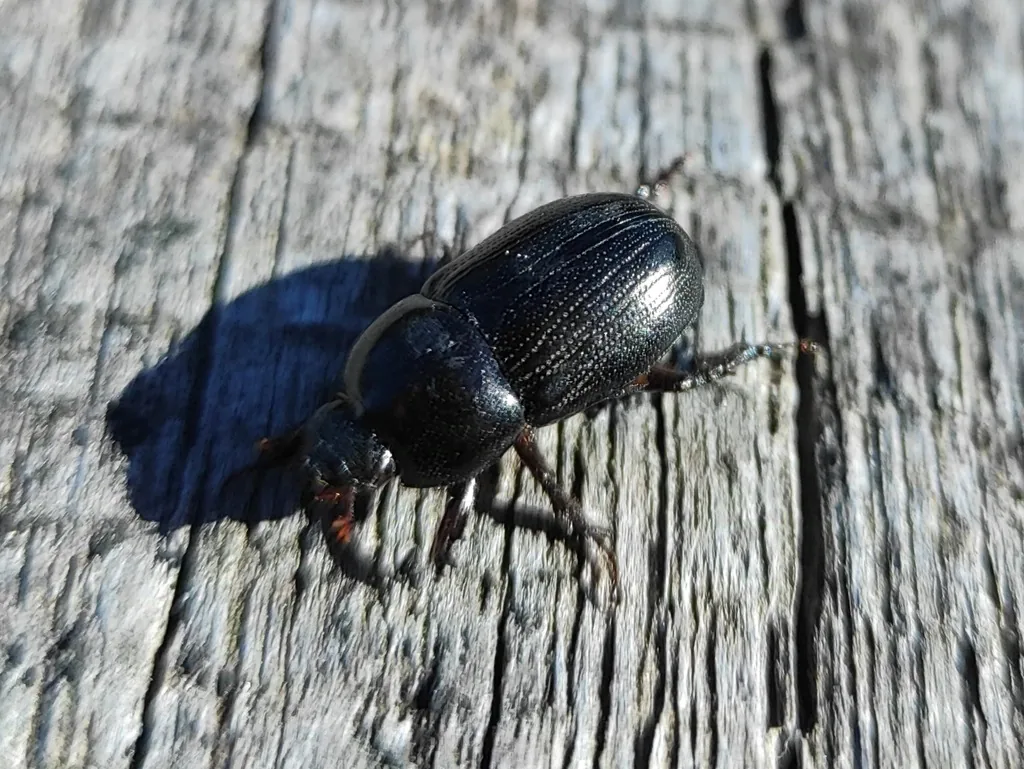
- Adults are dull black, about 1/2 to 0.6 inch long, with lengthwise grooves of small punctures along the wing covers.[1][2]
- The front legs have strong serrations for digging.[2]
- Larvae are C-shaped white grubs with red-orange or reddish-brown heads, up to about 1 1/4 inches; the hair pattern under the tail separates them from masked chafer grubs.[1][2]
Look-alikes
| Look-alike | How to tell them apart |
|---|---|
| Masked chafers | Their grubs look similar; sugarcane beetle larvae are usually in the soil earlier in the year, in May.[1] |
| White grubs | Unlike most white grubs, which do the damage as larvae, sugarcane beetles damage turf mainly as adults.[1] |
Where it lives
Once confined to the Southeast, it has spread north to Maryland, west into Texas and south into Florida.[1]
Biology and life cycle
Adults overwinter and are active from April to early June, when females lay eggs in soil; a female may lay 30 to 60 eggs.[1][2]
Grubs feed mostly on decaying plant matter from June to August; new adults appear from August or September and feed into October before overwintering.[1][2]
There is one generation a year, and adults are attracted to lights at night.[1][2]
Damage and signs
- Adults tunnel and feed on stems, roots and crowns, killing patches of turf; concentrations can exceed 50 beetles per square foot.[1][2]
- Adults drawn to building lights have damaged asphalt roofs, door gaskets and other soft materials.[2]
- It is also a long-standing pest of corn, sugarcane, sweet potato and rice.[1][2]
Health risk
Control
Prevention
Turn off unnecessary lights near lawns or switch to less attractive bulbs, and keep turf vigorous with appropriate fertilizer and infrequent, deep watering.[1][2]
Traps and physical control
After adults are controlled, core-aerate damaged bermudagrass or zoysia to encourage regrowth, or resod severe damage.[2]
Pesticides
Control targets the adults rather than grubs; pyrethroids applied late in the day as a thorough drench of the affected patch work best.[1][2]
Common questions
Sources
- NC State Extension, “Sugarcane Beetles in Turf (PDIC Factsheet).” content.ces.ncsu.edu/sugarcane-beetles-in-turf (accessed 2026-10-16)
- University of Georgia Cooperative Extension, “Sugarcane Beetle: An Emerging Insect Pest in Georgia Turfgrass (Circular 1257, reviewed July 2026).” fieldreport.caes.uga.edu/publications/C1257/sugarcane-beetle-an-emerging-insect-pest-in-georgia-turfgrass/ (accessed 2026-10-16)
- iNaturalist, “Euetheola humilis taxon page (order and family).” www.inaturalist.org/taxa/301485 (accessed 2026-10-06)