On this page
How to identify it
- The caterpillar is whitish with a brown head. In summer it has large brown spots on each body segment, each with a stout hair; the overwintering form lacks the spots. Full grown, it is about 1 inch long.[1][2]
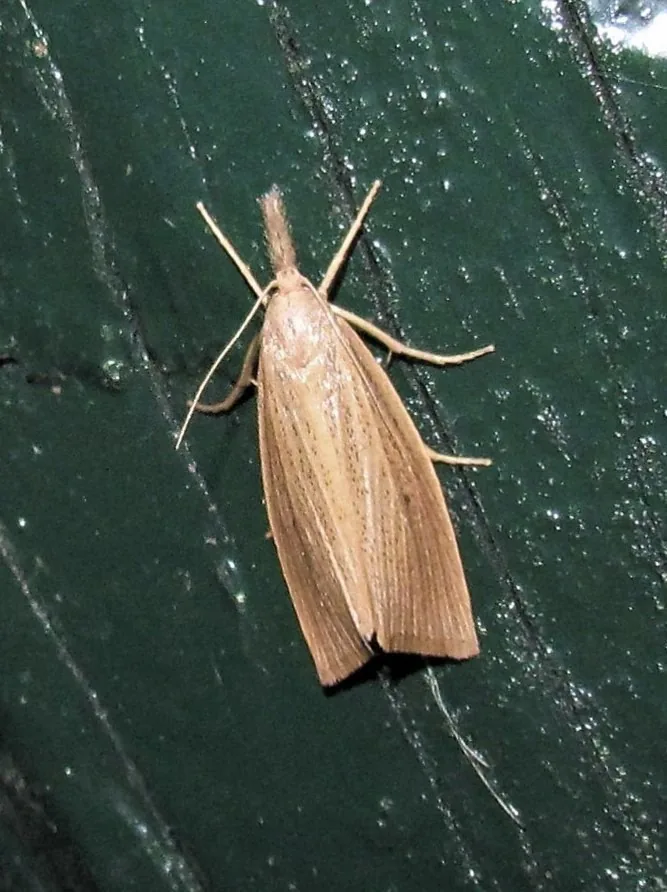
- The moth is straw-colored to yellowish brown, with numerous fine brown lines running the length of the forewing and, as Florida extension describes it, black dots in a V-shaped pattern. Its wingspan is about 3/4 to 1-1/2 inches; females are larger than males. The moths are active at night and seldom seen.[1][2]
- Eggs are flat and oval, laid in clusters that overlap like fish scales on the leaves. They are white at first, turn orange, then blackish just before hatching.[1]
- Signs in the plant: a row of tiny pin-holes straight across an unfurled leaf, small holes into the midribs, and holes in the stalk with fresh light-brown, fibrous frass.[2]
Look-alikes
| Look-alike | How to tell them apart |
|---|---|
| Southern cornstalk borer (Diatraea crambidoides) | Its caterpillars are easily confused with sugarcane borer and can only be told apart reliably by examining the mouthparts under a microscope. The southern cornstalk borer is much more likely to be the one found in corn.[1] |
Where it lives
Native to the warmer parts of the Americas but not to the United States. It apparently reached Louisiana about 1855 and spread to the warmer parts of the other Gulf Coast states; researchers have collected it in Texas, Louisiana and Florida. It also occurs through the Caribbean, Central America and warmer South America to northern Argentina.[1][4]
Biology and life cycle
It feeds on grasses. Sugarcane is the main host, but it also attacks corn, rice, sorghum and sudangrass, and wild grasses such as Johnsongrass.[1][2]
Florida extension estimates 200 to 300 eggs per female, laid in clusters on the leaves, often the undersides in the upper canopy; studies of borers reared on corn or sugarcane averaged about 700. Eggs hatch in 4 to 6 days.[2][1]
Newly hatched caterpillars move into the whorl or chew into a midrib or leaf sheath, then bore into the stalk after their first or second molt. They pupate inside the tunnel, and the moth leaves through an exit hole.[1][2]
It spends the winter as a caterpillar inside stalks, mainly of sugarcane. In Louisiana and Texas moths are active by April or May, and generations overlap until autumn; Florida extension reports up to six generations a year, each taking about 40 to 45 days in summer.[1][2]
Heavy rain, especially winter flooding, and cold winters reduce survival.[1]
Damage and signs
- Tunneling in sugarcane stalks reduces stalk weight, juice and sugar yield; bored internodes can produce 45% less sugar. Tops weaken or die and stalks break or fall over, and tunnels let in fungal, bacterial and other disease organisms.[1][2]
- In young plants the inner whorl dies, a condition called dead heart.[1][2]
- In corn, caterpillars first feed in the whorl, which can leave holes across the leaves or kill the growing point, then tunnel into the stalk, which may break, and sometimes into the ear. It is only a minor pest of sweet corn.[1]
Health risk
The sources describe it only as a crop pest; they mention no harm to people.[1][2]
Control
Prevention
Scout sugarcane every two or three weeks from March through November, checking leaves, the whorl and behind the leaf sheaths, and splitting stalks. Florida extension puts the economic threshold at about 2 to 3 live larvae per 100 stalks.[2]
Plant resistant sugarcane varieties and use seed pieces free of borer damage. Resistant grain corn varieties have also been identified.[2][1]
Sanitation
Destroy infested cane trash and stubble to reduce overwintering caterpillars; burning does not always kill borers deep in the stalks.[1][2]
Biological control
Fire ants and other ants are important predators in cane fields, and parasitic wasps such as Cotesia flavipes and Alabagrus stigmatera attack the caterpillars. Releases of Cotesia have controlled the borer well in Florida sugarcane. If half or more of sampled caterpillars are parasitized, insecticides are not recommended.[1][2]
Pesticides
Insecticides work best while caterpillars are young, before they tunnel into the stalk, though some control is possible later. In Louisiana, an integrated pest management program has cut the borer's impact on the sugarcane industry.[1][3]
Common questions
- What causes rows of tiny holes across sugarcane leaves?
- Young sugarcane borer caterpillars tunneling across the rolled leaves in the whorl leave a row of pin-holes that shows when the leaf unfurls. Infested stalks are usually nearby.[2]
- Is the sugarcane borer a problem in home gardens?
- It is mainly a pest of sugarcane and field crops. It is only a minor pest of sweet corn, even in Florida.[1]
Sources
- University of Florida/IFAS Extension (Featured Creatures), “Sugarcane Borer, Diatraea saccharalis (Fabricius), EENY-217/IN374 (J. L. Capinera, July 2001; archival copy).” journals.flvc.org/edis/article/view/110940 (accessed 2026-11-09)
- University of Florida/IFAS Extension, “Sugarcane Borer in Florida, ENY-666/SC011 (D. G. Hall, G. S. Nuessly and R. A. Gilbert; revised February 2007; archival copy).” journals.flvc.org/edis/article/view/116569 (accessed 2026-11-09)
- Journal of Economic Entomology (via NCBI PubMed), “Successful Integrated Pest Management Minimizes the Economic Impact of Diatraea saccharalis on the Louisiana Sugarcane Industry (B. E. Wilson et al.; Journal of Economic Entomology 114(1), 2021; abstract).” pubmed.ncbi.nlm.nih.gov/33247296/ (accessed 2026-11-09)
- PLoS ONE (via NCBI PubMed), “Geographic population structure of the sugarcane borer, Diatraea saccharalis, in the southern United States (A. L. Joyce et al.; PLoS ONE 9(10): e110036, 2014; abstract).” pubmed.ncbi.nlm.nih.gov/25337705/ (accessed 2026-11-09)
- iNaturalist, “Diatraea saccharalis taxon page (order and family).” www.inaturalist.org/taxa/330449 (accessed 2026-11-09)