On this page
How to identify it
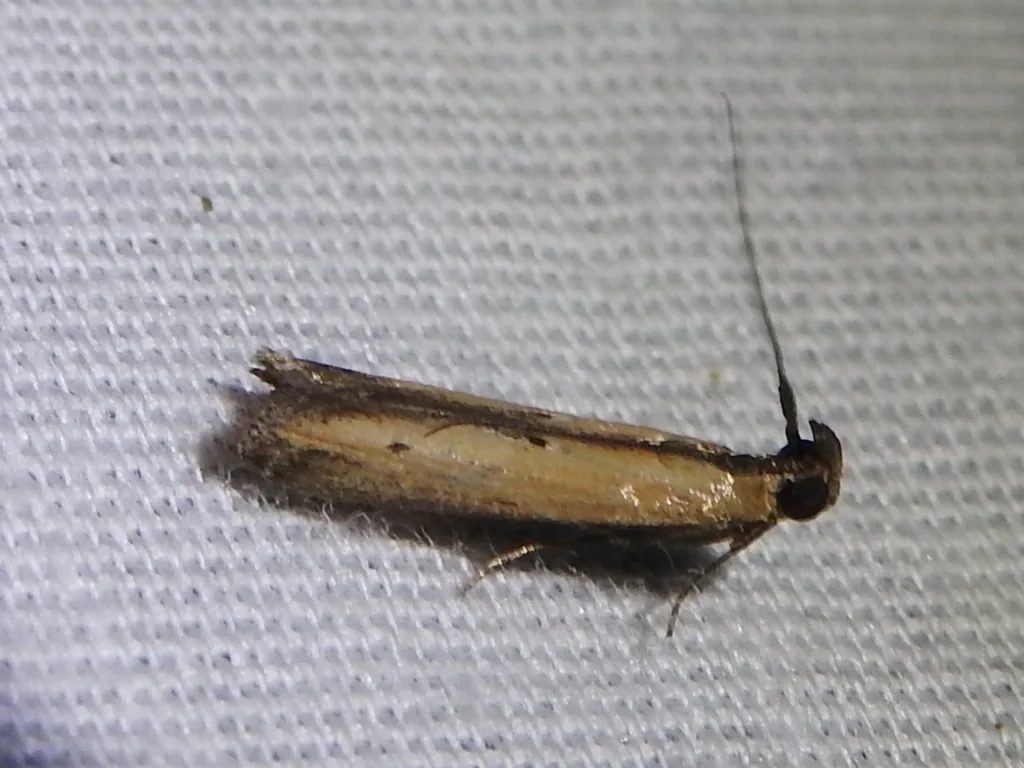
- Moths are about 1/2 inch long at rest (wingspan about 3/4 inch); males are lighter tan with a dark border, females dark brown to nearly black.[1][2]
- Grown caterpillars are bluish green with brownish rings or bands and yellowish-white stripes; UF gives about 5/8 inch long and NC State up to 7/8 inch.[1][2]
- Caterpillars wriggle violently when disturbed, earning the name jumping borer.[1]
- A small silk tube coated with sand at the base of the stem is the telltale sign.[1][2]
Look-alikes
Where it lives
Found across much of the southern United States, sporadically from Maine to southern California; damage is mostly in sandy soils of the coastal plain from South Carolina to Texas.[1][2]
Biology and life cycle
Moths fly from June to November, mostly at night in hot, humid, still weather; there are three to four overlapping generations a year in the Southeast.[1][2]
Females lay eggs on leaves, stems or soil near a host; caterpillars feed on leaves or roots, then build silk-lined burrows and bore into stems near the ground.[1][2]
A life cycle takes about 30 to 60 days, and it overwinters as a larva or pupa.[1][2]
Damage and signs
Health risk
Control
Prevention
Water frequently: moist soil discourages egg laying and favors fungi that kill the caterpillars; mulching may also help.[1][2]
Check by pulling small plants; UF suggests treatment if live larvae or pupae are on about 10 percent of plants.[1]
Pesticides
Landscape-labeled systemic insecticides such as imidacloprid applied as granules and watered in reach borers better than sprays.[2]
Common questions
- Why are my plants wilting in sandy soil during a drought?
- The lesser cornstalk borer is a common cause; look for sand-covered silk tubes at the stem base.[1][2]
- How do I prevent it?
- Keep the soil irrigated and mulched.[1][2]
- Does it attack ornamental grasses?
- Yes, including Miscanthus in dry, sandy sites.[2]
Sources
- University of Florida IFAS Extension (EDIS, Featured Creatures), “Lesser Cornstalk Borer, Elasmopalpus lignosellus (Zeller) (EENY-155).” ask.ifas.ufl.edu/publication/IN312 (accessed 2026-10-16)
- NC State Extension, “Lesser Cornstalk Borer in Ornamental Plants (PDIC Factsheet).” content.ces.ncsu.edu/lesser-cornstalk-borer-in-ornamental-plants (accessed 2026-10-16)
- iNaturalist, “Elasmopalpus lignosella taxon page (order and family).” www.inaturalist.org/taxa/1252809 (accessed 2026-10-06)