On this page
How to identify it
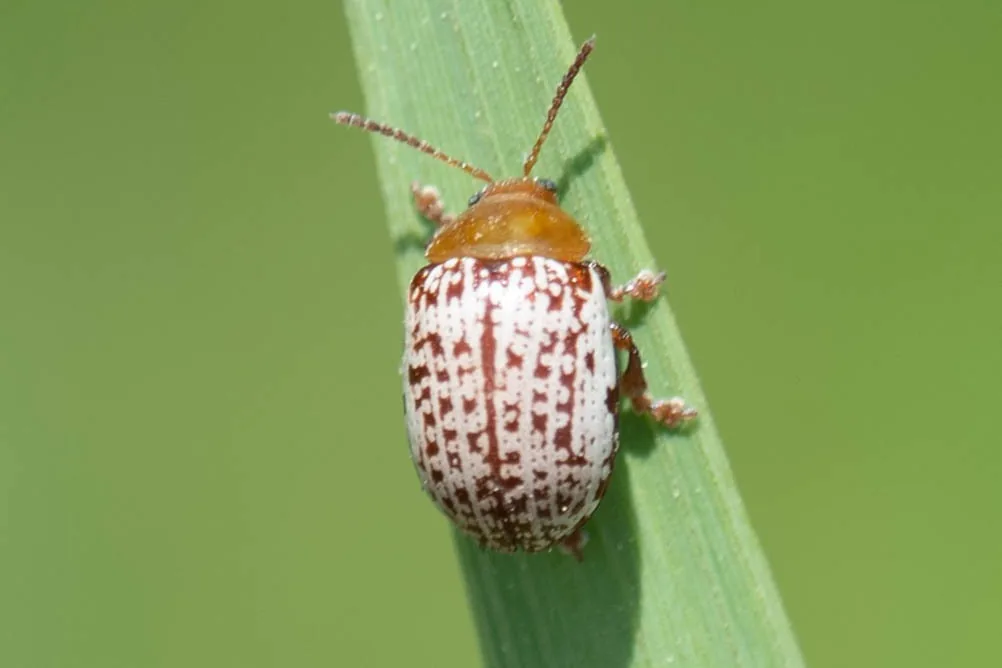
- Adults are about 1/4 inch long with cream wing covers marked by irregular, wavy reddish patterns, and an orange head and thorax; the pattern varies from beetle to beetle. They jump using their well-developed hind legs.[1][2]
- Larvae grow to about 1/4 inch and carry a pile of dark fecal particles on their backs, often near the head. Utah State describes them as yellow with pale stripes and black heads, and Colorado State as grayish, cylindrical and slightly shiny.[1][2]
- Eggs are laid in small groups on the twigs and covered with a paste of excrement.[2][1]
Look-alikes
| Look-alike | How to tell them apart |
|---|---|
| Calligrapha leaf beetles | Some Calligrapha species, found on willow, rose, and Ambrosia, Coreopsis and Bidens, are about the same size and shape, but their back pattern differs and they can't jump.[2] |
Where it lives
Colorado State reports it widely distributed in Colorado wherever its host, skunkbrush sumac, grows, and Utah State covers it on skunkbush, smokebush and sumac.[2][1]
Biology and life cycle
Hosts include skunkbush (skunkbrush) sumac, Rhus trilobata, other sumacs, and smokebush.[1][2]
Adults spend the winter outdoors in sheltered spots. In spring, shortly after bud break, they move onto the host, feed on the expanding growth, and lay their egg masses on the twigs.[1][2]
Larvae feed in small groups on the new leaves from about mid-May into early June, then crawl down to the soil to pupate. New adults appear in about two weeks, by early summer, and keep feeding on the leaves through September.[1][2]
There is one generation a year.[1][2]
The larvae's fecal shields contain toxins derived from the sumac, and they protect the larvae well against ants and many other predators; the mother's fecal coating protects the eggs the same way.[2]
Damage and signs
Health risk
Utah State and Colorado State describe it only as a leaf feeder on sumac, skunkbush and smokebush and mention no risk to people or pets.[1][2]
Control
Prevention
Keep plants healthy; Utah State notes that pesticides are not typically needed for this beetle.[1]
Pesticides
Check the leaves for young larvae in mid- to late May. If treatment is warranted, Utah State lists Bacillus thuringiensis, spinosad, carbaryl or a pyrethroid applied to branches and leaves just after the eggs hatch, while the larvae are young.[1]
Common questions
- What are the small cream-and-red beetles that jump off my skunkbush sumac?
- Cream-colored beetles about 1/4 inch long with wavy reddish markings and an orange head and thorax, which jump with their well-developed hind legs, are sumac flea beetles.[1][2]
- Why are the larvae on my sumac covered in dark gunk?
- Sumac flea beetle larvae pile their own droppings on their backs as a shield. It contains toxins from the sumac and protects them from ants and many other predators.[2][1]
- Do I need to spray?
- Usually not; Utah State says pesticides are not typically needed. If larvae are heavy, Utah State times treatment to just after egg hatch, to hit the young larvae.[1]
Sources
- Utah State University Extension, Integrated Pest Management, “Sumac Flea Beetle (Ornamental Pest Guide).” extension.usu.edu/planthealth/ipm/ornamental-pest-guide/arthopods/leaf-beetles-weevils/sumac-flea-beetle.php (accessed 2026-11-08)
- Colorado State University, “Colorado Insect of Interest: Sumac Flea Beetle.” webdoc.agsci.colostate.edu/bspm/Hexapoda%20(Insects)/Sumac%20Flea%20Beetle.pdf (accessed 2026-11-08)
- iNaturalist, “Blepharida rhois taxon page (order and family).” www.inaturalist.org/taxa/215269 (accessed 2026-11-08)