On this page
How to identify it
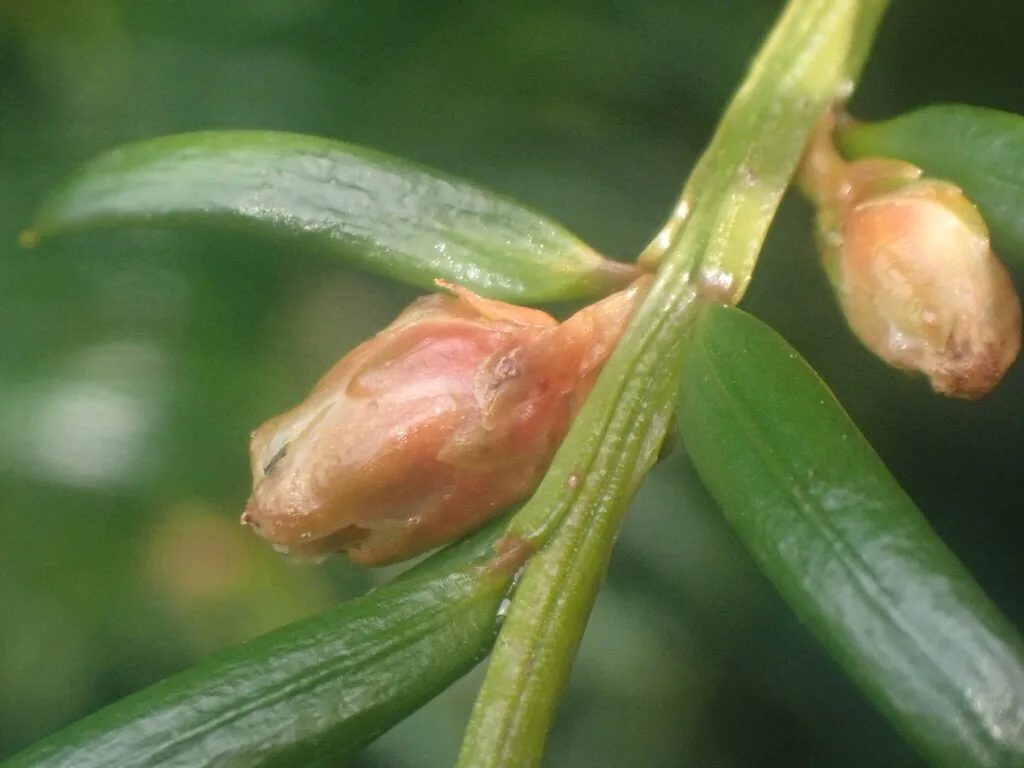
- The giveaway is enlarged, swollen buds that may wither and drop ("blast") or fail to grow in spring; lighter infestations distort the new needles and shoots.[1][2]
- The mites themselves need magnification: under a dissecting microscope the larvae are tiny and white or translucent, the nymphs a little larger, and the adults orange-brown.[1]
Look-alikes
| Look-alike | How to tell them apart |
|---|---|
| Gall mites | Taxus bud mite belongs to the same group of eriophyid mites as the gall mites on other trees and shrubs, but it lives hidden inside yew buds.[1] |
Where it lives
Common in several northeastern states and widespread in Europe; it also occurs on Pacific yew in British Columbia, where it was probably introduced from English yew.[1]
Biology and life cycle
The mites pass through egg, larva, nymph and adult stages and overwinter between the bud scales; as many as 1,000 may live in a single bud.[1][2]
Feeding and reproduction pick up by late summer and fall, when damage peaks, and the mites move into the new buds that form in summer.[1][2]
In a British Columbia study on Pacific yew, mite numbers were high from May to August, peaked in June and were lowest in March and October.[1]
Damage and signs
Health risk
It feeds only on yew; neither source reports any harm to people or pets.[1][2]
Control
Prevention
Check buds for swelling or decay; seeing the mites or their eggs requires magnification.[1]
Traps and physical control
Prune out and destroy infested branches.[1]
Biological control
Predatory mites, including phytoseiid mites, are among its natural enemies, and predation and cool temperatures may keep numbers low in early spring and fall.[1]
Pesticides
UMass lists products including horticultural oil and abamectin for bud mites on yew; follow the label.[1]
Common questions
- Why are the buds on my yew swollen?
- Enlarged buds that later wither, drop or put out distorted needles are typical of taxus bud mite; the mites can only be seen with magnification.[1][2]
- Can taxus bud mites kill my yew?
- They kill infested buds, and heavily infested buds won't grow in spring, but the sources describe damage to buds, needles and shoots rather than to the whole plant.[1][2]
Sources
- UMass Extension Landscape, Nursery and Urban Forestry Program (Landscape Insect & Mite Guide), “Cecidophyopsis psilaspis (Taxus Bud Mite).” www.umass.edu/agriculture-food-environment/landscape/publications-resources/insect-mite-guide/cecidophyopsis-psilaspis (accessed 2026-10-17)
- University of Kentucky Entomology, “Common Insect Pests of Yew/Taxus (Tree Pest Guide).” uky.edu/Ag/Entomology/treepestguide/taxus.html (accessed 2026-10-17)
- iNaturalist, “Cecidophyopsis psilaspis taxon page (order and family).” www.inaturalist.org/taxa/871656 (accessed 2026-10-06)