On this page
How to identify it
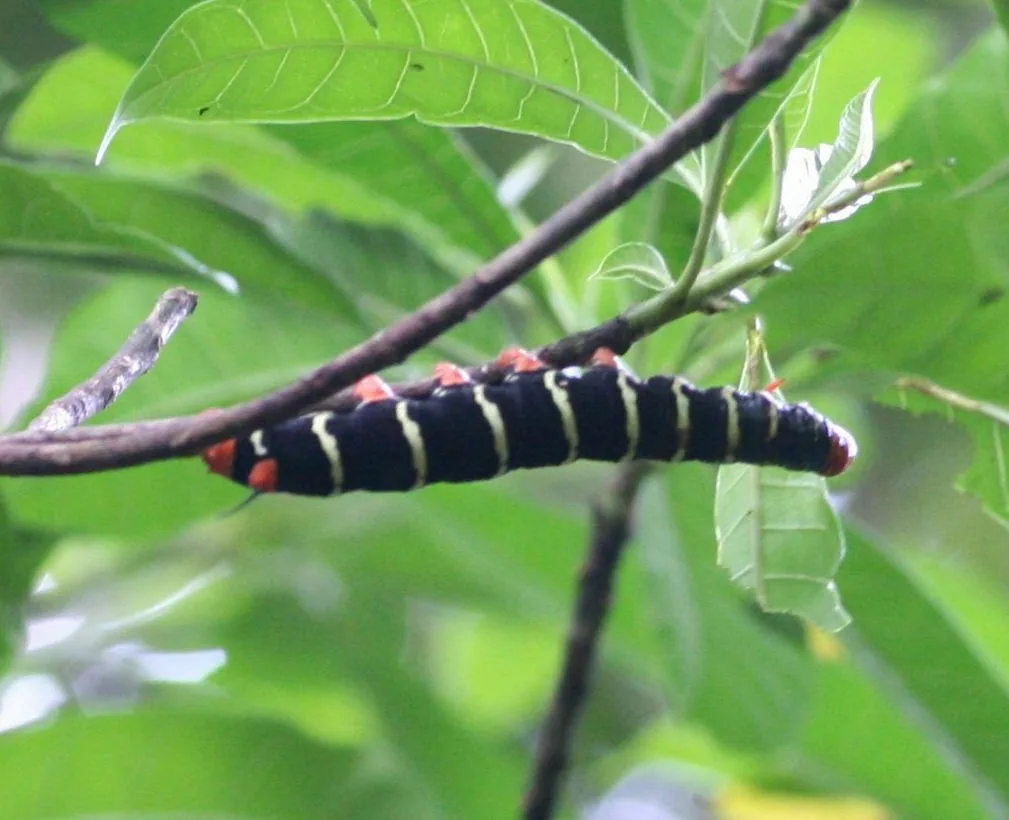
- Caterpillars are velvety black with yellow rings and a reddish-orange head, and they grow up to 6 inches long. The legs are orange with black spots.[1]
- The caterpillar has a black 'horn' near the rear, about 1 inch long, set on a raised orange button.[1]
- The adult is a big, mostly drab moth, with a wingspan of about 5 to 5-1/2 inches (12.7 to 14 cm). The forewings are brownish with blurry gray and white markings, the hindwings dark brown edged with white, and the body banded gray-white and black.[1]
- Eggs are pale green ovals about 2.2 to 2.5 mm long, laid in clusters of roughly 50 to 100 on the leaves. Pupae are about 7 cm long and darken to reddish-brown.[1]
Look-alikes
| Look-alike | How to tell them apart |
|---|---|
| Tomato and tobacco hornworms | Other sphinx moth caterpillars also carry a horn near the rear. The frangipani hornworm's velvety black body with yellow rings and an orange head, and its plumeria and allamanda host plants, set it apart.[1] |
Where it lives
Widespread in lowland tropical and subtropical America, from southern Brazil through Central America, Mexico and the West Indies to south Florida, southern Mississippi, Arkansas, Texas and southern Arizona, with strays as far north as Nebraska, Pennsylvania and Connecticut. It is very common in the Greater Antilles but less common in the United States. Florida records come from the southern counties where plumeria grows, including the Keys.[1]
Biology and life cycle
The main hosts are frangipani (Plumeria species) and other members of the dogbane family, such as allamanda. These plants have a toxic white latex that the caterpillar can detoxify, and it may store the toxins for its own defense; a study on allamanda suggests the caterpillar gets rid of some plant compounds in its droppings.[1][3]
The bold colors warn predators that it may be toxic. Disturbed caterpillars wave the front of the body back and forth, and they bite when handled.[1]
Pupation takes place in leaf litter or in chambers in the soil. In Florida there are several adult flights from March to September, and the moths visit flowers and lights at night.[1]
Damage and signs
- A single caterpillar can eat three large leaves a day, starting at the leaf tip, and a group can defoliate a frangipani in a few days to a couple of weeks. When the leaves run out, they may chew the stems. In southern Florida they are typically present from July to September.[1]
- Even so, the damage is usually not severe, and trees typically survive defoliation.[1]
Health risk
Caterpillars bite when handled. Their hairs have caused keratitis: in one case, a man clearing his garden without eye protection had a caterpillar flung into his eye, and many tiny hairs lodged in his cornea; they worked their way out over two weeks with treatment.[1][2]
Control
Prevention
Treatment is often unnecessary: the damage is usually not severe, and frangipani trees typically survive being stripped.[1]
Traps and physical control
Hand-picking the caterpillars is probably the best way to remove them from trees. Because they bite when handled, use gloves, and protect your eyes when clearing infested plants, since the hairs have injured a gardener's eye.[1][2]
Biological control
A biorational product containing spinosad or Bacillus thuringiensis (Bt) will also work.[1]
Common questions
- What is the huge black and yellow caterpillar eating my plumeria?
- It is most likely the frangipani hornworm, the caterpillar of the tetrio sphinx. It is velvety black with yellow rings and an orange head, grows up to 6 inches, and feeds on frangipani and related plants.[1]
- Will my frangipani tree die?
- Usually not. The caterpillars can strip the leaves in days, but trees typically survive and the damage is usually not severe.[1]
Sources
- University of Florida/IFAS Extension (Featured Creatures), “Tetrio Sphinx, Giant Gray Sphinx, Frangipani Hornworm, Pseudosphinx tetrio (Linnaeus), EENY-344 (J. C. Dunford and K. A. Barbara; March 2005; archival copy).” journals.flvc.org/edis/article/view/114884 (accessed 2026-11-09)
- Journal Français d'Ophtalmologie (via NCBI PubMed), “Keratitis due to caterpillar of Pseudosphinx tetrio hairs (Journal Français d'Ophtalmologie, 2001; abstract).” pubmed.ncbi.nlm.nih.gov/11460061/ (accessed 2026-11-09)
- Plants (via NCBI PubMed), “Phytochemical and biological study of trophic interaction between Pseudosphinx tetrio larvae and Allamanda cathartica (Plants, 2023; abstract).” pubmed.ncbi.nlm.nih.gov/36771605/ (accessed 2026-11-09)
- iNaturalist, “Pseudosphinx tetrio taxon page (order and family).” www.inaturalist.org/taxa/124467 (accessed 2026-11-09)