On this page
How to identify it
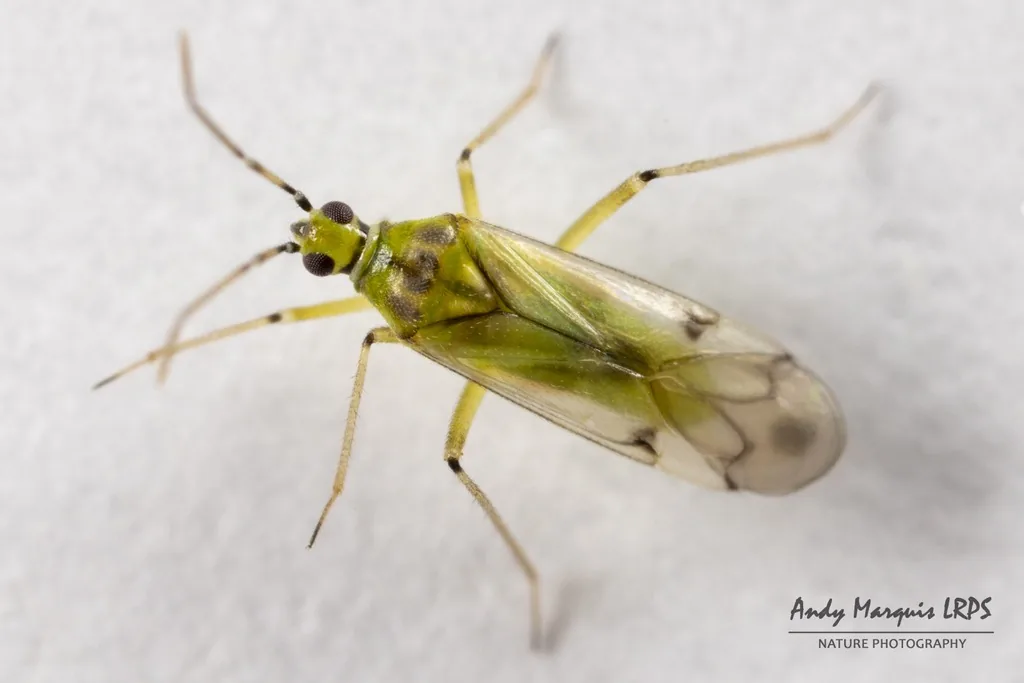
- Adults are green with an elongated, slender body and pale brown antennae; females are larger and more rounded than males.[1]
- A black band behind the eyes sets it apart from other plant bugs (mirids); Macrolophus bugs lack this band.[1]
- Nymphs are greenish and lack the adults' black spots and bands. Newly hatched nymphs are yellowish white, and wing buds appear in the third and fourth stages.[1]
- It has gone by several older names, including Cyrtopeltis tenuis and Engytatus tenuis.[1]
Look-alikes
| Look-alike | How to tell them apart |
|---|---|
| Macrolophus plant bugs | Related plant bugs (mirids) that lack the black band behind the eyes.[1] |
Where it lives
Widely distributed in Mediterranean countries, Europe, Asia, Africa, Central and South America, the Caribbean and North America. In the United States it was detected in the Rio Grande Valley of south Texas in 2013 and has established permanent populations in tomato fields there.[1][2]
Biology and life cycle
Females lay single eggs on younger leaves and flowers. Nymphs pass through five stages before becoming adults.[1]
Development depends on temperature: one generation takes about 15 days at 35°C, 22 days at 25°C and 87 days at 15°C.[1]
It feeds on tomato, sweet pepper, cucumber, zucchini, yellow squash, sesame, tobacco, eggplant and potato. In south Texas its numbers were higher in tomato fields than in nearby pepper, okra and squash, high in fall and low in winter.[1][2]
As a predator it takes whiteflies, thrips, aphids, mites, and the eggs and larvae of tomato pinworm, hornworms, tomato fruit borer and the tomato leafminer Tuta absoluta.[1]
Damage and signs
- Without enough prey, adults and nymphs feed on the plant. In tomato this leaves brown rings that eventually turn to dead tissue, sometimes on stems, flowers and fruit, and it can slow growth and reduce both the quality and quantity of the harvest.[1]
- It is regarded as a pest of tomato in Egypt, France and northern Europe, and it is now established in some year-round tomato crops in Europe, where its plant feeding causes significant losses for growers.[1][3][4]
- In Spain, Sicily and other parts of the Mediterranean it is valued as a biological control agent in tomato crops.[1][3]
Health risk
The sources discuss it only as a crop predator and plant feeder; none mentions any risk to people or pets.[1][4]
Control
Prevention
In commercial glasshouse trials, traps baited with its synthetic sex pheromone (1-octanol and octyl hexanoate) caught almost only males, worked best at plant height, and gave an indication of population levels.[4]
Biological control
Where it is released to control whiteflies in greenhouse tomatoes, the ratio of predators to prey has to be right, so that the bugs do not damage plants when prey becomes scarce or runs out.[1]
Pesticides
Where it has become a pest in European year-round tomato crops, control has relied on insecticides that do not fit current IPM programs, and pheromone trap catches fell sharply after an insecticide application.[4]
Common questions
- Is Nesidiocoris tenuis good or bad for tomatoes?
- Both. It preys on whiteflies, thrips and other tomato pests and is used for biological control, but it feeds on the plants when prey is scarce and leaves brown rings on stems, flowers and fruit.[1][3]
- Is it found in the United States?
- Yes. It was detected in the Rio Grande Valley of south Texas in October 2013 and has established permanent populations in tomato fields there.[2]
- How do I tell it from other plant bugs on tomatoes?
- Look for the black band behind the eyes on a slender green adult; similar Macrolophus bugs do not have it.[1]
Sources
- University of Florida IFAS Extension (Featured Creatures), “Tomato Bug, Tobacco Leaf Bug, Tomato Mirid, Green Tobacco Capsid, Nesidiocoris tenuis Reuter (EENY-766).” journals.flvc.org/edis/article/view/125297 (accessed 2026-11-09)
- MDPI (Insects), “Persistence of the exotic mirid Nesidiocoris tenuis (Hemiptera: Miridae) in South Texas (Esparza-Diaz et al. 2021).” doi.org/10.3390/insects12080715 (accessed 2026-11-09)
- Royal Entomological Society (Insect Molecular Biology), “Jekyll or Hyde? The genome (and more) of Nesidiocoris tenuis, a zoophytophagous predatory bug that is both a biological control agent and a pest (Ferguson et al. 2021).” doi.org/10.1111/imb.12688 (accessed 2026-11-09)
- Springer (Journal of Chemical Ecology), “Hero turned villain: identification of components of the sex pheromone of the tomato bug, Nesidiocoris tenuis (Hall et al. 2021).” doi.org/10.1007/s10886-021-01270-1 (accessed 2026-11-09)
- iNaturalist, “Nesidiocoris tenuis taxon page (order and family).” www.inaturalist.org/taxa/563359 (accessed 2026-11-09)