On this page
How to identify it
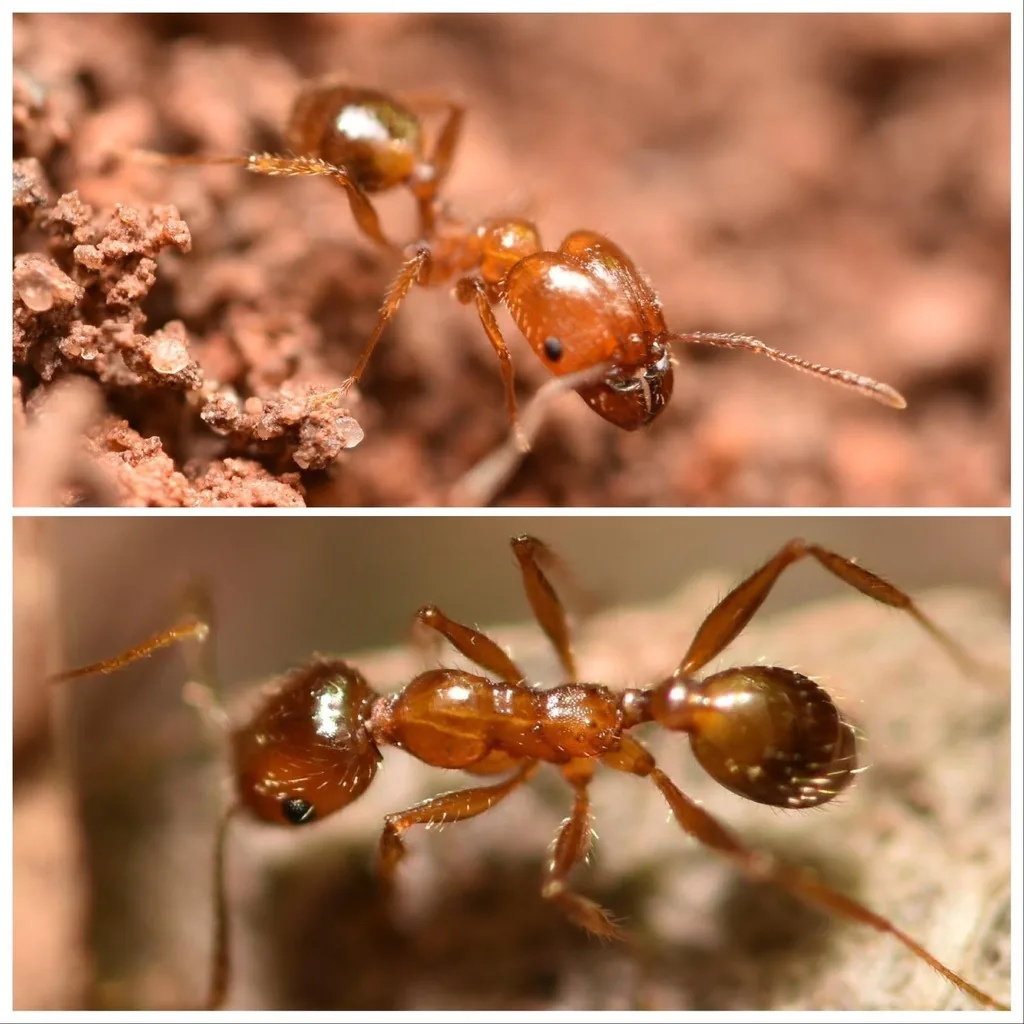
- Minor workers are small, about 2.3 to 2.9 mm long, reddish brown to dark reddish brown with the head usually a little darker than the thorax, lighter yellowish- to orange-brown antennae and legs, and a gaster that is often darker toward the tip; the body carries abundant erect hairs.[1]
- Major workers are 3.4 to 4.2 mm with a greatly enlarged head that is larger than the thorax, deeply notched at the rear, with strong lengthwise ridges on the front of the head and smooth, shiny rear lobes; their antennal scapes are short and do not reach the back of the head, while a minor's scapes extend well past it.[1]
- Both castes have 12-segmented antennae with a distinct three-segmented club, a two-segmented waist, short triangular propodeal spines and a strongly interrupted thorax profile with a deep metanotal groove; the sting is reduced.[1]
- Queens are 4.8 to 5.8 mm, like a major but larger, with ocelli and clear to faintly yellow wings; males are slender, 3.0 to 3.6 mm, with a dark head, a paler body and extremely large eyes.[1]
Look-alikes
| Look-alike | How to tell them apart |
|---|---|
| Variable big-headed ant (Pheidole bicarinata) | The species most like P. dentata. Toothed big-headed ant minors are darker reddish-brown with longer scapes and a deeply impressed metanotal groove; its majors have a largely uniform reddish-brown to orange-brown body, a deeply concave rear head margin and strong lengthwise ridges on the front of the head. P. dentata is more often in forested habitat, P. bicarinata in open or sandy ground.[1] |
| Large imported big-headed ant (Pheidole obscurithorax) | An introduced Gulf Coast Pheidole whose minors can be confused with P. dentata minors in the same habitats, but they are larger with a more oval head, and its soldiers are far bigger than any native big-headed ant's.[1] |
| Bigheaded ant (Pheidole megacephala) | An invasive tramp Pheidole of tropical and subtropical areas; P. dentata is the native species that nests mainly in woods and rotting wood across the Southeast.[1] |
Where it lives
Pheidole dentata is a common species in the southeastern United States, occurring in a wide variety of habitats, especially wooded areas and occasionally open ground.[1]
Biology and life cycle
Nests are typically in rotting wood but may extend into the soil and humus beneath it. Mature colonies may be large, with thousands of workers and either a single queen or several.[1]
Minor workers use odor trails not only to recruit nestmates to food but to summon major workers to intruders. This alarm-recruitment is narrowly specific: among potential enemies, only fire ants and other members of the genus Solenopsis trigger it, whether as single scouts or small invading forces.[2]
That soldier defense can be undone by a parasite. The phorid fly Apocephalus interferes with the defensive behavior of P. dentata majors, shifting the competitive balance between the ant and the fire ant Solenopsis texana, one of the first documented cases of a parasite deciding competition between terrestrial animals.[3]
Minor workers age unusually well. In laboratory colonies, 120-day-old minors that had lived through 86 percent of their lifespan showed no decline in the sensory and motor abilities behind brood care and foraging, no increase in brain cell death, and rising levels of the brain chemicals serotonin and dopamine.[4]
Damage and signs
- Pheidole dentata is not considered an economic pest. Workers may enter dwellings in search of food and pose a very minor nuisance.[1]
Health risk
The sting is reduced in both worker castes; the museum describes the species only as a very minor nuisance when it enters buildings.[1]
Control
Prevention
No control program is described for this native ant. It is not an economic pest, nests in rotting wood and soil outdoors, and only occasionally wanders indoors after food.[1]
Common questions
- Why do only some of the ants have huge heads?
- Pheidole colonies have two worker castes. Majors, or soldiers, have heads larger than their thorax with big crushing mandibles; minor workers are smaller with normal heads and do most of the trail-laying and foraging.[1][2]
- Is the toothed big-headed ant a house pest?
- Rarely. It is not an economic pest, but workers may enter buildings to search for food and are then a very minor nuisance.[1]
- How does it deal with fire ants?
- Minor workers that meet fire ants lay an odor trail that recruits the soldiers to the intruders. The response is specific to Solenopsis, and it can be sabotaged by phorid flies that attack the soldiers and tip the balance toward the fire ants.[2][3]
Sources
- Mississippi Entomological Museum, Mississippi State University, “Ants of the Southeastern United States: Pheidole dentata Mayr (J. A. MacGown and N. Rasoamanana, updated 2026).” mississippientomologicalmuseum.org.msstate.edu/Researchtaxapages/Formicidaepages/genericpages/Pheidole.dentata.htm (accessed 2026-11-10)
- Science, abstract via PubMed, “Enemy specification in the alarm-recruitment system of an ant (Wilson 1975, Science 190:798-800; PubMed 1198097).” doi.org/10.1126/science.1198097 (accessed 2026-11-10)
- Science, abstract via PubMed, “Competition between ant species: outcome controlled by parasitic flies (Feener 1981, Science 214:815-817; PubMed 17744403).” doi.org/10.1126/science.214.4522.815 (accessed 2026-11-10)
- Proceedings of the Royal Society B, abstract via PubMed, “Lifespan behavioural and neural resilience in a social insect (Giraldo et al. 2016, Proceedings of the Royal Society B 283:20152603; PubMed 26740614).” doi.org/10.1098/rspb.2015.2603 (accessed 2026-11-10)
- iNaturalist, “Pheidole dentata taxon page (order and family).” www.inaturalist.org/taxa/319437 (accessed 2026-11-10)