On this page
How to identify it
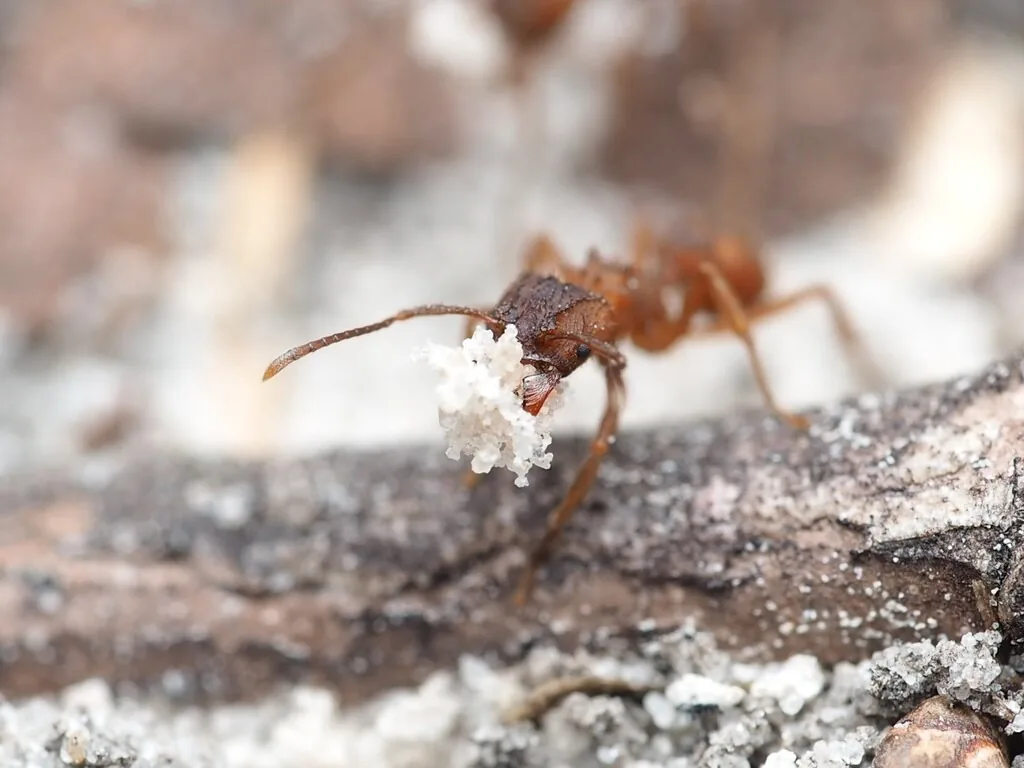
- A small to medium-sized, light brown to reddish brown ant with well-developed eyes; the worker's antennae have 11 segments and no club at the tip, and the mandibles overlap at their tips.[1]
- A rough, spiny look: the rear edge of the head carries jagged projections, the top of the thorax has larger jagged projections (three pairs of irregular spines), and the first segment of the gaster is studded with raised bumps.[1]
- A ridge runs from each eye to the base of the mandible (the superocular carina), a feature shared only with the other fungus-growing ants (Atta and Cyphomyrmex) in the Southeast.[1]
- Nest sign: a crescent- or half-moon-shaped mound of soil beside a single entrance hole, which is usually sealed during the warmer part of the day, often with a lone worker standing by. The mound shape itself helps identify the species.[1][2]
- Workers form loose columns carrying leaf fragments, including pieces cut from fallen leaves, or bits of insect droppings back to the nest.[1]
Look-alikes
| Look-alike | How to tell them apart |
|---|---|
| Texas leafcutter ant (Atta texana) | The much larger-scale relative in the same tribe (Attini); Trachymyrmex grows the same kind of subterranean fungus garden but on a far smaller scale and takes vegetable matter and insect excrement rather than stripping plants.[1] |
| Little black ant | Seen crawling through a Trachymyrmex foraging column in a Mississippi yard without interacting; it lacks the spiny thorax, reddish-brown color and crescent mound of the fungus gardener.[1] |
| Imported fire ants | Hybrid imported fire ants were observed foraging in the same yard as a Trachymyrmex column without any interaction; the fungus gardener is told by its jagged, spiny thorax and the crescent-shaped mound at its single entrance.[1] |
Where it lives
Trachymyrmex septentrionalis is described as a very common ant in the South that nests in many different habitats; the sources document it in Mississippi, East Texas and Florida, where panhandle and peninsular populations carry distinct maternal lineages.[1][4][5]
Biology and life cycle
These ants belong to the tribe Attini, the fungus growers, with Atta and Cyphomyrmex. They raise subterranean fungus gardens much as leafcutter ants do but on a smaller scale, using insect excrement and vegetative material as the substrate for the fungus.[1]
Workers cut sections of leaves with their mandibles and carry them piece by piece to the nest. In a Mississippi yard the author of the museum account watched a loose column in which about one worker in four carried a leaf bit cut from a fallen red oak leaf 8 to 10 inches from the entrance, while one carried insect droppings.[1]
DNA from excavated fungus gardens in East Texas identified 44 plant taxa across samples of this species and a co-occurring fungus gardener, with plant diversity differing between the two ant species and between colony locations, so what a colony collects depends on both its species and what grows nearby.[4]
The cultivated fungus can fall prey to fungal pathogens. Trichoderma molds are the most abundant non-cultivar fungi in wild T. septentrionalis gardens and act as pathogens of them; chemicals the Trichoderma produce trigger the ants to weed out compromised pieces of garden.[3]
New colonies depend on a virgin queen carrying the fungus with her. In Florida, maternal DNA shows three isolated lineages (two in the panhandle, one in the peninsula) while nuclear markers show wide gene flow, so most long-distance dispersal is by males and the queens, and with them the fungus, travel less far.[5]
The museum's author has often found Trachymyrmex nesting on slopes, including a shady sloping front yard. The entrance is usually sealed during the warmer periods of the day, and as summer heats up the ants are unlikely to be seen rambling freely at midday.[1]
Damage and signs
- The crescent mounds of excavated soil are the visible sign in lawns and gardens. The museum account describes the species cutting pieces from a fallen leaf rather than from the green plants growing around the nest, and the fungus is grown on vegetable debris and insect droppings; neither source describes plant damage.[1][2]
Health risk
The sources describe foraging and nest building and do not report stings or bites to people.[1][2]
Control
Prevention
No control is usually needed. The colony's mound is a small crescent of soil, the ants collect leaf bits and insect droppings to feed a fungus garden, and the sources describe no plant or structural damage; leave the colony alone or rake the mound if it bothers you.[1][2]
Common questions
- There is a half-moon-shaped pile of sandy soil in my lawn with one hole. What made it?
- A crescent or half-moon mound beside a single entrance is the signature of Trachymyrmex fungus-gardening ants, which collect leaves and insect droppings to grow an underground fungus garden. The entrance is often sealed during the hot part of the day.[2][1]
- Are these the leafcutter ants that strip plants?
- No. They are in the same tribe as the Texas leafcutter ant and grow the same kind of fungus garden, but on a much smaller scale. The museum account watched them cutting pieces from a fallen oak leaf while ignoring the green plants nearby.[1]
- Do fungus-gardening ants sting?
- None of the sources report stings or bites. The museum account describes workers that go about cutting leaf bits and hauling them home, with little black ants and fire ants crossing their column without any interaction.[1]
Sources
- Mississippi Entomological Museum, Mississippi State University, “Ants of the Southeastern United States: Trachymyrmex septentrionalis (McCook) (J. A. MacGown).” mississippientomologicalmuseum.org.msstate.edu/Researchtaxapages/Formicidaepages/genericpages/Trachy.septent.htm (accessed 2026-11-10)
- Texas A&M AgriLife Extension, “Trachymyrmex ant mound (Insects in the City photo caption).” citybugs.tamu.edu/trachymyrmex_mound-cropped/ (accessed 2026-11-10)
- Proceedings of the National Academy of Sciences, abstract via PubMed, “Trachymyrmex septentrionalis ants promote fungus garden hygiene using Trichoderma-derived metabolite cues (PNAS 2023, 120(25); PubMed 37319116).” doi.org/10.1073/pnas.2219373120 (accessed 2026-11-10)
- PLoS One, abstract via PubMed, “Forage preference in two geographically co-occurring fungus gardening ants: a dietary DNA approach (Richards-Perhatch et al. 2025, PLoS One; PubMed 41343616).” doi.org/10.1371/journal.pone.0336150 (accessed 2026-11-10)
- Ecology and Evolution (Wiley), abstract via PubMed, “Male-biased dispersal in a fungus-gardening ant symbiosis (Matthews, Kellner and Seal 2021, Ecology and Evolution; PubMed 33717457).” doi.org/10.1002/ece3.7198 (accessed 2026-11-10)
- iNaturalist, “Trachymyrmex septentrionalis taxon page (order and family).” www.inaturalist.org/taxa/232771 (accessed 2026-11-10)