On this page
How to identify it
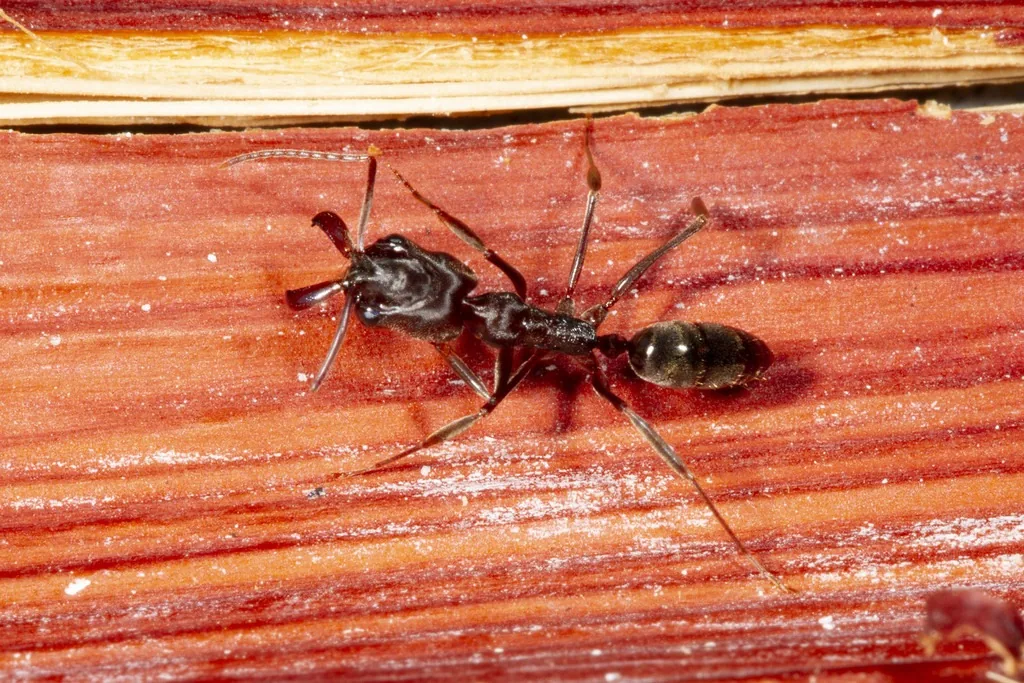
- A large worker for a ponerine ant: head about 2.1 to 2.4 mm long and the thorax 2.4 to 3.0 mm, with the head, thorax and petiole dark reddish-brown to dark brown, the gaster darker brown and the legs brown.[1]
- Long, straight mandibles inserted close together near the middle of the front of the head, able to open to 180 degrees and snap together on prey; the head shape, these jaws, the large tapering petiole and the big workers separate the genus from other ponerine ants in the United States.[1]
- Body generally shiny except where fine hairs obscure it; the head carries fine lengthwise striations, and the single petiole node tapers to a short spine pointing backward.[1]
- The first segment of the gaster is covered with much finer and denser flattened hairs than in other southeastern trap-jaw ants, the character that separates workers from the introduced O. haematodus.[1]
- Behavior is a clue: when the nest is disturbed, workers quickly retreat or leave rather than rushing out to sting, and they are more active at night than by day.[1]
Look-alikes
| Look-alike | How to tell them apart |
|---|---|
| Trap-jaw ant (Odontomachus haematodus) | The introduced Gulf Coast trap-jaw ant stings aggressively in defense of its colony and has alates in early summer; O. brunneus workers retreat when disturbed, have much finer and denser hairs on the first gastral segment, and produce winged forms from May through December.[1] |
| Odontomachus ruginodis and O. clarus | Caribbean and Latin American records once called O. brunneus belong to O. ruginodis; O. clarus was recently discovered in Louisiana. O. brunneus may be the only native Odontomachus along the Gulf Coast apart from O. clarus.[1] |
| Asian needle ant | Another dark ponerine ant of the Southeast; trap-jaw ants differ from all other United States ponerines by the head shape, the long mandibles inserted near the center of the clypeus, the large tapering petiole and the big workers.[1] |
Where it lives
Odontomachus brunneus is restricted to the southeastern United States: about 50 Florida counties from the panhandle to the Keys, Baldwin and Houston counties in Alabama, and Clinch County in Georgia. Because trap-jaw ants have often been misidentified, the museum notes the distribution is not fully understood.[1]
Biology and life cycle
The species occupies a wide range of natural habitats, including flatwoods, mesic forests, pine savannas, swamp forests, oak-pine and upland scrub, sandhills, bayheads, the edges of seasonal ponds and elevated tussocks, and it is generally found in undisturbed habitat rather than disturbed ground.[1]
Nests are made in leaf litter, rotting logs, at the bases of trees and in open to partly covered sandy areas. Casts of nests in sand show a simple design: one vertical shaft connecting a series of roughly horizontal chambers, from 2 to 17 chambers and 7 to 72 inches deep, holding 11 to 177 workers at about 2 square centimeters of floor per worker.[1][2]
Workers occasionally forage by day but are more active at night. Winged reproductives have been collected from May through December.[1]
The mandibles are trap jaws: opened to 180 degrees, they snap rapidly together on prey. The ants control the strike so precisely that the same jaws also handle larvae and build the nest, and a worker can fire them against a surface to throw itself several inches away.[1]
In experiments with pit-building antlions, O. brunneus workers escaped the pit by running in about half of encounters and by mandible-powered jumps in 15 percent; workers whose jaws were restrained escaped significantly less often, showing that a trait evolved for catching prey has been co-opted for defense.[3]
Damage and signs
Health risk
Odontomachus ants can sting, which is why the introduced O. haematodus is noted for aggressive defensive stinging. O. brunneus workers, by contrast, are not aggressive and quickly retreat or vacate the nest when the colony is disturbed.[1]
Control
Prevention
No control is needed. This native ant keeps to undisturbed natural habitats, retreats rather than stings when disturbed, and does no reported damage; leave colonies in litter, logs and sandy ground alone.[1]
Common questions
- How do I tell the Florida trap-jaw ant from the stinging trap-jaw ant on the Gulf Coast?
- Disturb the nest gently and watch: O. haematodus workers rush out and sting aggressively, while O. brunneus workers retreat or abandon the nest. Under magnification, O. brunneus has much finer and denser hairs on the first segment of the gaster. Its winged forms also appear over a much longer season, May through December.[1]
- Can this ant really jump?
- Yes. By snapping its mandibles against the ground a trap-jaw ant propels itself up to several inches. In antlion pits, O. brunneus workers used these jumps in 15 percent of escapes, and ants with their jaws held shut escaped significantly less often.[1][3]
- What does the nest look like underground?
- A single vertical shaft with a stack of simple horizontal chambers, 2 to 17 of them, reaching anywhere from 7 to 72 inches deep depending on colony size, with about 2 square centimeters of floor space per worker. Colonies sometimes take over cavities dug by other animals.[2]
Sources
- Mississippi Entomological Museum, Mississippi State University, “Ants of the Southeastern United States: Odontomachus brunneus (Patton, 1894) (J. A. MacGown, updated 2014).” mississippientomologicalmuseum.org.msstate.edu/Researchtaxapages/Formicidaepages/genericpages/Odontomachus.brunneus.htm (accessed 2026-11-10)
- Journal of Insect Science, abstract via PubMed, “The nest architecture of the ant Odontomachus brunneus (Cerquera and Tschinkel 2010, Journal of Insect Science 10:64; PubMed 20672980).” doi.org/10.1673/031.010.6401 (accessed 2026-11-10)
- PLoS One, abstract via PubMed, “Mandible-powered escape jumps in trap-jaw ants increase survival rates during predator-prey encounters (Larabee and Suarez 2015, PLoS One 10(5):e0124871; PubMed 25970637).” doi.org/10.1371/journal.pone.0124871 (accessed 2026-11-10)
- iNaturalist, “Odontomachus brunneus taxon page (order and family).” www.inaturalist.org/taxa/300384 (accessed 2026-11-10)