On this page
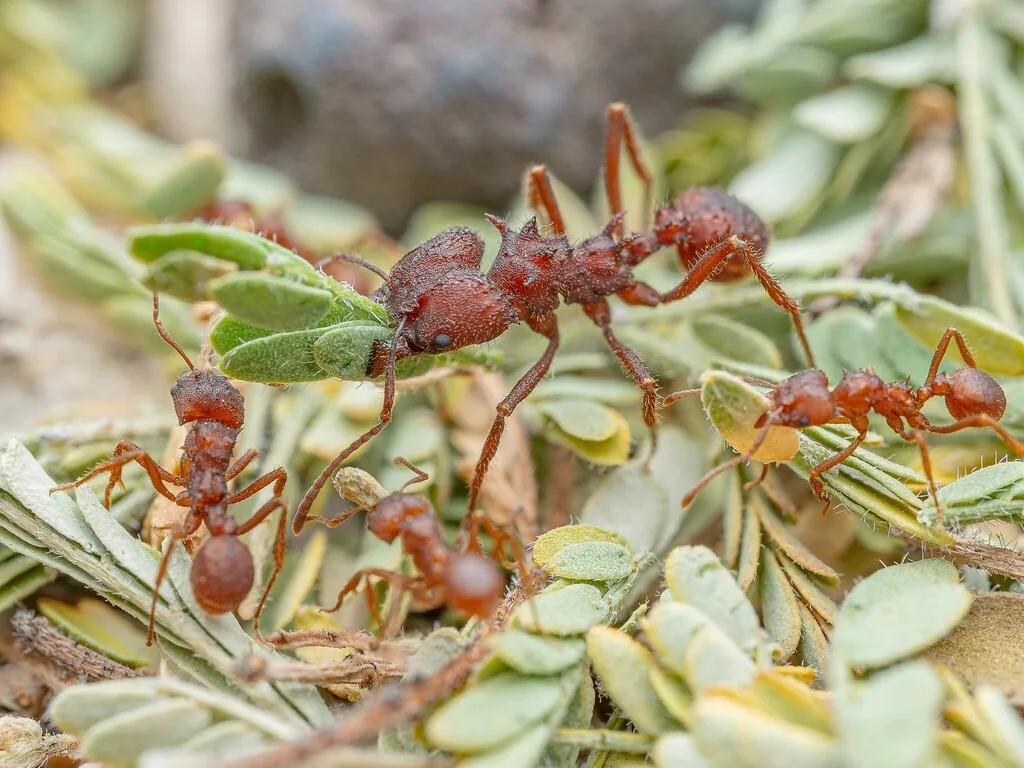
How to identify it
- Leafcutter behavior is the field mark: long columns of ants crossing the desert carrying cut leaves, dry grass and other plant pieces back to the nest, seen only in fall, spring and on cool summer mornings, since the colony stays underground at other times.[1]
- The load tells you what season it is: dry grasses make up the bulk of what the ants carry, and they switch to cutting more green vegetation after significant rain. Workers forage both along trails and singly.[2]
- Acromyrmex ants are the Sonoran Desert relatives of the larger leaf-cutting ants of the tropical Americas, and A. versicolor is the common species there.[1]
- Winged reproductives have wings; new queens look like workers but are two to three times as big, and males are smaller than workers with smaller heads and gasters.[1]
Look-alikes
| Look-alike | How to tell them apart |
|---|---|
| Texas leafcutter ant (Atta texana) | Acromyrmex ants are relatives of the larger leaf-cutting ants of the tropical Americas; A. versicolor is the common fungus grower of the Sonoran Desert, where dry grass rather than fresh leaves makes up most of the forage.[1][2] |
| Harvester ants (Pogonomyrmex) | Square-headed, stinging ants that carry seeds, not cut leaves, to store in dry chambers near the top of the nest; leafcutters carry plant fragments to feed a fungus deep underground.[1] |
| Rimose fungus-farming ant | A tiny Gulf Coast fungus grower that never cuts leaves; the desert leafcutter cuts and carries leaves and grass in long columns.[1] |
Where it lives
Common in the Sonoran Desert, and described by researchers as an important generalist herbivore of the southwestern United States.[1][4]
Biology and life cycle
Workers collect leaves and other plant parts and insert them into fungus masses grown in chambers deep in the underground nest. The fungus depends entirely on the ants for its care and propagation, and in turn the ants eat part of it as their sole source of solid food. A new garden starts from a small plug of fungus the queen brings from her home colony.[1]
Foraging columns move only when conditions permit, in fall and spring and on cool summer mornings; otherwise the ants remain underground.[1]
A field study of four colonies found the ants foraging along trails, as the advanced fungus growers do, and also singly, like more primitive gardeners. They cut both dry and green vegetation, with dry grasses the bulk of the harvest; after significant rainfall they cut more green plants, and in dry periods they collected dry grass almost exclusively, using a distinctive technique for cutting compound desert leaves.[2]
Some desert ants, including some Acromyrmex, found colonies cooperatively, several newly mated queens digging in together; founding is when most colonies fail, but an established desert colony can live a decade or more.[1]
Workers divide labor by individual tendency: in laboratory colonies with marked workers, certain individuals removed dead nestmates far more often than chance encounters would predict, and those undertaking specialists removed corpses more successfully and, in the largest colony, more quickly.[3]
Diet matters to young colonies. Foundress queens fed tall fescue infected with a Neotyphodium endophyte all died within six weeks and produced few workers and small gardens, while colonies on uninfected fescue or Arizona fescue did better than on the standard laboratory diet of palo verde and mesquite leaves.[4]
Damage and signs
- Researchers call A. versicolor an important generalist herbivore of the southwestern United States, and in the laboratory its colonies are kept on palo verde and mesquite leaves. In the desert the columns mostly cut dry grasses, with more green vegetation after rain. None of the sources describes damage to gardens or landscapes.[4][2]
Health risk
None of the sources reports stings or bites to people.[1]
Control
Prevention
No control is described in the sources. The ants are a native part of the Sonoran Desert, forage only in cool conditions, and spend the rest of the year underground tending their fungus garden.[1]
Common questions
- Do these ants eat the leaves they carry?
- No. The plant pieces feed an underground fungus garden, and the ants eat part of the fungus as their only solid food. The fungus cannot survive without the ants' care.[1]
- Why do I only see the columns at certain times?
- Foraging columns go out only when conditions permit: fall, spring and cool summer mornings. At other times the colony stays underground.[1]
- Will they strip my landscape plants?
- The sources describe the ants cutting mostly dry grasses, with more green vegetation after rain, and researchers class the species as an important generalist herbivore of the Southwest, but none of them reports damage to home landscapes or offers control advice.[2][4][1]
Sources
- Arizona-Sonora Desert Museum, “Ants, in A Natural History of the Sonoran Desert (D. E. Wheeler and S. W. Rissing).” www.desertmuseum.org/books/nhsd_ants.php (accessed 2026-11-10)
- Oecologia, abstract via PubMed, “Foraging and leaf-cutting of the desert gardening ant Acromyrmex versicolor versicolor (Pergande) (Gamboa 1975, Oecologia 20:103-110; PubMed 28309300).” doi.org/10.1007/BF00364324 (accessed 2026-11-10)
- Animal Behaviour, abstract via PubMed, “Undertaking specialization in the desert leaf-cutter ant Acromyrmex versicolor (Julian and Cahan 1999, Animal Behaviour 58:437-442; PubMed 10458895).” doi.org/10.1006/anbe.1999.1184 (accessed 2026-11-10)
- Oecologia, abstract via PubMed, “Neotyphodium endophytes in grasses: deterrents or promoters of herbivory by leaf-cutting ants? (Faeth et al. 1999, Oecologia 118:297-305; PubMed 28307273).” doi.org/10.1007/s004420050730 (accessed 2026-11-10)
- iNaturalist, “Acromyrmex versicolor taxon page (order and family).” www.inaturalist.org/taxa/50161 (accessed 2026-11-10)