On this page
How to identify it
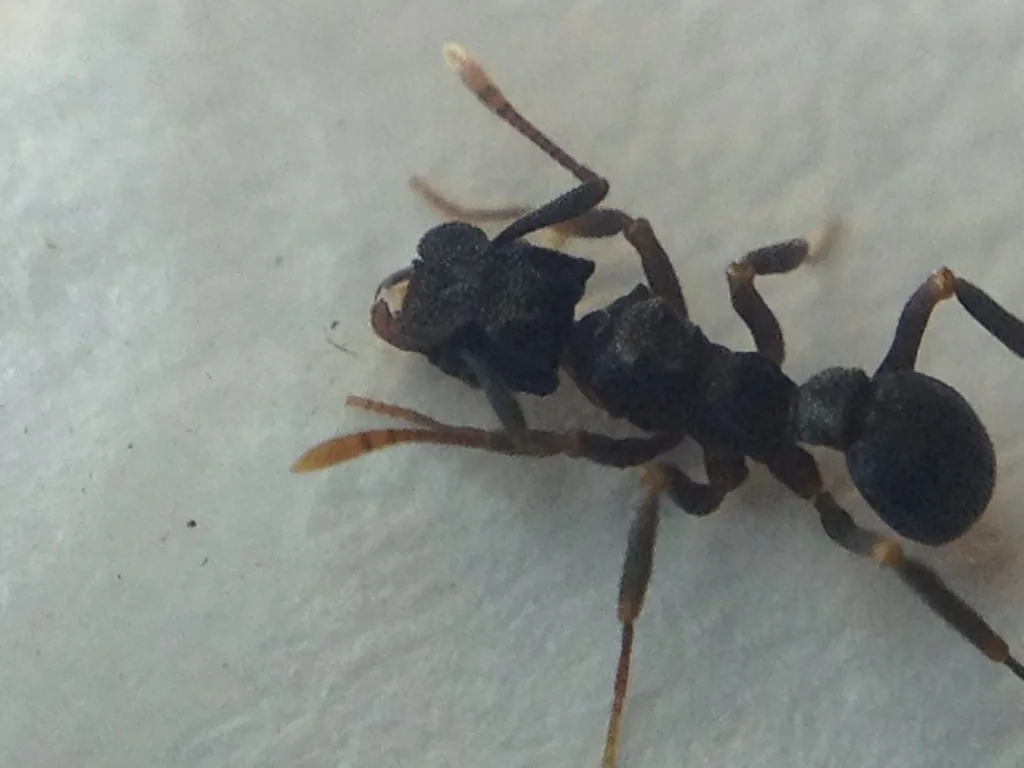
- A small ant, workers about 3.3 to 3.5 mm long, brown to blackish brown or two-toned with a dark head and gaster and a reddish-brown thorax; the legs and outer antennal segments are often orange-brown. The whole surface is matte and finely granular, often dulled with a whitish cast.[1]
- The frontal lobes of the head are hugely expanded sideways, covering the antennal sockets and much of the lower face so the head looks notched in front view, and deep grooves (scrobes) run back to the rear corners of the head to receive the antennae.[1]
- Antennae with 11 segments ending in a two-segmented club; mandibles triangular with five teeth; the top of the thorax carries prominent rounded bumps and there are no spines on the propodeum; the body is covered in flat, appressed, scale-like hairs. A sting is present.[1]
- In the Southeast, Cyphomyrmex workers are easily separated from every other genus by the head shape, dark color, short compact build with bumps on the thorax and the scale-like hairs.[1]
Look-alikes
| Look-alike | How to tell them apart |
|---|---|
| Cyphomyrmex minutus | A smaller species apparently native to Florida; its head is under 0.56 mm wide versus over 0.62 mm in C. rimosus, and the hairs on the first gastral segment lie flatter and farther apart. The two were treated as one species until 1992, so older records can refer to either.[1] |
| Fungus-gardening ant (Trachymyrmex septentrionalis) | A related attine ant of the Southeast. Cyphomyrmex is told from other genera by its expanded frontal lobes, 11-segmented antennae, five-toothed mandibles and the rounded bumps on its thorax; it grows yeast rather than a mycelial fungus.[1] |
| Texas leafcutter ant | Leafcutters cut leaves to feed a fungus garden; Cyphomyrmex species cultivate fungus too but do not cut leaves, using plant debris, insect droppings and dead insects instead.[1] |
Where it lives
Native to South America, Cyphomyrmex rimosus is established in the southern United States, with records from Alabama, Florida, Georgia, Louisiana, Mississippi, New Mexico, South Carolina and Texas, as well as the Galapagos Islands. Its rapid spread after first detection is why it is thought to be introduced, while the similar C. minutus is considered native to Florida.[1]
Biology and life cycle
Colonies are typically small, usually fewer than 100 workers, though colonies of more than 300 have been seen, and usually have one queen, sometimes several. Nests are often simple, shallow, impermanent structures under rocks, logs, dry cow manure or any other object lying on the ground.[1]
The species is very common in open habitats such as pastures and in open woodlands such as longleaf pine forest.[1]
Like other attine ants it cultivates underground fungus gardens on a substrate of vegetable matter, insect droppings and dead insects. Unusually, the garden is made of yeast growing in a single-celled phase, whereas most other fungus-growing ants grow fungus in its thread-like mycelial form. Free-living mushrooms related to these yeast cultivars have been collected in Neotropical rainforest, most readily early in the rainy season.[1][2]
Workers also feed on nectar and plant sap. Queens are reported to mate with a single male and to found nests semi-claustrally.[1]
Cyphomyrmex workers are notably unaggressive. In French Guiana they coexist beside dominant little fire ant populations, showing great passivity when confronted by Wasmannia workers, with more fighting between distant nests than between neighbors.[3]
Tiny diapriid wasps (Acanthopria and Mimopriella) parasitize the larvae; in Panama anywhere from none to all of a colony's larvae and 27 to 70 percent of colonies were parasitized, with smaller C. rimosus colonies hit hardest. Workers grab, bite and sometimes kill adult wasps that try to enter the nest.[4]
Damage and signs
- Cyphomyrmex rimosus is not considered a pest in its native or introduced range. Where it is abundant it could enter homes in search of sugary food.[1]
Health risk
Workers carry a sting, but the museum describes the species as passive and not a pest; it reports no stinging problems for people.[1][3]
Control
Prevention
No control is needed for this non-pest ant. Its shallow nests under rocks, logs and debris are short-lived, and the only household concern noted is that abundant colonies might wander indoors after sugary food.[1]
Common questions
- Does this ant cut leaves like leafcutter ants?
- No. Cyphomyrmex ants grow fungus gardens, as leafcutters do, but they never cut leaves; they build their gardens from plant debris, insect droppings and dead insects, and the garden itself is yeast rather than a thread-like fungus.[1]
- Where would I find a nest?
- Under rocks, logs, dry cow manure or almost any object on the ground in pastures and open pine woods. Nests are simple, shallow and temporary, and most colonies have fewer than 100 workers.[1]
- Is it a pest?
- No, in neither its native South America nor the southern United States. The museum notes only that very abundant colonies could invade homes looking for sweets.[1]
Sources
- Mississippi Entomological Museum, Mississippi State University, “Ants of the Southeastern United States: Cyphomyrmex rimosus (Spinola) (J. A. MacGown, updated 2016).” mississippientomologicalmuseum.org.msstate.edu/Researchtaxapages/Formicidaepages/genericpages/Cyphomyrmex.rimosus.htm (accessed 2026-11-10)
- Mycologia, abstract via PubMed, “Free-living fungal symbionts (Lepiotaceae) of fungus-growing ants (Attini: Formicidae) (Vo, Mueller and Mikheyev 2009, Mycologia 101:206-210; PubMed 19397193).” doi.org/10.3852/07-055 (accessed 2026-11-10)
- Behavioural Processes, abstract via PubMed, “Coexistence between Cyphomyrmex ants and dominant populations of Wasmannia auropunctata (Grangier et al. 2007, Behavioural Processes 74:93-96; PubMed 17129678).” doi.org/10.1016/j.beproc.2006.10.009 (accessed 2026-11-10)
- Naturwissenschaften, abstract via PubMed, “Acanthopria and Mimopriella parasitoid wasps (Diapriidae) attack Cyphomyrmex fungus-growing ants (Fernandez-Marin et al. 2006, Naturwissenschaften 93:17-21; PubMed 16315027).” doi.org/10.1007/s00114-005-0048-z (accessed 2026-11-10)
- iNaturalist, “Cyphomyrmex rimosus taxon page (order and family).” www.inaturalist.org/taxa/265954 (accessed 2026-11-10)