On this page
How to identify it
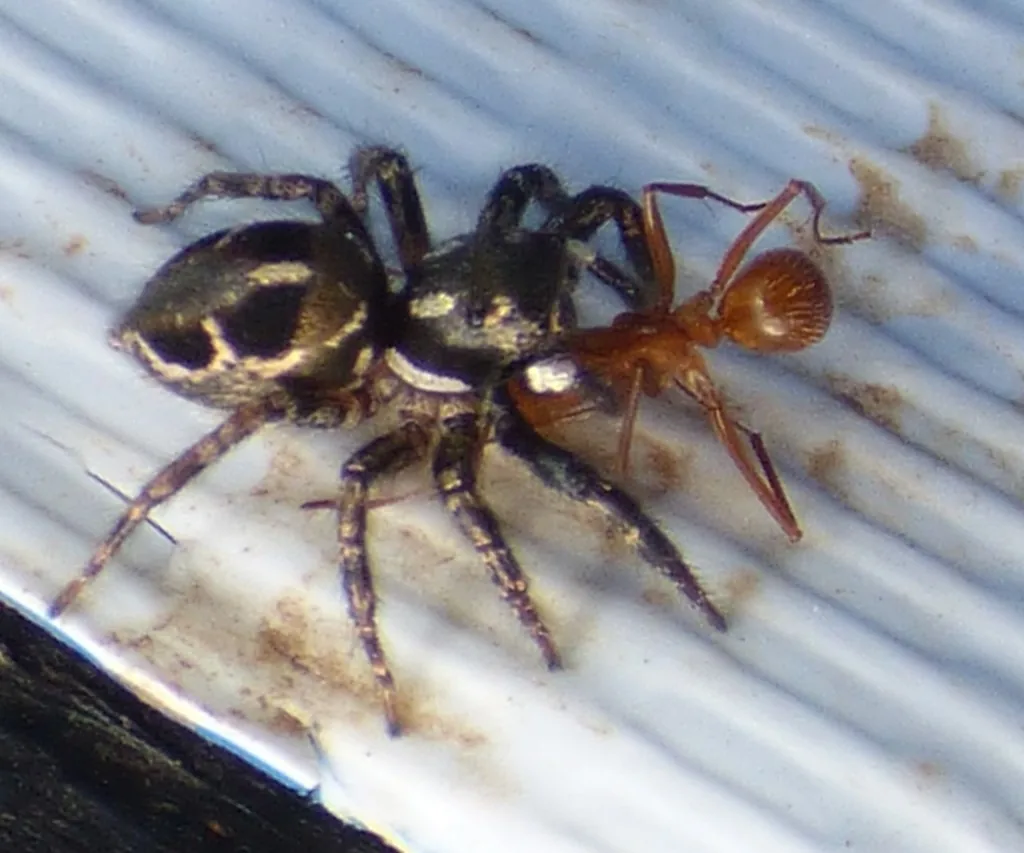
- It is small, 4 to 7 mm, dark brown or black with a golden sheen, four white marks on the head and iridescent white markings on the abdomen.[1]
- The bright white scales on its pedipalps look like little flags when waved.[1]
- Like other jumping spiders it has a stout body and a large pair of forward-facing eyes.[1][2]
Look-alikes
| Look-alike | How to tell them apart |
|---|---|
| Bold jumping spider | Another common jumping spider of homes and gardens, with white to red spots on the abdomen.[2] |
Where it lives
Known from the southeastern United States and Mexico, including Alabama, Florida, Georgia, Louisiana, Mississippi, Oklahoma, South Carolina and Texas.[1]
Biology and life cycle
It hunts by day in shaded leaf litter and builds silk nests in litter or under pine bark.[1]
Unusually for a jumping spider, it specializes in eating ants but takes other small prey too.[1]
Damage and signs
Health risk
Jumping spiders are not harmful to people and usually flee once noticed.[2]
Control
Traps and physical control
Indoors, catch the spider with a glass and release it outside rather than spraying.[2]
Common questions
- What is the tiny black spider waving white flags?
- Likely a twin-flagged jumping spider, named for its white pedipalps.[1]
Sources
- University of Florida IFAS Extension (EDIS, Featured Creatures), “Twin-flagged Jumping Spider, Anasaitis canosa (EENY-802).” ask.ifas.ufl.edu/publication/IN1395 (accessed 2026-10-16)
- Clemson Cooperative Extension Home & Garden Information Center, “Jumping Spiders (HGIC factsheet).” hgic.clemson.edu/factsheet/jumping-spiders/ (accessed 2026-10-16)
- iNaturalist, “Anasaitis canosus taxon page (order and family).” www.inaturalist.org/taxa/311233 (accessed 2026-10-06)