On this page
How to identify it
- The mature caterpillar is green, pink, tan or brown with seven pairs of slanted stripes on the sides that merge into a wide stripe running back to the horn on the tail end.[1][3]
- The front of the body looks swollen: the last thoracic and first abdominal segments are greatly enlarged. The head has pale bands, and the breathing holes (spiracles) along the sides are orange with white at each end.[3][1]
- Young caterpillars are slender and yellowish with a horn that looks oversized for their body.[1]
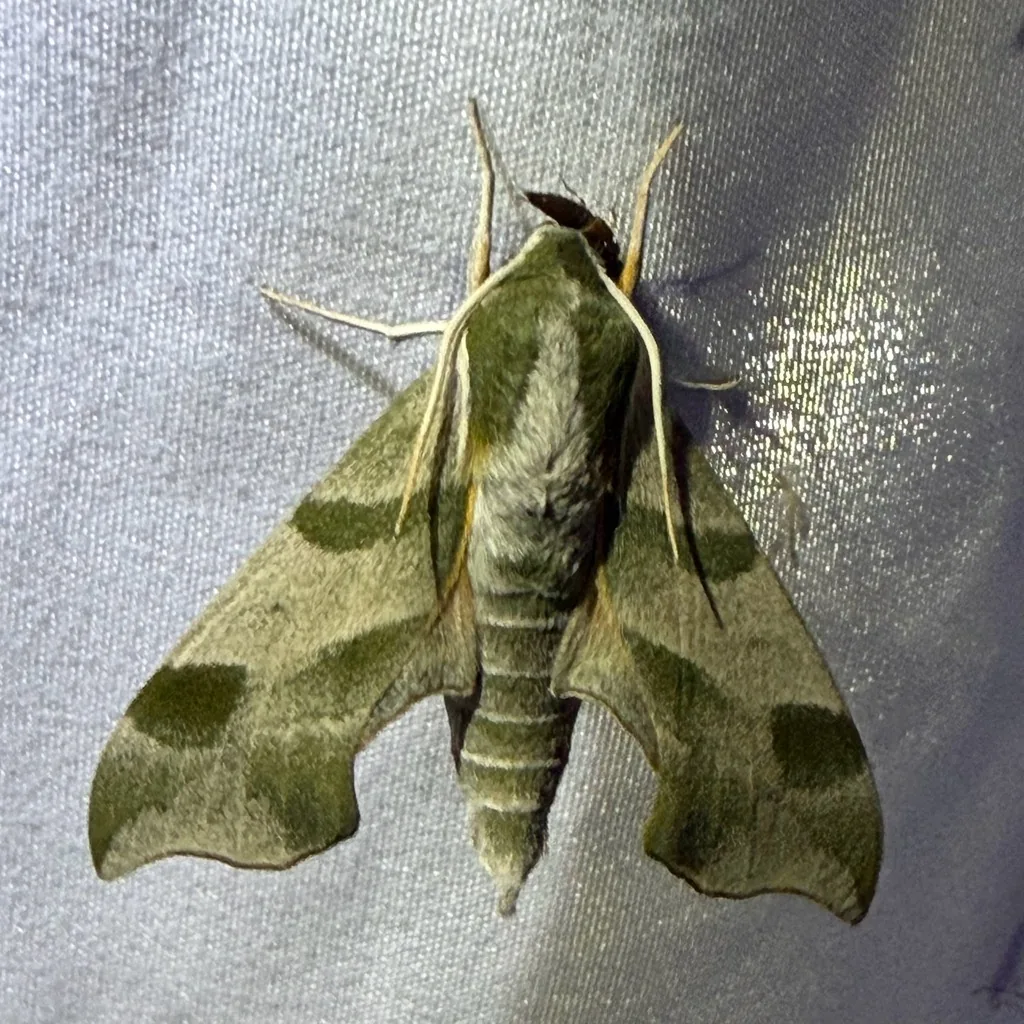
- The moth has a wingspan of about 1 3/4 to 2 1/2 inches. Its forewings range from pale tan to dark brown, banded with gray and often some olive green, with a dark dot near the middle; the hindwings are almost always orange or rusty and are usually hidden when the moth rests.[1][2]
Look-alikes
| Look-alike | How to tell them apart |
|---|---|
| Azalea sphinx (Darapsa choerilus) | Very similar as a moth and as a caterpillar. The adult usually has some purple on the forewing, and the border between its light and dark forewing areas is straight rather than curved. The Forest Service guide (which lists it as D. pholus) says its caterpillar's horn is straight and thornlike, while the hog sphinx's is longer, more slender and clearly curved; azalea sphinx caterpillars feed on azaleas, viburnums and other shrubs rather than grape-family vines.[2][3][4] |
| Other hornworms | Sphinx moth caterpillars in general are hornworms with a pointed horn at the tail end. On this species, look for the seven slanted side stripes that fuse into a stripe running to the horn and the greatly swollen front segments.[1][3] |
Where it lives
Found statewide in Missouri and among Ohio's most common sphinx moths, it lives along forest edges, in woodlots and brushy areas and wherever its host vines and shrubs grow. GBIF holds about 15,000 US records since 1990 from 35 states, most from Texas, Ohio and North Carolina.[1][2][7]
Biology and life cycle
Adults fly from mid-April into September in Missouri, where there are several broods. The Forest Service reports two or more generations in the South and one in the North, with caterpillars from April to November.[1][3]
Females lay eggs a few at a time on the undersides of host leaves. Grown caterpillars make a cocoon of silk and dried leaves and pupate in the soil or leaf litter.[1]
Adults hover at flowers to drink nectar, much like hummingbirds, and help pollinate them; a 2026 study of pollinator timing in the eastern US counted it among insects verified as pollinators. Adults come readily to lights at night.[1][2][6]
In collection records from the northeastern US, adults are night fliers recorded mainly in June and July, with a forewing length of 26 to 32 mm, and the larvae feed on grape-family vines.[4]
Damage and signs
Health risk
The sources describe the caterpillar only as a leaf feeder on grape, Virginia creeper and viburnum and the adult as a flower-visiting moth; they report no effects on people.[1][2]
Control
Prevention
Missouri describes it as a common resident whose caterpillars and moths are food for nesting birds and other predators and whose adults help pollinate flowers; the state's many native wild grapes and Virginia creepers feed the caterpillars.[1]
Biological control
Sphinx moth caterpillars are commonly parasitized by wasps that lay their eggs directly on the caterpillar. The braconid wasp Cotesia congregata, which researchers collected from six different sphinx moth hosts, has been reared from Virginia creeper sphinx caterpillars in Virginia.[1][5]
Where sources disagree
Wingspan: the Missouri Department of Conservation gives about 1 3/4 to 2 1/2 inches; the Ohio DNR field guide lists 2.0 inches.[1][2]
Season: in Missouri adults fly from mid-April into September with several broods; northeastern collection records fall mainly in June and July; the Forest Service gives caterpillars from April to November, with two or more generations in the South and one in the North.[1][4][3]
Common questions
- What is the green caterpillar with a horn on my Virginia creeper?
- Most likely the Virginia creeper sphinx (hog sphinx), a hornworm with seven slanted side stripes that join a stripe running to the horn.[1][3]
- Is it a problem on grapes?
- It feeds on grape leaves and can be a pest in vineyards, but many native wild grapes and Virginia creepers also feed them.[1][2]
- Why is it called the hog sphinx?
- Hog sphinx is another common name for this moth; the sources do not explain the name.[1][3]
Sources
- Missouri Department of Conservation, “Virginia Creeper Sphinx (Field Guide).” mdc.mo.gov/discover-nature/field-guide/virginia-creeper-sphinx (accessed 2026-11-11)
- Ohio Department of Natural Resources, Division of Wildlife, “Moths of Ohio Field Guide (Publication 5467).” dam.assets.ohio.gov/image/upload/ohiodnr.gov/documents/wildlife/backyard-wildlife/Moths%20of%20Ohio%20Field%20Guide%20pub5467.pdf (accessed 2026-11-11)
- USDA Forest Service, Forest Health Technology Enterprise Team, “Caterpillars of Eastern Forests, FHTET-96-34 (D. L. Wagner, V. Giles, R. C. Reardon and M. L. McManus, November 1997; scanned copy).” archive.org/details/caterpillarsofea001997 (accessed 2026-11-11)
- PLOS ONE (full text via PubMed Central), “Are pollinating hawk moths declining in the Northeastern United States? An analysis of collection records (Young et al. 2017).” pmc.ncbi.nlm.nih.gov/articles/PMC5628844/ (accessed 2026-11-11). Cited from the full text in PubMed Central.
- PLOS ONE (full text via PubMed Central), “Evolutionary relationships of courtship songs in the parasitic wasp genus Cotesia (Bredlau and Kester 2019), host collection table.” pmc.ncbi.nlm.nih.gov/articles/PMC6319714/ (accessed 2026-11-11). Cited from the full text in PubMed Central.
- Royal Society Open Science (full text via PubMed Central), “Anthropogenic modification shifts pollinator phenology in the eastern USA (Marquis et al. 2026), Table 1.” pmc.ncbi.nlm.nih.gov/articles/PMC13561042/ (accessed 2026-11-11). Cited from the full text in PubMed Central.
- Global Biodiversity Information Facility (GBIF), “Darapsa myron: US occurrence records since 1990 by state (GBIF occurrence search API).” api.gbif.org/v1/occurrence/search?taxonKey=1863088&country=US&hasGeospatialIssue=false&occurrenceStatus=PRESENT&year=1990%2C2026&facet=stateProvince&facetLimit=400&limit=0 (accessed 2026-11-11). State counts are records reported (iNaturalist research-grade, museum specimens, surveys), not abundance.
- iNaturalist, “Darapsa myron taxon page (order and family).” www.inaturalist.org/taxa/118503 (accessed 2026-11-11)