On this page
How to identify it
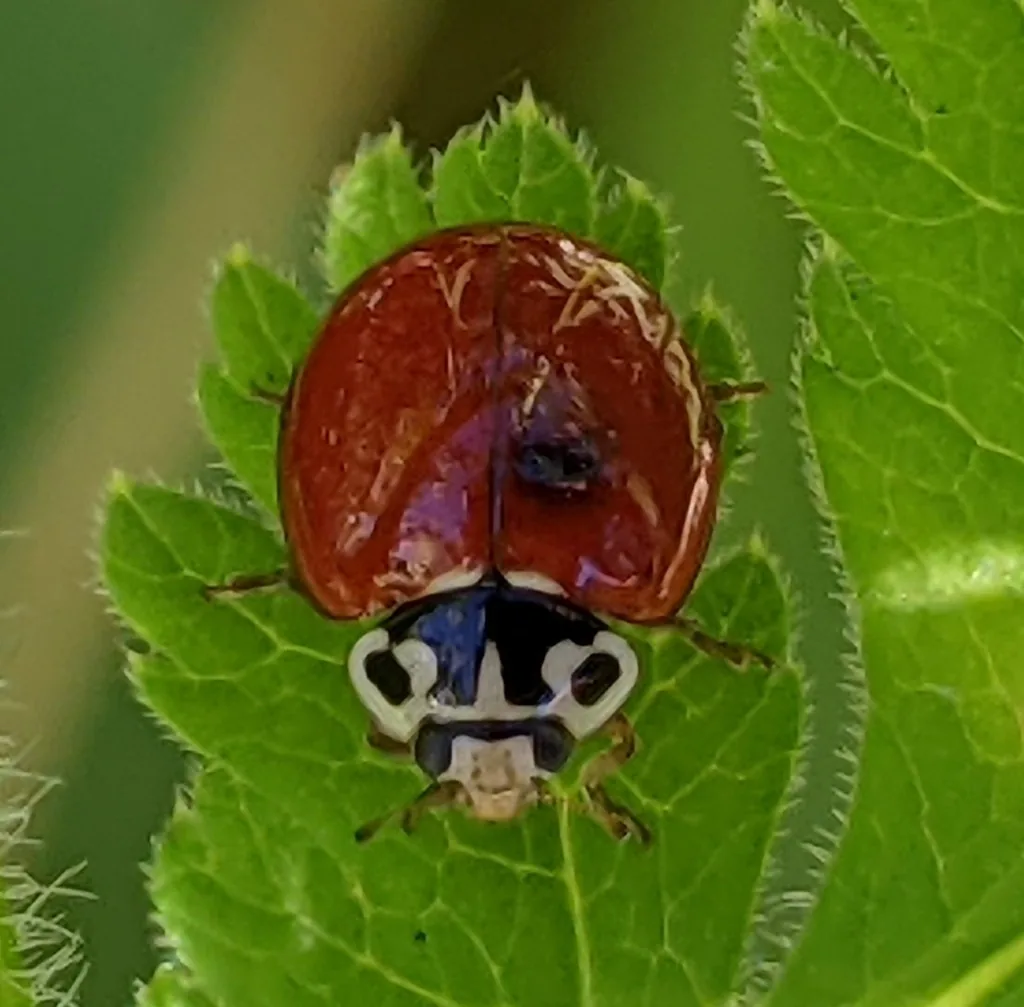
- Adults are 4 to 6 mm (1/6 to 1/4 inch) long, round when seen from above and dome-shaped from the side.[1]
- The wing covers are bright red to yellowish red and unspotted, though two pale blotches may sit just behind the thorax.[1]
- The thorax is black with pale yellowish or white markings, and on each side the pale area forms a C shape that is almost a complete ring.[1]
- Its legs are black or dark brown.[1]
- In females the face between the eyes is black and white; in males it is white.[1]
- Larvae are long-legged and alligator-like, up to about 1/4 inch long, black marked with yellow, white or both. Pupae are oval, about 1/5 inch long and glued by the rear end to plants, pale at first and then brown, or orange with black and whitish.[1]
Look-alikes
| Look-alike | How to tell them apart |
|---|---|
| Polished lady beetle (Cycloneda munda) | The polished lady beetle has the same C-shaped thorax marks but yellowish brown legs, and its wing covers are generally orange rather than red. Either species can be orange or red, and telling them apart with confidence may require an expert to dissect and examine a male's genitalia.[1] |
| Spotless lady beetle (Cycloneda sanguinea) | The spotless lady beetle has a pale spot surrounded by black on each side of the thorax, which the western blood-red lady beetle lacks.[1] |
Where it lives
It is native to the western United States. The Oregon Department of Agriculture lists it among Oregon's native lady beetles, and UC IPM names it as one of three similar Cycloneda species in California.[2][1]
Biology and life cycle
Aphids are its main food. An adult female eats about 300 aphids during a life span of several weeks, and each larva eats about 400 as it develops.[1]
Females lay small groups of about 10 to 20 football-shaped, orange to yellow eggs, set on end. Larvae go through four stages.[1]
Mature larvae pupate glued to plants, with the shriveled skin of the last larval stage at the rear of the pupa.[1]
It has several generations a year, and adults live longer when they can find nectar and pollen.[1]
It can occur most places where plants are infested with aphids: field and tree crops, gardens, landscapes and wildlands.[1]
Damage and signs
- It is one of roughly 90 native lady beetle species in the Pacific Northwest, many of which help keep aphids, scales, mealybugs and even mites in check.[2]
Health risk
It is a predatory lady beetle; neither UC IPM nor the Oregon Department of Agriculture describes any risk to people.[1][2]
Control
Prevention
Protect it rather than control it: avoid broad-spectrum, persistent insecticides, which are toxic to lady beetles and other natural enemies.[1]
Biological control
Flowering insectary plants feed the adults with nectar and pollen, and controlling ants and hosing dust off small plants helps natural enemies do their work.[1]
Don't release lady beetles collected elsewhere. The Oregon Department of Agriculture warns that even North American species collected outside Oregon may carry diseases and parasites not found there.[2]
Common questions
- How do I tell a western blood-red lady beetle from a polished lady beetle?
- Check the legs: they are black or dark brown on the western blood-red lady beetle and yellowish brown on the polished lady beetle. Its wing covers are typically redder, but both species can be orange or red.[1]
- Is the western blood-red lady beetle a native insect?
- Yes. The Oregon Department of Agriculture describes it as native to the western United States and lists it among Oregon's native lady beetles.[2]
- What do western blood-red lady beetle larvae look like?
- They are long-legged, alligator-shaped larvae up to about 1/4 inch long, black with yellow or white markings or both.[1]
Sources
- University of California Statewide IPM Program, “Western Blood-Red Lady Beetle, Natural Enemies Gallery.” ipm.ucanr.edu/natural-enemies/western-blood-red-lady-beetle/ (accessed 2026-11-09)
- Oregon Department of Agriculture, “Oregon Insect Pest Alert: Lady Beetles (revised August 2014).” www.oregon.gov/oda/Documents/Publications/IPPM/LadyBeetlesPestAlert.pdf (accessed 2026-11-09)
- iNaturalist, “Cycloneda polita taxon page (order and family).” www.inaturalist.org/taxa/55492 (accessed 2026-11-09)