On this page
How to identify it
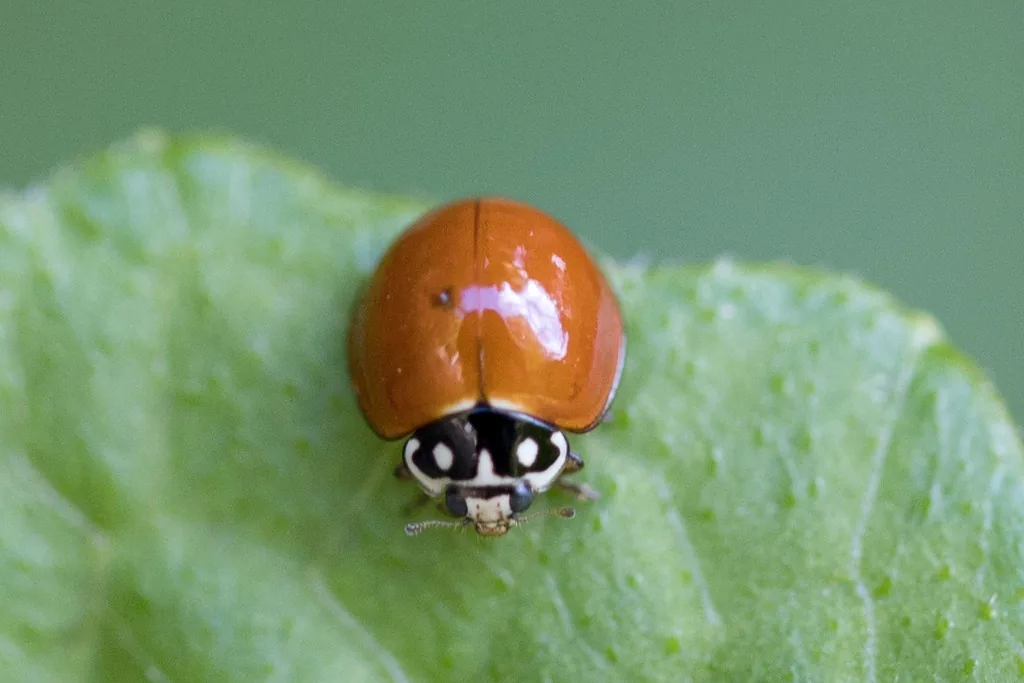
- Adults measure 4 to 6.5 mm (1/6 to almost 5/16 inch). Seen from above they are round; from the side they are dome-shaped.[1]
- The wing covers are shiny yellowish red without spots, apart from two pale blotches that some individuals show right behind the thorax.[1]
- The thorax is black and pale yellow or white. On each side is a pale yellowish or white spot surrounded by black, a mark that the polished and western blood-red lady beetles lack.[1]
- Females have a black and white face between the eyes, while the male's face there is mostly white.[1]
- The larvae are elongate and long-legged, like tiny alligators, up to about 1/4 inch long and blackish with orange or yellowish markings.[1]
- Pupae are oval, about 1/4 inch long and glued in the open to plant parts; they start out pale and then turn black and brown or orange.[1]
Look-alikes
| Look-alike | How to tell them apart |
|---|---|
| Polished lady beetle (Cycloneda munda) | The polished lady beetle has a pale C-shaped mark, nearly a ring, on each side of the thorax instead of a pale spot fully ringed in black.[1] |
| Western blood-red lady beetle (Cycloneda polita) | Cycloneda polita also has the C-shaped thorax mark rather than the black-ringed pale spot of the spotless lady beetle.[1] |
Where it lives
UC IPM lists it among three similar Cycloneda lady beetles found in California. GBIF holds about 15,000 US records since 1990 from 12 states, most from California, Texas and Florida.[1][7]
Biology and life cycle
Aphids are its primary prey, and it can turn up most places where plants are infested with them, including field and tree crops, gardens, landscapes and wildlands.[1]
A female eats about 300 aphids over an adult life of several weeks, and each larva eats around 400 before it pupates.[1]
Females lay groups of football-shaped, orange to yellow eggs, commonly one to two dozen standing on end. Larvae pass through four stages and pupate out in the open on plants.[1]
There are several generations a year. Adults live longer where flowers supply nectar and pollen.[1]
Eggs are about 1/25 inch (1 mm) long.[1]
In a Mexican lab study comparing native lady beetles with the introduced multicolored Asian lady beetle, the spotless lady beetle ate the most aphids, while the convergent lady beetle was fastest to find and eat each one.[3]
Reared on greenbugs at 25 °C in a Brazilian lab study, spotless lady beetle females laid about 1,021 eggs each, about as many as the Asian lady beetle and twice the convergent lady beetle's 484.5 eggs.[4]
Lab models put its best development temperature at about 27 to 28 °C for larvae and 28 to 29 °C for pupae, with an upper limit near 34 °C and, for larvae and pupae, a lower limit near 16 °C.[5]
Damage and signs
Health risk
It is a predatory lady beetle, and neither UC IPM nor the Missouri Department of Conservation describes any risk to people from it.[1][2]
Control
Prevention
Let it work. Broad-spectrum, persistent insecticides are toxic to natural enemies like this one, so avoid using them against any pest.[1]
Biological control
Support it with flowering insectary plants for nectar and pollen, keep ants in check because they attack lady beetles, and rinse dust off small plants now and then.[1]
Pesticides
In Brazilian lab and field tests on three beneficial insects including the spotless lady beetle, chlorpyrifos and acephate were the most toxic of seven insecticides and chlorantraniliprole the least; surfaces treated with pyrethroids, neonicotinoids and organophosphates repelled them.[6]
Native lady beetles and the Asian lady beetle
The Missouri Department of Conservation lists pesticide use and heavy competition from nonnative insects such as the multicolored Asian lady beetle among the threats to native lady beetles.[2]
Lab studies have not found the Asian lady beetle to be a better aphid predator than this native: in Mexico the spotless lady beetle ate more aphids, and in Brazil both species, along with the convergent lady beetle, showed a similar capacity to control greenbugs.[3][4]
Common questions
- How do I tell a spotless lady beetle from a polished lady beetle?
- Check the sides of the thorax. The spotless lady beetle has a pale spot completely ringed with black on each side, while the polished lady beetle has a pale C shape there.[1]
- How many aphids does a spotless lady beetle eat?
- A female eats about 300 aphids during her several-week adult life, and each larva eats about 400 while it develops.[1]
- What does a spotless lady beetle pupa look like?
- It is an oval, roughly 1/4-inch case glued in the open to a plant, pale at first and later black and brown or orange.[1]
Sources
- University of California Statewide IPM Program, “Spotless Lady Beetle, Natural Enemies Gallery.” ipm.ucanr.edu/natural-enemies/spotless-lady-beetle/ (accessed 2026-11-11)
- Missouri Department of Conservation, “Lady Beetles (Ladybird Beetles; Ladybugs) (field guide).” mdc.mo.gov/discover-nature/field-guide/lady-beetles-ladybird-beetles-ladybugs (accessed 2026-11-11)
- PeerJ, via PubMed, “Exotic predators are not better biocontrol agents: the harlequin ladybird is not the most voracious in Mexico (Camacho-Cervantes et al. 2021).” pubmed.ncbi.nlm.nih.gov/34820207/ (accessed 2026-11-11). Cited from the PubMed abstract.
- Brazilian Journal of Biology, via PubMed, “Life tables of the ladybird beetles Harmonia axyridis, Cycloneda sanguinea and Hippodamia convergens reared on the greenbug (Santos-Cividanes et al. 2022).” pubmed.ncbi.nlm.nih.gov/35894351/ (accessed 2026-11-11). Cited from the PubMed abstract.
- Journal of Thermal Biology, via PubMed, “Models to describe the thermal development rates of Cycloneda sanguinea (Pachu et al. 2018).” pubmed.ncbi.nlm.nih.gov/29549986/ (accessed 2026-11-11). Cited from the PubMed abstract.
- Chemosphere, via PubMed, “Lethal and sublethal effects of seven insecticides on three beneficial insects in laboratory assays and field trials (Fernandes et al. 2016).” pubmed.ncbi.nlm.nih.gov/27160634/ (accessed 2026-11-11). Cited from the PubMed abstract.
- Global Biodiversity Information Facility (GBIF), “Cycloneda sanguinea: US occurrence records since 1990 by state (GBIF occurrence search API).” api.gbif.org/v1/occurrence/search?taxonKey=1043105&country=US&hasGeospatialIssue=false&occurrenceStatus=PRESENT&year=1990%2C2026&facet=stateProvince&facetLimit=400&limit=0 (accessed 2026-11-11). State counts are records reported (iNaturalist research-grade, museum specimens, surveys), not abundance.
- iNaturalist, “Cycloneda sanguinea taxon page (order and family).” www.inaturalist.org/taxa/124431 (accessed 2026-11-11)